
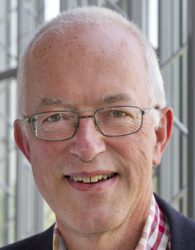

This website shows two of my sides. Firstly, my lifelong enthusiasm for music. Secondly, my professional interest in the living environment. It’s safe to say that this second side has dominated my life for a long time. Until last year, when I decided to stop writing about habitat and related topics and start posting about my (broad) interests in the musical field from now on.
You can read what to expect from this new website at ‘about this site’. The following describes what I have been doing professionally.
Human geography
Towns and landscapes fascinated me even as a child. I studied social geography – certainly for that reason too – and taught this subject for many years.
The fact that basically everyone benefits from geographical knowledge prompted me to specialise in ‘geography for education’. My students from that time became teachers, but also museum staff, municipal information officers or film makers. After my years as a teacher, I held administrative positions at several universities for quite some time. After retirement, I was able to resume my interest in the environment.
My academic publications are related to competence-based learning, educational innovation, educational leadership and learning regions. After my retirement, I decided to share my knowledge with a wider audience, which resulted in hundreds of short essays and blog posts, but in recent years, publications in various journals again, including the fine ‘Geography’.
But let me start at the beginning
So my studies were social geography and planning at what is now called Radboud University in Nijmegen (1965 – 1972). After my studies, I stayed at that institution and obtained my PhD there in 1980 with a thesis on the educational value of geography in (primary) education. During those years, I had the opportunity to give substance to the specialism ‘geography for education’ as associate professor.
While we developed the finest interactive education for primary and secondary schools, the university gave itself a pat on the back when an even bigger lecture hall was built. I realised that didactics and pedagogy of higher education did not exist, except in a few outposts like Maastricht and Aalborg. So I seized the opportunity to introduce innovative teaching in the new Faculty of Policy Sciences in Nijmegen as well with both hands. In became ‘Head of the School of Policy Sciences’ and later Director of Education of the Faculty of Policy Sciences (from 2000 Faculty of Management Sciences). Here I had the opportunity to shape the development of a faculty teaching concept for more than 13 years: a smart combination of conventional, problem-driven and project-driven teaching and forms of team-based learning and student participation.
In the autumn of 2001, I decided to accept the position of dean of the Faculty of Management Sciences at the Open University, leaving Nijmegen after more than 35 years. That hurt, but I regret it anything but. Having helped introduce the bachelor-master structure in Nijmegen, I was able to do the same at the Open University. Moreover, the digitisation of distance learning ran like a thread through my work, also as a professor of educational development. After stepping down after a 10-year deanship, I simply remained a professor until 2021.
Humane space
After my deanship, I was able to focus (again) on the content of higher education. First the focus was on innovation, which soon became focused on ínnovative regions’ and from here the “project humane space” took shape.
We humans must strive for a more just society and at the same time we must stay within the boundaries of ecosystems. We accomplished neither task. With Kate Rayworth, I therefore began to talk about a humane space created by the simultaneous application of social and ecological sustainability goals. ‘Humane space’ became the motto of my writing from about 2015, and from there I polemicised against the ‘smart city’ hype that promoted ‘big tech’.
For a while, I was curator of Amsterdam Smart City. An organisation dedicated to using technology to enhance the livability and sustainability of the city. But I see too many examples worldwide of how ‘big tech’ uses technology mainly to enrich itself. I therefore think anyone who wants to use technology to make the world a better place should first and foremost look at what is wrong with the world. So far, we are mostly concerned with repairing the damage that technology has done.
In exploring human space, I gave myself the freedom to explore different themes rather than take up this challenge systematically. The articles in the journal Geography allowed me to explore a topic in more depth and the same happens in the e-books I have published around different themes. My first was on smart cities and the now sixth on nature-inclusive development of city and country.
I look back with satisfaction on my publications on ‘humane space’. I am even happier to have drawn a line under it and picked up my ‘old love’ for music again. The website ‘Music: listening, watching and enjoying’ is about my new love without forgetting the old one.
 Music: Listen, Look and Enjoy