

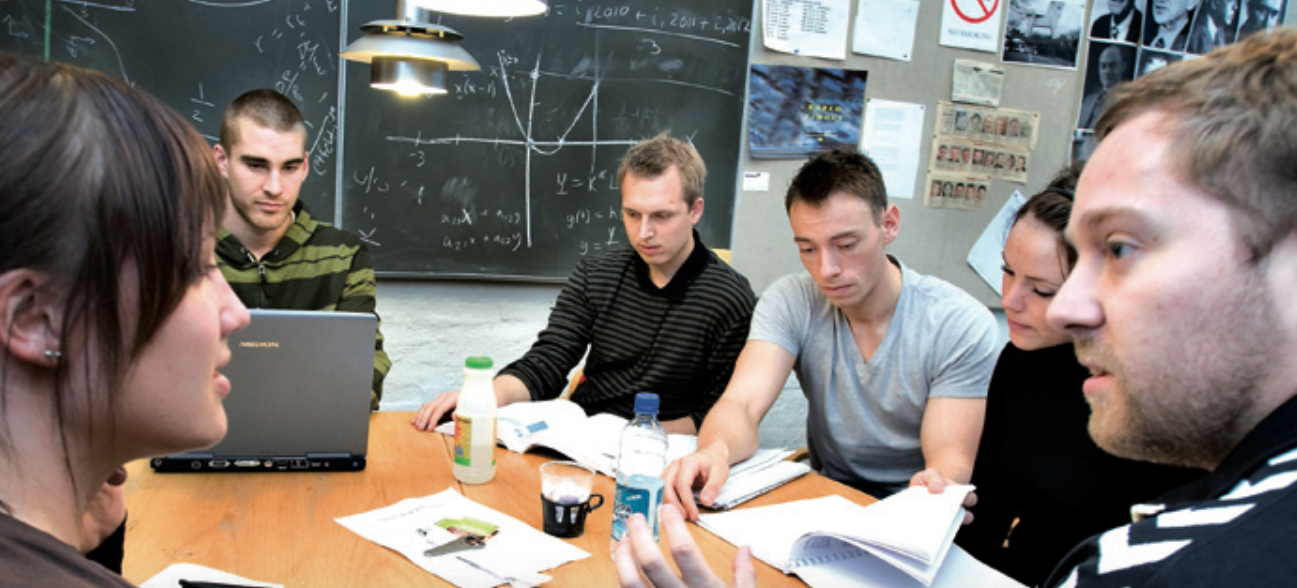
The improvement of education with the aim of empowering people and enable them to perform their duties has run like a thread through my professional life. I have written many academic publications on the subject. You can find these in the ‘My publications’ section. The posts you find below are reflections on earlier work. The first group – competences – is about the need to focus educational goals primarily on (cognitive and emotional) skills that will enable students – young and old – to better deal with questions that arise every day. The fact that education from primary school to university prioritized knowledge transfer has resulted in its underachievement. Therefore, the question is not whether we need more knowledge, but whether the knowledge we acquire is adapted to deal with problems.
The second group of posts – mixing distance and physical education – is more instrumental. Those who see knowledge transfer as the main objective of education will choose the classroom or lecture. Those who aspire to ‘knowledge for life’ are more likely to think of problem- or project-based education. Moreover, in all cases, the daily walk of learners to a training institute is not necessary at all. ‘Distance learning’ is a useful alternative, possibly in combination with physical education that also makes it easier to combine learning and working.
1. Competences
My inspiration
March 31, 2013
When I decided to start writing a blog, the first question was choosing a topic: innovation, regional development, quality of higher education, corporate social responsibility, just to mention a few ideas that came up. Did these topics have something in common? The answer appeared to be yes indeed.
How much knowledge do we need more to save the world?
October 29, 2016
To solve global problems, we do not need more knowledge, but more knowledge that has been developed within the context of those problems: Applied knowledge and fundamental knowledge as well.
Agility and the future of universities
January 8, 2017
According to many, there is a gap between what society needs and what higher education offers. But whatever that gap looks like, universities need to change course dramatically to maintain their value to society.
Stop publishing in journals!
August 9, 2015
This is a plea for radical innovation of the disclosure of research outcomes with the help of ICT. The Publication is the sacred cow of scientists. Number of publications, reputation of journals, number of citations and impact scores have become crucial in their career. Therefore, most academics are eager to publish as much as possible, without taking into consideration its value for society.
Why universities underachieve
September 8, 2015
European universities consider the Dublin descriptors as their objectives for about 20 years. Consequently, they claim that upon graduation: Students are acquainted with the knowledge base of one or more fields of knowledge, research methods included. Students can apply the acquainted knowledge, which means that they can relate concepts and theories with related. If only it were true…
Instead of diplomas: Badges
May 1, 2017
Badges might become a replacement of traditional diplomas. Bud badges alone are not sufficient
Teachers: Be educators!
April 24, 2016
In secondary schools knowledge transfer dominates. Instead, teachers must claim an active role in the redesign of the curriculum starting from future competences. This will reinforce their role as educators.
Universities neglect the role of experience in learning
September 16, 2015
I have been working for a long time with initial fulltime students and with full-employed adult students as well. A bigger difference cannot be fancied. For young students encountering each other at the campus and participating in student’s life is mandatory and time-consuming. Most elder students enter university for work-related reasons, varying from curiosity to…
2. Mixing distance and physical education
The lecture is the iconic symbol of wastage in higher education
September 5, 2016
Universities ignored the necessity to adapt their methods to the growth of the number of students. The lecture is the silly result. On-line learning will improve the quality of students’ acquaintance with scientific insights and therefore teachers find time to guide students in academic tasks.
e-Learning: Boost to education in developing countries
November 16, 2014
Distance education is the principal way for developing countries to cope with the fast-growing educational needs of their population. Worldwide from 2000 until 2010, the number of students in higher education has increased from 100 to 150 million. Primary and secondary education is challenged even more. In the long run, acceptance of distance education…
Smart higher education: both face-to-face and online
April 1, 2017
Distance teaching and campus-based education both have potential advantages, whose benefits are not fully used. However, students will benefit best, if these advantages are made available for all of them at the same time.
Higher education in US is ready for disruption
January 21, 2015
Changes in higher education in the US are worth looking at, because they will turn up worldwide in due course. Higher education in the US is ready for disruption: During the past 30 years, fees have increased 538%, which is 4 1/2 times more than average. Until recently, the earnings of alumni allowed them to…
MOOCs: The announcement of the wrong revolution
April 15, 2013
A litany of recent complaints shows that something is wrong with higher education: In the USA cost are rising with 10% every year, content has lost track with the explosive development of new knowledge, alumni’s competences do not match with the requirements of the labor market, teachers deliver lectures in the same way as their predecessors did…
 Music: Listen, Look and Enjoy