
20. Facilities within walking and cycling distance

This is the 20th episode of a series 25 building blocks to create better streets, neighbourhoods, and cities. Its topic is to enable citizens having daily necessities in a walking and bicycling distance. 

During the pandemic, lockdowns prevented people from leaving their homes or moving over a longer distance. Many citizens rediscovered their own neighbourhood. They visited the parks every day, the turnover of the local shops increased, and commuters suddenly had much more time. Despite all the concerns, the pandemic contributed to a revival of a village-like sociability.

Revival of the ‘whole neighbourhood’

Revival indeed, because until the 1960s, most residents of cities in Europe, the US, Canada, and Australia did not know better than their dally needs were available within a few minutes’ walk. In the street where I was born, there were four butchers, four bakers, three greengrocers and four groceries, even though the street was not much longer than 500 meters. No single shop survived. My primary school was also on that street, and you had to be around the corner for the doctor. This type of quality of life went lost, in the USA in particular. However, urban planners never have forgotten this idea. In many cities, the pandemic has turned these memories into attainable goals, albeit still far removed from reality. Nevertheless, the idea of the ‘whole neighborhood’ gained traction in many cities. It fits into a more comprehensive planning concept, the 15-minute city.

Support for facilities

The idea is that residents can find all daily needs within an imaginary circle with an area of approximately 50 hectares. This implies a proportionate number of residents. A lower limit of 150 residents per hectare is often mentioned, considering a floor area of 40% for offices and small industry. The idea is further that most streets are car-free and provide plenty of opportunity for play and meeting.

Opportunity for social contacts

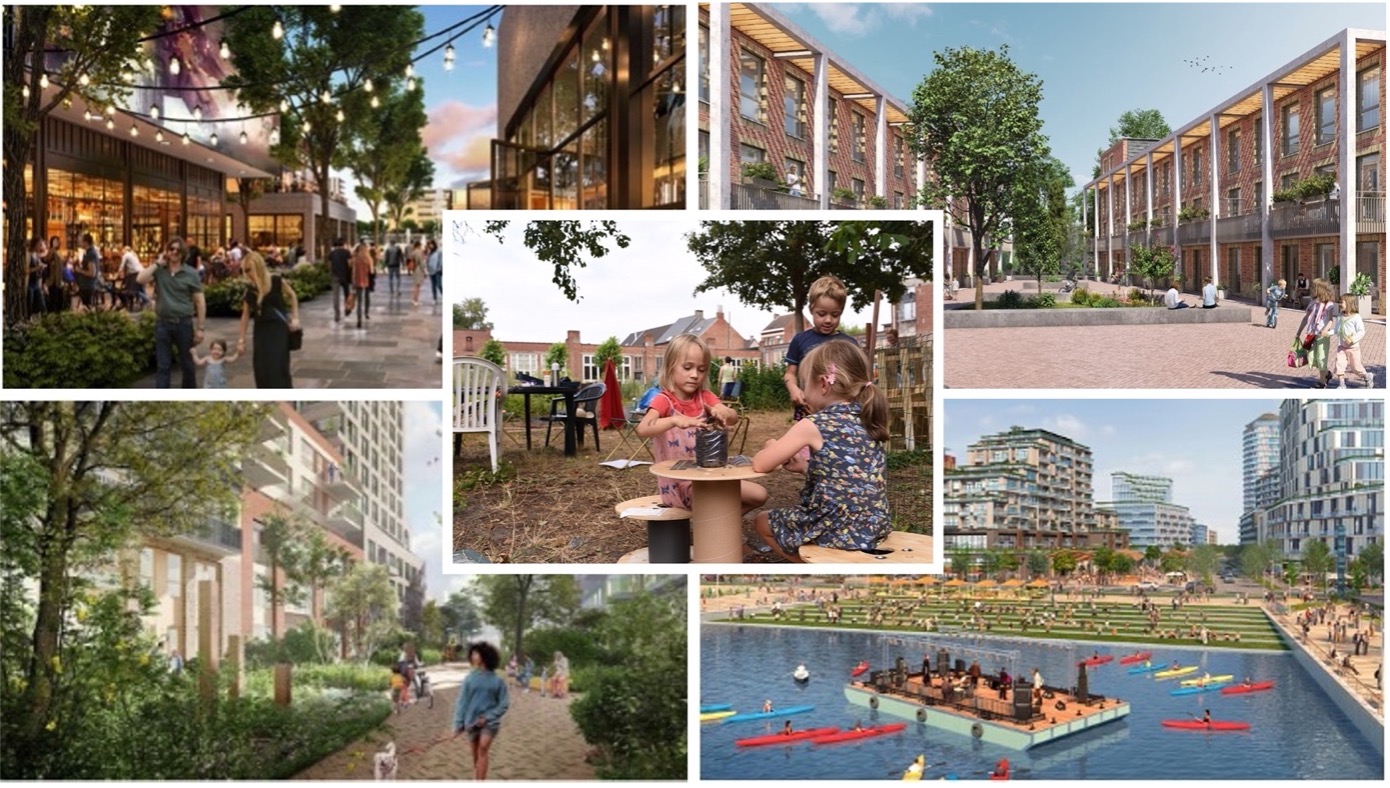
In a ‘whole neighbourhood’, residents find opportunity for shopping and meeting from morning to evening. There is a supermarket, a bakery, a butcher, a greengrocer’s shop, a drugstore, a handful of cafes and restaurants, a fitness center, a primary school, a medical center, craft workshops, offices, green spaces and a wide variety of houses. Here, people who work at home drink their morning coffee, employees meet colleagues and freelancers work at a café table during the quiet hours. Housemen and women do their daily shopping or work out in the gym, have a chat, and drink a cup of tea. People meet for lunch, dinner and socializing on the terrace or in the cafes, until closing time. A good example is the Oostpoort in Amsterdam, albeit one of the larger ones with a station and a few tram lines.

Planning model

On the map above, the boundaries of the neighborhoods with an area of approximately 50 hectares are shown in the form of circles. The circular neighborhood is a model. This principle can already play a role on the drawing board in new neighborhoods to be built. In existing neighbourhoods, drawing circles is mainly a matter of considering local data. The center of the circle will then often be placed where there are already some shops. Shops outside the intended central area can be helped to move to this area. Spaces between existing homes can be reserved for small-scale businesses, schools, small parks, communal gardens and play facilities. Once the contours have been established, densification can be implemented by choosing housing designs that align to the character of the neighbourhood. Towards the outside of the imaginary circle, the building density will decrease, except at public transport stops or where circles border the water, often an ideal place for higher buildings.

If a thoroughfare passes through the center of the circle, this street can be developed into a city street, including a public transport route. Facilities are then realized around a small square in the center of the circle and the surrounding streets.

Incidentally, space between the circles can be used for through traffic, parks, and facilities that transcend districts, for instance a swimming pool or a sports hall or an underground parking garage. Mostly, neighborhoods will merge seamlessly into each other.

It will take time before this dream comes true.

Follow this link below to find an overview of all articles.

19. Safe living environment

This is the 19th episode of a series 25 building blocks to create better streets, neighbourhoods, and cities. This post is about increasing the independent mobility of children and the elderly, which is limited due to the dangers that traffic entails.

For safety reasons, most urban children under the age of ten are taken to school. The same goes for most other destinations nearby. It hampers children’s independent mobility, which is important for their development.

Car-free routes for pedestrians and cyclists

For security reasons, car-free connections between homes and schools, community centers, bus stops and other facilities are mandatory (photo’s top left and bottom right). Car routes, in their turn, head to neighborhood parking spaces or underground parking garages. Except for a limited number of parking spaces for disabled people.

Design rules

Model-wise, the design of a residential area consists of quadrants of approximately 200 x 200 meters in which connections are primarily intended for pedestrians and cyclists. There are routes for motorized traffic between the quadrants and there are parking facilities and bus stops at the edges. Inhabitants might decide that cars may enter the pedestrian area at walking pace to load and unload to disappear immediately afterwards. The routes for pedestrians and cyclists connect directly with the shops and other destinations in the neighborhood, based on the idea of the 15-minute city. Shops ‘ideally’ serve 9 to 16 quadrants. In practice, this mode will have many variations because of terrain characteristics, building types and aesthetic considerations.

Examples

The number of neighborhoods where cars can only park on the outskirts is growing. A classic example is ‘ecological paradise’ Vauban were 50 ‘Baugruppen’ (housing cooperatives) have provided affordable housing (photo bottom middle ). Car-free too is the former site of the Gemeentelijk waterleidingbedrijf municipal water supply company in Amsterdam – (photo bottom left). Here almost all homes have a garden, roof terrace or spacious balcony. The Merwede district in Utrecht (top middle) will have 12,000 inhabitants and for only 30% room for parking is available, and even then only on the edge of the district. Shared cars, on the other hand, will be widely available. The space between the houses is intended for pedestrians, cyclists and children playing.

More emphasis on collective green

Due to the separation of traffic types and the absence of nuisance caused by car, there are no obligatory streets, but wide foot- and cycle paths. Instead there are large lawns for playing and picnicking, vegetable gardens and playgrounds. Further space savings will be achieved by limiting the depth of the front and back gardens. Instead, large collective space appears between the residential blocks; remember the Rivierenwijk in Utrecht that I mentioned in the former post (top right). Behind the buildings, there is room for small backyards, storage sheds and possibly parking space.

Follow this link below to find an overview of all articles.

18 Space for playing and sporting in a green environment

This is the 18th episode of a series 25 building blocks to create better streets, neighbourhoods, and cities. This message is about the limited possibilities for children to play in a green environment because of the sacrifices that are made to offer space for cars and private gardens

Almost all residential areas in the Netherlands offer too little opportunity for children to play. This post deals with this topic. But also, with changing the classic street pattern to make way for routes for pedestrians and cyclists.

Everything previously mentioned about the value of a green space applies to the living environment. The rule 3 : 30 : 300 is often used as an ideal: Three trees must be visible from every house, the canopy cover of the neighborhood is 30% and within an average distance of 300 meters there is a quarter of a hectare of green space, whether or not divided over a number of smaller parcels.

Functions of ‘green’ in neighbourhoods

The green space in the living environment must be more than a grass cover. Instead, it creates a park-like environment where people meet, it is accompanied by water features and can store water in case of superfluent rain, it limits the temperature and forms the basis for play areas for children.

Legally, communal, and private green areas are different entities; in practice, hybrid forms are becoming common. For example, a communal (inner) garden that can be closed off in the evening or public green that is cadastral property of the residents but intended for public use. In that case the residents live in a park-like environment which they might maintain and use together. Het Rivierdistrict in Utrecht is an example of this.

Play at the neighborhood level

Children want wide sidewalks and a place (at least 20 x 10 m2) close to home that is suitable for (fantasy) games and where there may also be attractive play equipment. The importance of playground equipment should not be overestimated. For many children, the ideal playground consists of heaps of coarse sand, water, climbing trees and pallets. To the local residents It undoubtedly looks messier than a field full of seesaw chickens. Good playground equipment is of course safe and encourages creative action. They can also be used for more than one purpose. You can climb on it, slide off it, play hide and seek and more. Of the simple devices, (saucer) swings and climbing frames are favorites.

A somewhat larger playground to play football and practice other sports is highly regarded. Such a space attracts many children from the surrounding streets and leads to the children playing with each other in varying combinations.

Squares

Most squares are large bare plains, which you prefer to walk around. Every neighborhood should have a square of considerable size as a place where various forms of play and exercise are concentrated. In the middle there is room for a multifunctional space – tastefully tiled or equipped with (artificial) grass – for ball games, events, music performances, markets and possibly movable benches. Ideally, the central part is somewhat lower, so that there is a slope to sit on, climb and slide down. On the edge there is room for countless activities, such as different forms of ball games, a rough part, with climbing trees, meeting places, spaces to hide, space to barbecue and walls to paint, but also catering and one or more terraces. Lighting is desirable in the evening, possibly (coloured) mood lighting. There is an opportunity for unexpected and unforeseen activities, such as a food car that comes by regularly, street musicians that come to visit, changing fairground attractions and a salsa band that comes to rehearse every week.

Such a square can possibly be integrated into a park that, apart from its value as a green space, already offers opportunities for children to play. Adding explicit game elements makes parks even more attractive.

Connecting car-free routes

Safe walking and cycling routes connect playgrounds, parks, and homes. They offer excellent opportunities to use bicycles, especially where they are connected to those of other neighbourhoods.

By seeing facilities for different age groups in conjunction, networks and nodes are created for distinctive target groups. The children’s network mainly includes play areas close to home, connected via safe paths to playgrounds in the vicinity. Facilities especially for teenagers are best located somewhat secluded, but not isolated. Essentially, they want to fit in. The teenage network also includes places where there is something to eat, but also various facilities for sports and at a certain age it includes the entire municipality.

Follow this link below to find an overview of all articles.
17. A sociable inclusive neighborhood

This is the 17th episode of a series 25 building blocks to create better streets, neighbourhoods, and cities. This post is about the contributions of sociability and inclusivity to the quality of the living environment.

Almost everyone who is going to move looks forward with some trepidation to who the neighbors will be. This post is about similarities and differences between residents as the basis for a sociable end inclusive neighborhood.

“Our kind of people”

The question ‘what do you hope your neighbors are’ is often answered spontaneously with ‘our kind of people’. There is a practical side to this: a family with children hopes for a family with playmates of about the same age. But also, that the neighbors are not too noisy, that they are in for a pleasant contact or for making practical arrangements, bearing in mind the principle ‘a good neighbor is better than a distant friend’. A person with poor understanding often interprets ‘our kind of people’ as people with the same income, religion, ethnic or cultural background. That doesn’t have to be the case. On the other hand, nothing is wrong if people with similar identities seeking each other’s proximity on a small scale.

All kinds of people

A certain homogeneity among the immediate neighbours, say those in the same building block, can go hand in hand with a greater variety at the neighbourhood level in terms of lifestyle, ethnic or cultural background, age, and capacity. This variety is a prerequisite for the growth of inclusiveness. Not everyone will interact with everyone, but diversity in ideas, interests and capacities can come in handy when organizing joint activities at neighborhood and district level.

Variation in living and living arrangements

The presence of a variety in lifestyles and living arrangements can be inspiring. For example, cohousing projects sometimes have facilities such as a fitness center or a restaurant that are accessible to other residents in the neighbourhood. The same applies to a cohabitation project for the elderly. But it is also conceivable that there is a project in the area for assisted living for (former) drug addicts or former homeless people. The Actieagenda Wonen “Samen werken aan goed wonen” (2021) provides examples of the new mantra ‘the inclusive neighbourhood’. It is a hopeful story in a dossier in which misery predominates. The Majella Wonen project in Utrecht appealed to me: Two post-war apartment complexes have been converted into a place where former homeless people and ‘regular’ tenants have developed a close-knit community. It benefits everyone if the residents of these types of projects are accepted in the neighborhood and invited to participate.

Consultation between neighbours

It remains important that residents as early as possible discuss agreements about how the shared part of life can be made as pleasant as possible. This is best done through varying combinations of informal neighborhood representatives who discuss current affairs with their immediate neighbours. A Whatsapp group is indispensable. 

Mixing income groups is also desirable, especially if the differences in housing and garden size are not too great. It does not work if the impression of a kind of ‘gold coast’ is created.

If functions are mixed and there are also offices and other forms of activity in a neighborhood, it is desirable that employees also integrate. This will almost happen automatically if there is a community center with catering. 

Most of what is mentioned above, cannot be planned, but a dose of goodwill on the part of all those involved contributes to the best quality of living together.

Follow the link below to find an overview of all articles.

15. Affordable housing

This is the 15th episode of a series 25 building blocks to create better streets, neighbourhoods, and cities. This post is about one of the most serious threats to the quality of the living environment, namely the scarcity of housing, which is also unaffordable for many.

In many countries, adequate housing has become scarcer and too expensive for an increasing number of people. Unfortunately, government policy plays an important role in this. But good policy can also bring about a change. That’s what this post is about.

As in many other developed countries, for a large part of the 20th century, the Dutch government considered it as its task to provide lower and middle classes with good and affordable housing. Housing associations ensured the implementation of this policy. Add to this well-equipped neighborhood shopping centers, ample medical, social, educational and transportation facilities and a diverse population. When the housing shortage eased in the 1970s, the nation was happier than ever. That didn’t take long.

The emergence of market thinking in housing policy

During the last decades of the 20th century, the concern for housing largely shifted to the market. Parallel to this, housing corporations had to sell part of their housing stock. Mortgages were in easy reach and various tax facilities, such as the ‘jubelton’ and the mortgage interest deduction, brought an owner-occupied home within reach of many. In contrast, the waiting time for affordable rental housing increased to more than 10 years and rental housing in the liberalized zone became increasingly scarce and expensive. In Germany and Austria, providing good housing has remained a high priority for the government and waiting times are much shorter. The photo at the top left part shows the famous housing project Alt Erla in Vienna. Bottom shows left six affordable homes on the surface of one former home in an American suburb and top right is the ‘Kolenkit’, a social housing project in Amsterdam.

The explosive rise in housing costs

In order to adapt housing cost to the available budget, many people look for a house quite far away from the place where they work. Something that in turn has a negative effect on the travel costs and the time involved. Others settle in a neighborhood where the quality of life is moderate to poor or rent a too expensive house. More than a million households spend much more than the maximum desirable percentage of income (40%) on housing, utilities, and transport.

Between 2012 and 2022, the average price of a home in the Netherlands rose from €233,000 to €380,000. In Amsterdam, the price doubled from €280,000 to €560,000. Living in the city is becoming a privilege of the wealthier part of the population.

It is often assumed that around 900,000 housing units will be needed in the Netherlands by 2030, of which 80% is intended for single-person households.

An approaching change?

It seems that there is a shift going on, at least in policy thinking. The aim is to build an average of 100,000 homes per year in the coming years and to shorten the lead time between planning and realization. Achieving these intentions is uncartain because construction is being seriously delayed by the nitrogen crisis. The slow pace of new construction has once again drawn attention to the possibility of using existing houses and buildings for a significant proportion of these new housing units. More so as it is estimated that 80% of demand comes from single-person households.

The existing housing stock offers large potential for the creation of new living spaces. This potential has been investigated by, among others, the Kooperative Architecten Werkplaats in Groningen, resulting in the report Ruimte zat in de stad. The research focuses on 1800 post-war neighbourhoods, built between 1950 and 1980 with 1.8 million homes, 720,000 of which are social rental homes. The conclusion is that the division and expansion of these homes can yield 221,000 new units in the coming years. Eligible for this are single-family houses, which can be divided into two, and porch apartment blocks, which can be divided into more units per floor. Dividing up existing ground-access homes and homes in apartment blocks is technically not difficult and the costs are manageable. This applies even more if the adjustments are carried out in combination with making the relevant homes climate neutral. In addition, huge savings are made on increasingly expensive materials.

Even more interesting is to combine compaction with topping. This means the addition of one or two extra floors, so that a lift can also be added to the existing apartments. In construction terms, such an operation can be carried out by using light materials and installing an extra foundation. A project group at Delft University of Technology has designed a prototype that can be used for all 847,000 post-war porch houses, all of which need major maintenance. This prototype also ensures that the buildings in which these homes are located become energy-neutral and include facilities for socializing and play. Hence the extra wide galleries, with stairs between the floors and common areas in the plinth (image below right).

Follow this link to find an overview of all articles.

14. Liveability

The average development of the liveability per household in residential neighborhoods in the Netherlands from 2014 (source: Leefbaarheid in Nederland, 2020)

This is the 14th episode of a series 25 building blocks to create better streets, neighbourhoods, and cities. This post discusses how to improve the liveability of neighbourhoods. Liveability is defined as the extent to which the living environment meets the requirements and wishes set by residents.

Differences in liveability between Dutch neighbourhoods

From the image above can be concluded that more than half of all households live in neighborhoods to be qualified as at least ‘good’. On the other hand, about 1 million households live in neighborhoods where liveability is weak or even less.

These differences are mainly caused by nuisance, insecurity, and lack of social cohesion. Locally, the quality of the houses stays behind.

The neighborhoods with a weak or poorer liveability are mainly located in the large cities. Besides the fact that many residents are unemployed and have financial problems, there is also a relatively high concentration of (mental) health problems, loneliness, abuse of alcohol and drugs and crime. However, many people with similar problems also live outside these neighbourhoods, spread across the entire city.

Integration through differentiation: limited success

The Netherlands look back on a 75 years period in which urban renewal was high on the agenda of the national and municipal government. Over the years, housing different income groups within each neighbourhood has played a major role in policy. To achieve this goal, part of the housing stock was demolished to be replaced by more expensive houses. This also happened if the structural condition of the houses involved gave no reason to demolishment.

Most studies show that the differentiation of the housing stock has rarely had a positive impact on social cohesion in a neighborhood and often even a negative one. The problems, on the other hand, were spread over a wider area.

Ensuring a liveable existence of the poor and an integrated neighbourhood-oriented approach

Reinout Kleinhans justly states: Poor neighborhoods are the location of deprivation, but by no means always the cause of it. A twofold focus is therefore required: First and foremost, tackling poverty and a structural improvement of the quality of life of people in disadvantaged positions, and furthermore an integrated neighborhood-oriented approach in places where many disadvantaged people live together.

I have already listed measures to improve the quality of life of disadvantaged groups in an earlier post that dealt with social security. I will therefore focus here on the characteristics of an integrated neighbourhood-oriented approach.

• Strengthening of the remaining social cohesion in neighborhoods by supporting bottom-up initiatives that result in new connections and feed feelings of hope and recognition.

• Improvement of the quality of the housing stock and public space where necessary to stimulate mobility within the neighborhood, instead of attracting ‘import’ from outside.

• Allowing residents to continue living in their own neighborhood in the event of necessary improvements in the housing stock.

• Abstaining from large-scale demolition to make room for better-off residents from outside the neighborhood if there are sufficient candidates from within.

• In new neighborhoods, strive for social, cultural, and ethnic diversity at neighborhood level so that children and adults can meet each other. On ‘block level’, being ‘among us’ can contribute to feeling at home, liveability, and self-confidence.

• Curative approach to nuisance-causing residents and repressive approach to subversive crime through the prominent presence of community police officers who operate right into the capillaries of neighbourhoods, without inciting aggression.

• Offering small-scale assisted living programs to people for whom independent living is still too much of a task. This also applies to housing-first for the homeless.

• Strengthening the possibilities for identification and proudness of inhabitants by establishing top-quality play and park facilities, a multifunctional cultural center with a cross-district function and the choice of beautiful architecture.

• Improving the involvement of residents of neighbourhoods by trusting them and giving them actual say, laid down in neighborhood law.

Follow the link below to find an overview of all articles.

13. Social safety

This is the 13th episode of a series 25 building blocks to create better streets, neighbourhoods, and cities. This post discusses the way cities can secure public space, distinguishing symptom control and a more fundamental approach.

Scope of crime

According to the World Health Organization, the risk of being confronted with physical violence significantly detracts from the quality of life. In 2000, homicides worldwide resulted in half a million deaths, nearly twice the number of people who died in a war that year, but less than 40% of fatalities on roads. Many murders are related to drug trafficking. The number of murders in the European Union that year was about 5200. Between 2008 and 2016, car thefts dropped by 36% and robberies by 24%. Both trends leveled off after 2010. However, police-recorded sexual violence in the EU shows an increase of 26% between 2013 and 2016.

Monitoring

Social safety is a precondition for the viability of public space. This applies to who works there, who lives there and who visits it. Frequently chosen solutions are the installation of cameras. Not bad, although streets without cameras run the risk of becoming less safe. Moreover, miscreants know well how to disguise their identity.

In Stratumseind, the illustrious nightlife center of Eindhoven, extensive experiments with CCTV cameras and sensors and, in addition, atmospheric lighting and scents have been executed (photo below right researcher Rinus Kanters in the control room). The city regards this experiment as a ‘living lab’ and it has continuously been evaluated. The results so far are that no clear connection has been found between this technology and the number of incidents, the feeling of safety among visitors has increased and the police are more quickly on the scene in the event of incidents.

Intensive use

Further conditions are intensive use. The more people on the street, the greater the social security, except for theft. Also ‘eyes on the street’, apartments in the space above the plinths help. More generally, transparency is of value. Transparent plinths of apartment buildings contribute to it (photo left: the Kleiburgflat, Amsterdam)

Lighting

Lighting is an important issue. It is not even so much about the fierceness of it, which entails other objections, but about the uniformity (photo above right). A particularly wrong idea is to equip lights with motion sensors, so that they only come on when a passer-by approaches. This is at the expense of the ability to keep an overview. There is no objection to slightly dimming the lighting when streets are less busy.

A decent existence

The ultimate policy to reduce crime and improve security is:

• Providing training, guidance and ‘social employment’, such as the ‘Melkert jobs’ from the 1990s, to bridge the distance to the labor market.

• Creating guaranteed jobs in the public sector for all. Not only to improve the quality of life of the unemployed, but also to perform numerous tasks that are currently left undone.

• Allocating a decent income to all adults, as long as paid work still falls short. Experiments with basic income show that this increases resilience, self-confidence and the chance of paid work.

• Providing temporary professional (psychological) assistance and guidance with household, and financial management and training on the way to full integration in society.

• The more intensively residents of a neighborhood interact with each other and keep an eye on each other’s possessions, the less crime will have a chance. Social control has always been a powerful weapon against crime.

• In anticipation of permanent housing, shelter the homeless to prevent drug-related crimes and give high priority to combating violence and burglary.

It would be naive to think that less inequality and improvements in income, jobs and housing for the poorest groups will eliminate crime altogether. Greed, thrill-seeking, boredom, membership in wrong groups, wrong connections, imitation, mental illness, and alcohol and drugs abuse are not necessarily related to poverty.

Effective prevention and policing

• protection against the relatively small group of repeat-offenders, who are responsible for most crimes, especially violent crimes.

• Close cooperation between residents and the police at neighborhood level 

• Police presence on bicycles (better than in cars),

• Detailed knowledge of the police and judiciary of and communication with youth groups that incidentally causes problems

• Sensible and proportionate use of digital resources to track down criminals.

Follow this link  to find an overview of all articles.

12. Watermanagement

This is the 12th episode of a series 25 building blocks to create better streets, neighbourhoods, and cities. This post deals with the question of how nature itself can help to deal with excessive rainfall and subsequently flooding of brooks and rivers, although these disasters are partially human-made. 

Until now, flooding has mainly been combated with technical measures such as the construction of dykes and dams. There are many disadvantages associated with this approach and its effectiveness decreases. Nature-inclusive measures, on the other hand, are on the rise. The Netherlands is at the forefront of creating space for rivers to flood, where this is possible without too many problems.

Sponge areas

An important principle is to retain water before it ends up in rivers, canals, and sewers. The so-called sponge city approach can be incorporated into the fabric of new neighbourhoods and it creates sustainable, attractive places too. A combination of small and large parks, green roofs, wadis, but also private gardens will increase the water storage capacity and prevents the sewer system from becoming overloaded and flooding streets and houses. Steps are being taken in many places in the world; China is leading the way (photo top right). However, the intensity of the precipitation is increasing. In 2023, 75 cm of rain fell in Beijing in a few days. Under such conditions, local measures fall short. Instead, nature-inclusive measures must be applied throughout the river basin.

Retention basins

In new housing estates, water basins are constructed to collect a lot of water. Their stepped slopes make them pleasant places to stay in times of normal water level. The pictures on the left are from Freiburg (above) and Stockholm (below). The top center photo shows the construction of a retention basin in Lois Angeles.

Wadis

Wadis are artificial small-scale streams in a green bed with a high water-absorbing capacity. In the event of heavy rainfall, they collect, retain and discharge considerably more water than the sewer system (bottom center photo). Green strips, for example between sidewalks, cycle paths and roads also serve this purpose (photo bottom right: climate-adaptive streets in Arnhem).

Green roofs, roof gardens and soils

Green roofs look good, they absorb a lot of CO2 and retain water. The stone-covered urban environment is reducing the water-retaining capacity of the soil. Sufficiently large interspaces between paving stones, filled with crushed stone, ensure better permeability of streets and sidewalks. The same applies to half-open paving stones in parking lots.

Refrain from building in flood-prone areas

Up to the present day, flood-prone parts of cities are used for various purposes, often because the risk is underestimated or the pressure on space is very great. London’s Housing and Climate Crises are on a Collision Course is the eloquent title of an article about the rapidly growing risk of flooding in London.

Hackney Wick is one of 32 growth centers set to help alleviate London’s chronic housing shortage, which has already been repeatedly flooded by heavy rainfall. However, the construction of new homes continues. Measures to limit the flood damage at ground floor level include tiled walls and floors, water-inhibiting steel exterior doors, aluminum interior doors, kitchen appliances at chest height, closable sewers, and power supply at roof-level. Instead, floating neighbourhoods should be considered.

Follow this link to find an overview of all articles.