

This is the 25st and last episode of a series 25 building blocks to create better streets, neighbourhoods, and cities. Its topic is happiness. Happiness is both a building block for the quality of the living environment and at the same time it is partially shaped by it. This is what this post is about.
A municipality with residents who all feel happy. Who wouldn’t want that? It is not an easily attainable goal, also because there are still many unanswered questions about the circumstances that make people happy.
In its broadest sense, happiness refers to people’s satisfaction with their lives in general over an extended period.
Can happiness be developed?
Only in a limited way. According to Ruut Veenhoven, the Dutch ‘happiness professor’, half of happiness is determined by character traits, such as honesty, openness, optimism, forgiveness, and inquisiveness. Five societal characteristics determine the rest. These are a certain level of material wealth, social relations, health, living conditions and self-determination. In between, culture plays a role.
Happy and unhappy cities
What about the happiness of cities, for what it’s worth? The happiness of cities depends on the self-declared degree of happiness (of a sample) of its inhabitants. Scandinavian cities dominate the top 10: Helsinki (Finland) and Aarhus (Denmark) rank first and second, Copenhagen (Denmark), Bergen (Norway) and Oslo (Norway) rank fifth, sixth and seventh. Stockholm (Sweden) is ninth. Amsterdam follows in 11th place. Two of the top ten cities are in Australia and New Zealand: Wellington, New Zealand’s capital, ranks third and Brisbane (Australia) ranks tenth. The only top ten cities not in the Scandinavia or Australia and New Zealand are Zurich (Switzerland) and Tel Aviv (Israel).
The bottom five cities are mainly cities that have been strongly marked by wars and conflicts: Kabul in Afghanistan, Sanaa in Yemen, Gaza in Palestine, and Juba in South Sudan. Delhi (India) ranks the fifth place from the bottom, because of the perceived very poor quality of life.
Independently from the place where they live, people who are happy are characterized by longevity, better health, more social relationships, and active citizenship.
Can cities improve their inhabitants’ happiness?
A happiness-based policy provides ‘resources’ in the first place, such as a livable income, affordable housing, health care and, in addition, creates circumstances (‘conversion factors’) to support people in making optimal use these resources. For instance, through social work, opportunities for participation, and invitation to festivities, such as street fairs, car-free days and music in the street.
Municipalities such as Schagen and Roerdalen consider the happiness of their citizens as the first goal for their policy. Cities abroad that intend the same are Bristol, Seoul, and Vilnius, among others. Nevertheless, Nancy Peters (project leader happiness of the municipality of Schagen) remarks: We cannot make people happy. But the government offers a frame that helps people to become happy.
Together with the Erasmus Happiness Economics Research Organization (EHERO), the municipality of Schagen has agreed on 12 spearheads: meaningful work, meaningful contact, participation in social life, connection with the neighbourhood, social safety net, trust in the municipality, pride in the place where people live, satisfaction with relationships, sports facilities, quality of public space, neighborhood-oriented cooperation and the relationship between citizens and community.
The importance of participation
In the previous blogposts, many topics have been discussed that easily fit in one of these spearheads. In his book The Architecture of Happiness, Alain de Botton notes that the characteristics of the environment that ignite social activities contribute most to the pursuit of happiness. In addition to the tangible properties of the living environment, participation by citizens plays is of importance as a direct consequence of self-determination.
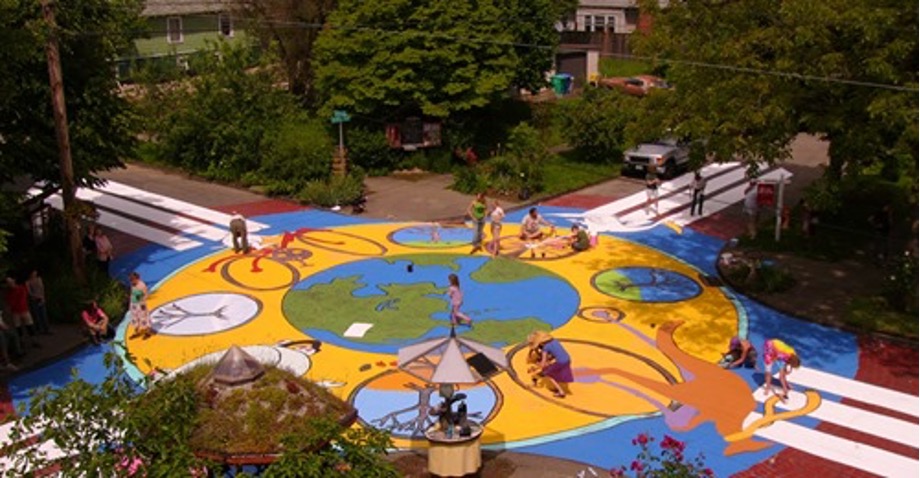
25 years ago, residents of two streets in Portland (USA) decided to turn the intersection of those streets into a meeting place. At first, only tents, tables, chairs and play equipment were placed on the sidewalks, later the intersection itself was used at set times. After some negotiations, the city council agreed, if this would be sufficiently made visible. The residents didn’t think twice and engaged in painting the street as visible as possible (See the image above). The residents agree that this whole project has made their lives happier and that the many activities they organize on the square still contribute to this.
The impact of happiness on the quality of the living environment.
But, what about the other way around, happiness as a building block for the quality of the living environment? Happy people are a blessing for the other inhabitants of a neighbourhood, because of their good mood, social attitude, willingness to take initiatives, and optimism regarding the future. At their turn, happy people can make most of available resources in their living environment because of the above-mentioned characteristics. Environmental qualities are not fixed entities: they derive their value from the meaning citizens give them. In this context, happiness is a mediator between environmental features and their appraisal by citizens.
Therefore, happy citizens can be found in Mumbai slums, and they might be happier than a selfish grumbler in a fancy apartment. At the same time, happy citizens might be best equipped to take the lead in collective action to improve the quality of the living environment, also because of the above-mentioned characteristics.
Follow the link below to find an overview of all articles.

 Music: Listen, Look and Enjoy