

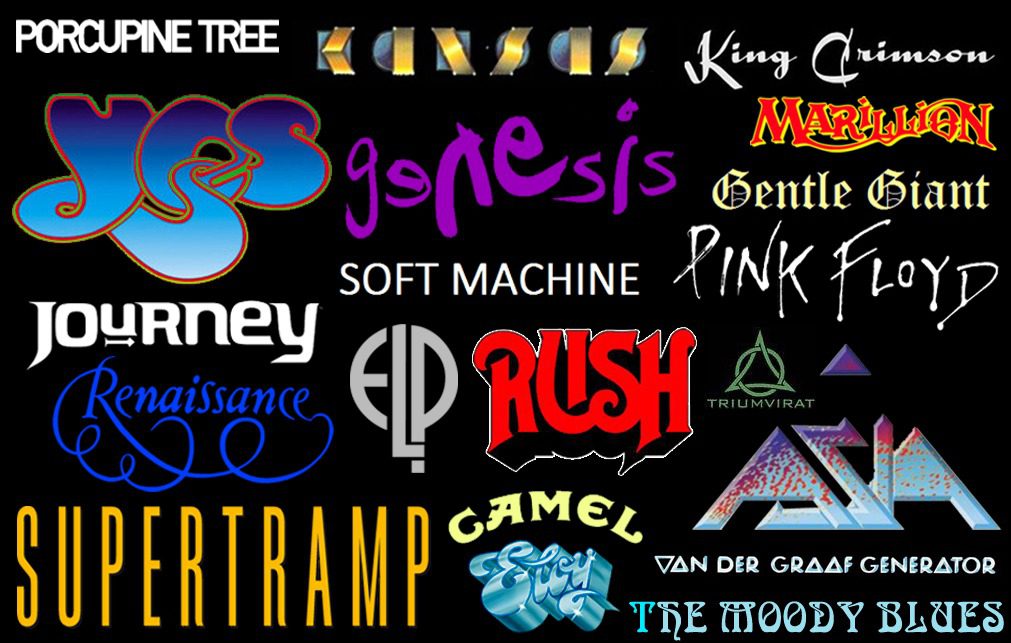
The term “prog rock” (progressive rock) will not be on everyone’s lips. That changes as soon as names of groups like Pink Floyd and Genesis drop. These groups wanted to distinguish themselves by constantly striving for innovation within the boundaries of the genre but also by building bridges with other genres such as jazz and soul. ‘Prog rock’ differs from ‘mainstream rock’, which was discussed at length in the six-part series I published earlier (You can find the first episode of that series here).
In this first post, I will clarify the concept of progressive rock and show some examples of musical styles that underpin it. Broad agreement exists that the development of ‘prog rock’ was decisively influenced by three albums by the Beatles after 1966, namely ‘Rubber Soul’, Revolver and ‘Sgt Pepper’s Lonely Hearts Club Band’. A second influential group were the Beach Boys, particularly their album ‘Pet Sounds’. You are now watching and listening to the song ‘A Day in the Life’ from the album ‘Sgt Pepper’s Lonely Hearts Club Band’. In the absence of live recordings by the Beatles themselves, here you listen and watch the live version made by Dutch cover band ‘The Analogues’.
Many other groups provided building blocks for the development of ‘prog rock’, such as, ‘The Doors’, ‘The Pretty Things‘, ‘The Zombies‘, ‘The Byrds’, ‘Grateful Dead’, ‘Jethro Tull‘, ‘Caravan‘, ‘Yardbirds‘,’So’Soft Machine‘, ‘Hollies’ and ‘Velvet Underground’. You can spend the next months deepening your acquaintance with most of these groups
Features
Although progressive rock will not mean the same thing to everyone, a few of the characteristics below will be something everyone will be able to mention:
– Striking lyrics or sound figures that attract and hold attention (‘hooks’, also called ‘earworms’.
– Deliberate deviations from rhythm, tempo, measure and key, which may be perceived as surprising or dissonant.
– Unorthodox instrumentation, such as the sitar and harpsichord.
– Distortion of guitar sounds, also to mimic the sound of exotic instruments, such as the sitar.
– The use of electronics in music reproduction and recording.
– High level of instrument mastery.
– Composition techniques borrowed from jazz and classical music.
– Frequent occurrence of long songs and improvised solos.
– In many cases, the studio became the place where the music was developed.
– Music to listen to; not dance music.
– Symphonic elements.
– Poetic lyrics.
– Striving to be recognized as an art form.
‘Artrock’
In the beginning of the 1960s musicians distinguished themselves from ‘commercial’ pop music by uswing the label ‘progressive pop’. Identifying with ‘progressive rock’ was a nest step. sometimes the term “art rock” is used exclusively for avant-garde rock music. An example is Bowie’s album ‘Station to station’ (1976), whose title track you can listen to and watch here. Critics were divided over the album and some of his fans had great difficulty with its experimental nature. It would later influence a large group of ‘new wave’ artists.
The groups I mentioned above each represent different stylistic contributions to the development of ‘prog rock’. By far the most important contribution came from psychedelia: In the 1960s musicians frequently used hallucinogens as a source of inspiration or to create an atmosphere on stage that supported the use of perception-altering drugs. Other influences came from symphonic rock, ‘space music’, jazz rock, classical music and folk rock, incidentally in combination with the use of hallucinogens. I dwell on each of these forms.
Psychedelics
Especially in the early years, a remarkable difference occurred between Europe and the US. In Europe, the influence of psychedelics was central to the creation of music, which, besides the Beatles’ albums already mentioned, was also true of the Beach Boys with their leading album ‘Petsounds’.
With lead guitarist Jeff Beck, the ‘Yardbird’s laid the foundations for the ‘psychedelic guitar’ with its ominous sounds in minor, hyperactive instrumental breaks, unpredictable tempo changes, the use of Gregorian chants, Eastern-sounding tonal loaders and shifting rhythms. You can hear and see this here in the song ‘Heart Full of Soul’ (1965)
The psychedelic variety that developed from the American West Coast was primarily intended to enhance the hallucinatory experience of drugs in the public. Among other things, light effects were used for this purpose, but the music, usually based on blues(rock), was also more intense. It was then referred to as acid rock. ‘Grateful death’ was one of the first acid rock bands and Jefferson Airplane was that first whose albums sold widely. You can listen to this group here, which also explicitly referred to the use of drugs in ‘White rabbit’.
Acid rock also featured many long guitar solos as in this song by the Paul Butterfield Blues band ‘Driftin Blues’ The electric (Hammond) organ, here in ‘The Doors’ Riders on the Storm – is also often heard.
In the late 1960s, the partly drug-based youth culture experienced highlights like ‘Summer of love’ (1967) and the Woodstock Rock Festival(1969). Legislation became stricter and several headliners (such as Jimi Hendrix, Janis Joplin and Jim Morrison) died. Acid rock developed in the direction of hard rock and heavy metal. That transition can be clearly heard in the song ‘In-A-Gada-Da-Vida’from ‘Iron Butterfly’.
Other groups eventually shifted towards ‘prog rock’. They experimented with electronics and added classical and jazz-related themes to their music. Examples are Pink Floyd, Yes and King Crimson. Here, you watch and listen to Lark’s Tongues in Aspic Part 2 by the latter group here.
‘Space or cosmic rock’, also called ‘Krautrock’
The term ‘Krautrock’ refers to a broad collection of experimental musical forms, which developed mainly in West Germany. The artists involved combined elements of psychedelic rock, avant-garde composition and electronic sounds. Common elements were hypnotic rhythms, extensive improvisation, use of realistic sounds and of early synthesisers. Themes often related to space. Prominent groups associated with the Krautrock label included ‘Tangerine Dream‘ (1975), ‘Osees‘ (2021), ‘Kraftwerk’ (1974), ‘Can‘ (1973) and more recently Neu!!! (2016), The development of this style resulted from young people’s desire to develop their own genre of music in their own language and apart from German ‘Schlagers’. Here as an example, Kraftwerk’s best-known song, ‘Autobahn’.
Jazz and classical music
Several groups sought to enrich their timbre by incorporating jazz. They usually used wind instruments in addition to guitars. Examples include ‘Colosseum‘ (1970), ‘Blood, Sweat and Tears‘ (1969), ‘Chicago‘ (1969), ‘Caravan‘ (1972), ‘Soft Machine’ (1974) and the Dutch group ‘Focus‘ (1973). Of more recent origin is ‘In Cahoots’ (2015).
Classical influences sometimes be heard in the choice of melodies, such as ‘Beck’s Bolero’ (2016) . Watch and listen here to ‘Jethro Tull’s’ ‘Bourée’, (1969), inspired by Johann Sebastian’s Bach Bourrée.
Most of the groups mentioned in this post have provided building blocks for the development of ‘prog rock’. Some groups, such as the ‘Beatles’, the ‘Beachboys’ and ‘Pink Floyd’ were on the frontier of the genre in the late 1960s. Starting in the next post, I will discuss groups that rightfully pass for ‘prog rock’. I will do this from three angles: the three periods that are distinguished in the development of ‘prog rock’, (progressive, neo-progressive and post-progressive rock); four groups characteristic of these periods (Pink Floyd, Genesis, Marillion and Rush) and two artists who have made essential contributions to it throughout their lives (Peter Gabriel and Steven Wilson). The final episode will be about ‘new blood’, developments beyond 2020.

 Music: Listen, Look and Enjoy