
Marillion (Prog rock 1965 – 2025 part 7)

Marillion has been formed in Aylesbury in 1979 (Buckinghamshire). The band’s roots lie in post-punk and from there the group bridged towards prog rock. From 1984 to the present, the band consisted of Steve Rothery (guitar), Ian Mosley (drums), Mark Kelly (keyboards) and Pete Trewavas (bass guitar). Singer Steve Hogarth replaced singer  Fish in 1987 and is also still a member of the band. Mark Kelly said in 2016: “One of the reasons we still together is because we’re successful enough to make a living, but not successful enough not to have to do anything.”

The group is releasing its first studio album in 1983: ‘Script for a jester’s tear’. 19 others would follow, the last being ‘An hour before it’s dark’ in 2022. Many albums reached the top 10. I selected a limited number of post-1980 albums, and from each I chose songs that exemplify neo-progressive and, in some cases, post-progressive rock. in subsequent posts. I will go into this distinction between the two in more detail. But first a list of characteristics of neo-prog rock. These characteristics differ only gradually from those of ‘prog rock’ as discussed so far. 

1. More symphonic approach

2. Shorter songs, even if they consist of more parts.

3. Narrative, theatrical construction with lyrics and vocals full of emotion.

4. More dominant use of synthesisers.

5. In the case of a conceptual approach, greater use of topical and personal themes.

6. Atmosphere is more often melancholic and introspective.

7. Less need to demonstrate virtuosity.

8. Stronger influence from pop music, especially alt-rock.

Script for a jester’s tear (1983)

The title track ‘Script for a jester’s tear’ from this album illustrates the symphonic approach, but also the construction of several songs with different parts, the extensive role of synthesisers and the narrative structure. Especially its emotional lyrics and theatrical vocals set it apart from older prog rock songs. You can listen to it here.

The album also includes ‘He knows, you know….’. Here, too, Fish’s powerful, emotion-rich and theatrical vocals stand out. The lyrics are poetic and full of metaphors. The third track from this album I mention is ‘Chelsea Monday’. This illustrates the use of synthesisers in creating a dreamy and melancholic atmosphere.

Misplaced childhood (1985)

The single ‘Kayleigh’ illustrates that the group certainly does not shy away from shorter ‘poppy’ songs. Nevertheless, the melancholic and emotive vocals and use of keyboards stand out. The song is about a former girlfriend of the singer and the unhappy way the relationship ended. The group’s fame increased significantly after this accessible song. Incidentally, the number of children named Kayleigh also increased. Watch and listen to this song here.

The single ‘Blind curve‘ consists of several parts that together tell the story of a bizarre journey, based on contemporary themes.

Finally, from this album, I mention ‘Lavender‘. The structure and melody of this song are simple; not because the members of the band cannot play complex solos, but because the story comes out better that way. 

Clutching at straws (1987)

This album was also successful, especially the song ‘Incommunicado’Key neo-prog rock characteristics of this song are its narrative nature, layered structure and the influence of 1980s pop music.  The recording dates from 1990, when Steve Hogarth already had replaced Fish.

Another track on this album is ‘Sugar mice’ Again, the emotion-rich vocals and melancholic atmosphere evoked using synthesisers, characterise the song as neo-progressive.

After going on one last tour with the band, singer Fish leaves the band due to the stress and fatigue such a tour caused, in return for which there were limited earnings.  He opts for a solo career.

During Fish’s time as vocalist, neo-progressive influences predominated. Partly due to the arrival of Steve Hogarth as vocalist, the band increasingly opens to other influences.  Some songs are still clearly neo-prog, others are post-prog or alternative in the first place. I will give examples of these.  However, the distinction between neo-progressive and post-progressive rock will be discussed in more detail in the following episodes.

Holidays in Eden

The band’s first album with Hogarth was ‘Holidays in Eden’ (1990). This album is heavily influenced by pop, much to the chagrin of hardcore fans. The band went on tour with it, completed at a sold-out Wembley stadium in London. At least in two songs, neo-prog characteristics can be heard: ‘Splintering heart’ and ‘The party’.

Splintering heart’ has an introspective intro that develops into a dramatic climax, which returns to a contemplative and melancholic part. This pattern repeats itself at the end of the song. You can listen to it here:

The party’ is an emotionally charged story that far exceeds the character of a pop ballad through its changes of timbres. In this song, prog-rock and alternative rock come close together.

Brave

The group used the whole of 1993 to make a new album, which would become one of the most impressive in its history: ‘Brave’, released in 1994. It is a rich and complex concept album, with longer songs, in which emotion masterfully finds a release. The album can be characterised as neo- and post-progressive. Examples include ‘Bridge’, ‘The great escape’ and the title track ‘Brave’.

The beginning of ‘Bridge’ is almost classic, the story is told against a varying musical backdrop and features a hard rock-like release with accompanying guitar solos. You can listen to it here.

 ‘The great escape’ is an epic song that can be listened to like as a pop song, but it evokes more atmosphere and commitment in its vocals and instrumentation.

Brave‘ is a mostly neo-prog, atmospheric and melodic song, full of synth sound and rhythm changes. You can see a live recording of the song ‘Brave’ (Brave, 1994) here. 

‘Afraid of sunlight’

The next album Afraid of sunlight’ (1995) was a lesser commercial success. It contained a remarkable song ‘Out of this world’. The song is about Donald Campbell’s failed attempt to set a speed record with his speedboat. An atmospheric prog rock song that makes abundant use of synthesizers, complemented by Hogarth’s subdued vocals. This song prompted a successful attempt in 2001 to salvage the boat. You can listen to a 2008 recording here.

Another song that qualifies as neo prog-rock is ‘King’ which poignantly sings of the destructive influence of fame. The ‘poppy’ melody is wrapped in a sea of sounds that highlights destruction and transience with an overwhelmingly bombastic ending.

The band was not destitute, but the resources to invest in new tours or in developing a new album were lacking. Towards the end of the 20ste century, fans began to play an increasing role in financing the band. For instance, they raise the funds to enable a US tour and to promote the new album ‘This strange machine’ (1997). Later, they are willing to pre-order albums even before these are made. The band’s next step is organising holiday camps, worldwide. Fans are invited to a three-day stay during which they can attend three concerts. In February 2007, the first ‘Marillion weekend’ took place abroad, namely at Center Parcs, Port Zรฉlande in the Netherlands.

Marbles (2004) was another successful album, to be classified as (post) progressive rock. ‘You’re  gone’ and ‘Don’t hurt yourself’ have a solid dose of pop. โ€˜Neverlandโ€™ and โ€˜Fantastic placeโ€™ are closest to the neo-progressive period. The first because of its dramatic tension and the second because of the melancholic atmosphere it evokes. You can hear the second song here.

In 2009, the group released an acoustic album, ‘Less is more’. This consisted largely of older songs. You can listen to ‘This train is my live’ and ‘Anniversary‘. 

I am now making a leap in time.  During this period, the band produced a few more albums, toured regularly and the members worked on a few solo projects. A show at London’s Royal Albert Hall in 2018 sold out within four minutes. A film was made of the performance: โ€˜All One Tonight – Live at the Royal Albert Hallโ€™. You can watch ‘White Paper’ here.

The band’s most recent album is ‘An hour before it’s dark’ (1922) The album is post-progressive and focused on current themes. Two examples are ‘Be hard on yourself‘ – an outspoken climate protest song – and ‘Care‘. Of the first song, the beat changes and tension building stand out. The second is atmospheric and contains a compelling melody

The music press in the UK always left the band loopy and wrote about them smugly, as if the band’s members were “prog rock dinosaurs”. Music by Marillion was rarely broadcasted on radio and TV appearances were scarce too. In contrast, the hard core of fans called ‘the Freaks’ have been and supported the band in many ways. Much recognition for the band also exists in the ‘Progressive rock community’. At the ‘2017 Progressive Music Awards’ ceremony, the band was voted ‘UK Band of the year’.
Neo-progressive rock (Prog rock 1965 – 2025 part 6)

To understand the evolution from prog rock to neo-progressive rock and later to post progressive rock, it is necessary to dwell on what was happening on the musical scene in the period after 1975, in particular the rise of punk.[1]

Changing environment

Punk opposed what were seen as musical excesses, such as psychedelic-influenced musical styles, theatrical and virtuoso playing, long songs, imaginative themes and social utopias. This mainly concerned hard rock, metal, symphonic rock and prog rock. Fans also got tired of the long, complicated songs with sometimes inimitable lyrics. For this, see my post on punk in the history of rock after 1960 series. 

The popularity of punk was short-lived, after which most of the remaining groups improved mastery of their instruments and replaced political slogans with appealing lyrics. Initially, this new brand of punk was referred to as ‘post punk’; record companies started using the term ‘new wave’, music critics spoke of ‘alternative’ or ‘alt-rock’ and young people spoke of ‘underground music’. A wide variety of styles fall under this heading. Groups included in this category are R.E.M, Nirvana, Pearl jam, Red hot chili peppers, Pixies, Cure, Green day and many others. What these bands have in common is that they distance themselves from what they saw as commercial pop music, which of course is partly a sham.  You can also read about this in my post on alternative rock.

All this, of course, does not escape the notice of prog rock groups. They realise that adjustments are inevitable, first and foremost, improving the accessibility of their music. This would also increase the willingness of radio stations to play it. This went down well with groups like Pink Floyd, Genesis, Asia and Yes. Especially by taking substantial steps towards pop. Groups without an established tradition, such as Marillion, IQ and Pendragon were looking for a way to renew prog rock itself. This certainly succeeded well in the 1980s.

Characteristics of neo-progressive rock

I will list characteristics of neo-progressive rock below and for each of these you can look and listen to a song for illustration. Remember that the differences between prog rock and neo-progressive rock are gradual. For that matter, so are the differences between neo-progressive and post-progressive rock. Also, you must realise that typifying music on the basis of stylistic characteristics is usually done afterwards and musicians are hardly concerned with it.

1. Melody and accessibility (versus complexity and long songs)

Neo-progressive rock remains more complex than ‘mainstream rock’. There is more emphasis on catchy melodies and the articulation of emotion, making songs more resonant than older prog rock tunes.

And good example is: ‘Kayleigh’ (Misplaced childhood, 1985) by MarillionThis song has personal and emotional lyrics and a simple structure.

2. Synthesiser-driven sound (versus analogue instruments such as guitar and organ)

Synthesisers and other electronic instruments play a dominant role in neo-progressive rock, partly replacing guitar and piano. With electronic instruments, greater differences in timbre can be created, ranging from dreamy (or ethereal) to menacing and bombastic. You can now watch and listen to ‘Awake and Nervous’ (Tales from the lush attic, 1983) by IQ, a recording from 2019. The synthesiser creates a layered pallet of sounds to reinforce the emotion this song seeks to evoke.

3. Influence of pop and new wave (versus classical and jazz)

Influences from pop music, new wave and alternative rock result in a tighter and more polished sound, and as a consequence, music that resonates better with a wider audience.

A good example is ‘A man of nomadic traits'(Not of this world, 2001) by Pendragon, a 2008 recording. You can watch and listen to this song here

4. Introspective texts (versus philosophical, mythical and science fiction sources)

Song lyrics are often introspective and based on personal experiences or feelings of melancholy, sadness or anger. A good example is Marillion’s album ‘Script for a Jester’s tear’ (1983). You can hear the title track with the same name here, also recorded in 1983.

5. Less experimental with more focus on atmosphere (versus virtuosity and variation of beat, rhythm, timbre and volume)

Creating an atmospheric experience is more important than complexity and technical feats. A good example of such a melodic song is ‘The voyager’ (Men who climb mountains, 1994) by Pendragon. The version here was recorded in 2018. 

6. Conceptual approach

Albums, like their prog rock predecessors, often have overarching themes, but now with a more personal or introspective slant rather than a mythological character

A good example is ‘This Green and Pleasant Land’ (Out of order comes chaos, 2012) by Pendragon. You can watch and listen to this song here.

Other differences include focus on a wider audience rather than on a niche market and modern production techniques versus analogue recordings.

Similarities and differences between prog rock and alternative rock become manifest from the 1980s onwards . Both styles are reactions to mainstream rock and pop music. Prog rock is mainly driven by the pursuit of recognition as an art form and translates this into virtuosity and complexity.  Alternative rock also is experimental but is mainly driven by authenticity and introspection and expresses this through variations in timbre. The differences between the two styles are sometimes easily audible but sometimes not, for instance in the case of some songs by NirvanaRadioheadThe Mars Volta and Tool

Marillion is one of the most pronounced neo-prog rock groups. This group will be in the spotlight in the next post and I will show why the above-mentioned characteristics of neo-prog rock fit this group well.


[1] This post is based on an analysis of articles in Wikipedia (Eng.) and recordings on YouTube. ChatGPT was used as an aid in structuring the information.

Rush (Prog rock 1965 – 2025 part 5)

Rush is a Canadian band formed in 1968 in Toronto. After some personnel changes, until its disbanding in 2015, the band consisted of Geddy Lee (vocals, bass guitar and keyboards), Alex Lifeson (guitar) and Neil Peart (drums, percussion). Lee and Lifeson wrote the music, Peart the lyrics.

Most prog rock groups were psychedelic-oriented in their early years, in the late 1960s. Rush, on the other hand, was a hard rock band and as such entered the world of prog rock. Hard rock has always remained the group’s DNA; the group made a conscious decision to be inspired by prog rock and smoothly moved with the different guises that prog rock took over the years. Hard rock combined with prog rock rock the phenomenal craftsmanship of the three members have led to the group always having a large following.

Giving attention to the band is warranted because it illustrates the development of progressive rock over three periods, giving a first impression of the changes that took place in the genre.  

Embracing prog rock 

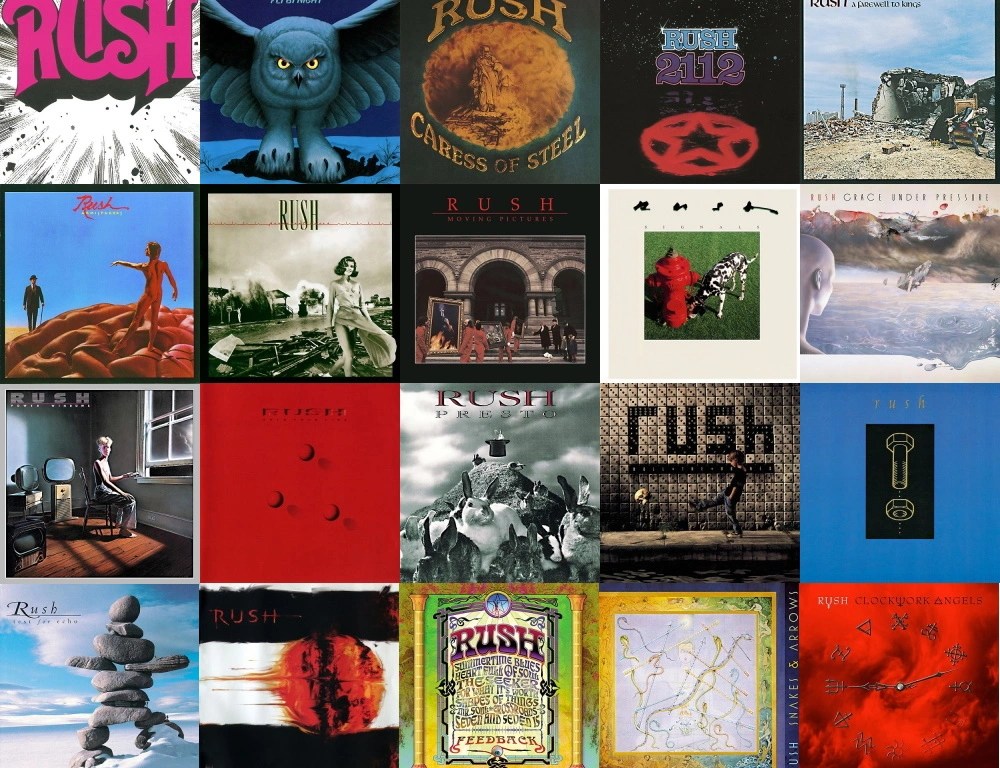
The band’s hard rock roots still dominate its second album, ‘Fly by night’, which also shows the first signs of prog rock. A song like ‘By-Tor & the Snow Dog’ (Fly by night, 1975) consists of several sections, has complex arrangements and a mythological theme.

The next album, Caress of Steel, continues the trend towards prog rock. This is evident in the long compositions, choice of mythological themes and complex structures. You can hear this in the song ‘The Necromancer’ (Caress of Steel, 1975), an atmospheric epic song, b great success either. The fourth album ‘2112’ (1976) provides a breakthrough. You’re watching and listening here to an animation of the full title track ‘2112’ (2112, 1976) that covers one side of the record and consists of seven parts; here a live recording from โ€˜2112โ€™. It is a sci-fi epic set in the city of Megadon in the year 2112. Hard rock fans who like progressive rock are in the right place here, and vice versa. 

The upward trend in interest in Rush as a prog rock band continues in ‘A farewell to kings’ (1977) and Hemisphere(1978). The group now also lends its ear to established prog rock groups such as Yes and King Crimson. You are now watching and listening to ‘A Farewell to kings’ (A Farewell to kings, 1977)

The transition to neo-progressive rock

In albums from the late 1970s and early 1980s such as “Permanent Waves” (1980) and “Moving Pictures” (1981), more neo-progressive characteristics come through. To this end, Lifeson starts experimenting with classical and 12-string guitars and Lee adds bass pedal synthesisers and Mini Moog. Peart expands his already no small amount of percussion instruments to include triangles, wood blocks, cowbells, timpani and a gong. Besides adding instruments, the band stayed in tune with progressive rock trends by composing long, conceptual songs with science fiction and fantasy themes, which are more accessible than the songs from the previous period.  โ€˜Permanent wavesโ€™, and especially โ€˜Moving pictureโ€™ penetrated to the top of the charts in Canada, the US and Europe. and were even appreciated by the critics.

A number of songs from both albums Pictures’ also scored high as a single.

The ‘Spirit of Radio’ (Permanent Waves, 1980) is a complex yet accessible composition with diverse styles, including reggae and new wave elements. The content of the songs shifts from a fairy-tale and mythical fantasy world to current social themes.

Rush toured with ‘Permanent waves’ for six months and reached some 650,000 fans during that period. 

‘The camera eye’ (Moving Pictures, 1981) combines neo-progressive elements and contains experiments with electronics. This song, which lasted 11 minutes, was the band’s last long song. The same album also features ‘Tom Sawyer’ (Moving pictures, 1981). You can watch and listen to that now, a recording from 2007 in Ahoy, Rotterdam.

These two albums were followed by another series of albums, for instance โ€˜Signalsโ€™ that found a warm reception and, while retaining the hard rock DNA, went along with the changes that prog rock was undergoing.

‘Subdivisions’ ( Signals,1982) is an introspective song in which synthesisers play a more important role than the guitar. This makes this song a model for neo-progressive rock. Other songs on this album, such as ‘Digital man‘, ‘The weapon‘ and ‘Chemistry’ show that the band was also influenced by ska, reggae and funk and, of course, hard rock. You watch and listen to Chemistry here.

Post-progressive influence

Over time, Rush evolves further with a focus on textures, atmospheres and simpler structures. Synthesisers continue to play an important role in this initially. The album ‘Grace under pressure’ (1984) builds on the style of ‘Signals’. The title is a paraphrase of Hemmingway’s quote ‘Courage is grace under pressure’. This is followed by ‘Power window’ (1985) and Hold your fire (1987). Illustrative songs in the last album are ‘Time stand still’ย and ‘The pass’. In this album, the guitar again resonates more strongly than in the previous albums.

In the early 1990s, Rush further abandons the heavily keyboard-dominated sound. This is evident in the albums Presto (1989), Rolling the bones (1991), Counterparts (1993) and Test for Echo.  From the latter album, you can hear here the title track ‘Test for Echo’, performed live in Toronto (1997). After the ‘Test for Echo’ tour, the band took a break, eventually lasting five years. Cause were tragic events in Peart’s life.

The trio picked up where they left off in 2001 and the first album the group released is ‘Vapor Trails’ (2002). All songs were recorded without keyboards and synthesizers. The same applies to Snakes & Arrows (2007), whose song ‘Far cry’ became a hit. You can listen to this song here. The recording was made at Rotterdam Ahoy in 2007. 

The group’s latest studio album is Clockwork Angels (2012). You can listen to three songs from this album; ‘Caravan‘, ‘Halo effect‘ and ‘The garden’. In the latter song, hard rock has finally largely given way to more introspective neo-pro rock sounds, accompanied by a string section.

In August 2020, Peart dies of brain cancer. Lee and Lifeson declare that they will still play songs together but will never tour again.

The band has sold about 40 million albums. โ€˜Moving picturesโ€™ was the best-selling and also highest-rated album, which you should definitely listen to in its entirety once.

In essence, Rush remained a hard rock band with an open eye to other styles, the development of prog rock first and foremost. This led to long songs, irregular and shifting tunings and changing time signatures. In the 1980s, the band added elements borrowed from new wave, reggae and pop. At the time, synthesisers and electronic percussion were widely used. The mix of hard rock, technical virtuosity and features of prog rock made Rush unique, and the group in turn influenced the further development of post-progressive rock. 

Generalising, you could say that neo-progressive rock is more concerned with atmosphere and emotion and less with demonstrating technical virtuosity. Long songs are less prominent and there is more focus on accessibility. Post-progressive rock further opens to other genres, such as alternative rock and pop music. In the next post, I discuss the differences between the first and second periods more systematically, then shift the focus to the third period and put the three periods side by side.