

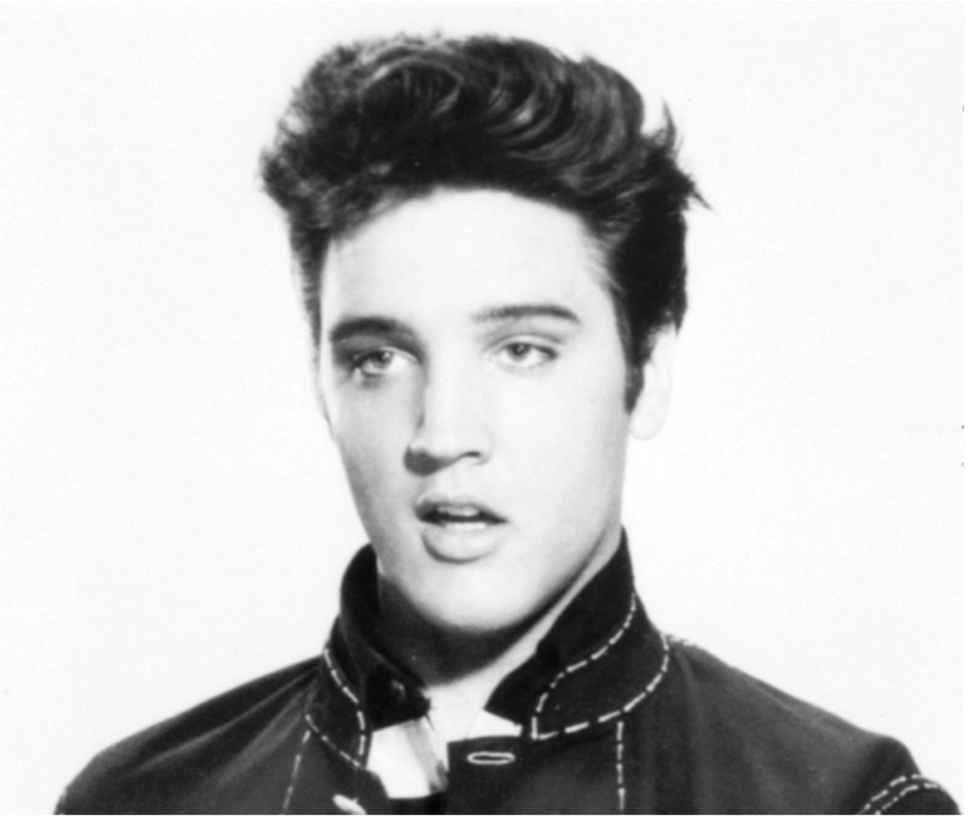
Elvis Presley was born on 8 January 1935 in Tupelo, Mississippi. His family moved to Memphis, Tennessee, in 1948. He learned to play the guitar from a boy next door. He was not a very popular kid at school. This changed after his appearance in the local minstrel show, after friends signed him up for the show.
The start of Elvis’ carrier
At 18the , Elvis went to work as a truck driver and in the meantime, he looked forward to an opportunity to use his talents as a musician. That this was successful was mostly due to coincidence. Elvis had had a song recorded at Sam Phillips’ studio to give as a gift to his mother. Phillips, the owner of the studio was just looking for a ‘white’ boy with a ‘black’ voice. The assistant who had recorded the record remembered Elvis and he, along with two other boys, guitarist “Scotty” Moore and bassist Bill Black, were invited to come and do some singing. Afterwards, the trio would be inseparable for several years. It seemed to be nothing and when the session had already ended, Elvis started singing Arthur Cudrups’ song “That’s all right, mama” (1946). That was the sound Phillips was looking for. The song appeared on local radio and the interviewer asked him what school he had attended in order to reveal his white identity. Phillips now recorded his song with “Blue Moon of Kentucky” on the B-side.
The trio was regularly invited to perform at local clubs over the following months, often as the support act for a more celebrity. At those gigs, Elvis was shaking on his legs with nerves, which led to the girls in the audience starting to scream. Elvis soon became more confident, but he developed the shaking of his lower body into an act in no time. The girls screamed, but the boys hated them out of jealousy. The police often got involved as these boys were waiting for Elvis outside. Later, even the national guard joined the police. He was much less heard on the radio. The stations broadcasting country & western thought he was a ‘nigger’ and the more ‘rhythm & blues’ oriented stations thought he sounded too much like a ‘hillbilly’.
Breaking through and becoming a celebrity
Heartbreak Hotel became Presley’s first number-one hit, making him a national celebrity. A few weeks later, RCA released his first album “Elvis Presley”. His raucous vocals had a great influence on then barely known singers like John Lennon and Keith Richards. Their appreciation was countered by the disgust of established newspapers and their readers and television presenters. Yet they all invited him to perform on their shows. Ed Sullivan, for instance, paid $50,000 for three performances, most of it went to Elvis’ manager, “Colonel” Tom Parker. Half of the audience tuned into these shows to enjoy, scream or giggle at his songs, including, for example, “Blue Suede shoes”, which you can hear now, including the screams on a 1956 recording.
Meanwhile, his second film “Loving You” was released and he was shooting his third film “Jailhouse Rock”. The title song of this film had become a huge success. You can hear this song here.
In the army
On 24 March 1958, Elvis’ tour of duty broke. He had expressed his wish to be treated as an ‘ordinary’ soldier and so it happened. He spent part of his military service in Germany, where he also met Priscilla Beaulieu, whom he would marry eight years later. She was only 14 at the time. He also got to know something completely different, namely amphetamine. The sergeant generously dispensed it to him and other soldiers because he had noticed that it made his men a lot more energetic. Meanwhile, Elvis had also bought a new house for his parents and himself, Graceland.
His fans had no chance to forget him. The record company had the necessary recordings on the shelf, such as “Wear My Ring Around Your Neck“, “Hard Headed Woman “, “One Night“, “A Fool Such as I” and “Big Hunk o’ Love”. You can hear the latter one here.
Back from service, Elvis immediately dove into the RCA studio, where his best album up to that point, ‘Elvis Back’, was recorded. The album showed Elvis at his strongest, from raw rocker, emotional blues singer to interpreter of romantic ballads. It includes his best-selling singles, such as Stuck on you“, “Is now or never” and “Are you lonesome tonight?” You can hear the last song here:
A few more albums were released in the 1960s that exemplified the then dominating ‘cosmopolitan’ Nashville country style. Furthermore, 27 more films were recorded in the 1960s, mostly dubbed ‘dregs’ by critics. The songs Elvis had to sing on those were invariably put on record and sold well too, but it depressed Elvis that he had no challenging projects on his hands.
Some of his most popular songs – all from films – were “Can’t help falling in love” (1961), “Return to Sender” (1962), “Viva Las Vegas“, the title track of a 1964 film that would only become popular years later, “A little less conversation” (1968) which became a number-one hit as a remix in a Nike advertisement at the World Cup only in 2002. “Crying in the chapel” which had been recorded in 1960 and was still on the shelf, was the only song to reach the top-ten. Most of the above-mentioned songs are fragments from films. However, the fans wanted to see Elvis sing live. That happened again from 1968 onwards.
Live again
Everyone thought Elvis should perform again and in 1968 the ‘Come back special’ was broadcast. Presley, tight in leather, appealed to the feelings of the of years gone by. You can see and hear a medley of three old songs “Heartbreak Hotel”, “Hound Dog “and “All shook up.
Elvis was uplifted by this performance, but Parker was furious because he had in mind a sweet-voiced Christmas show. Presley recorded another album not consisting of film music for the first time in eight years, called “From Elvis in Memphis“. Critics were positive. For the first time, ‘soul’ took center stage, alongside rock and country songs. A choice was made to put more emphasis on what was called the Memphis sound (akin to country & western) instead of the standard pop sound. The following songs date from this time and are partly on this album. The recordings are from Las Vegas and Honolulu: “Burning love“, “The wonder of you”, “Suspicious minds“, “Kentucky rain“, “Patch it up” and “In the ghetto”, you are about to watch. This protest song jumped that straight to number one on charts.
From his early childhood, Elvis loved gospel songs after his parents took him to performances by the Statesmen Quartet.
Elvis sings gospel
In 1957, he made his first gospel album “How Great Thou Art’. From this, you can listen to “Run on”. No older recording is available, so you can now watch a recording from 1972.
His style increasingly becoming a mix of soul, rock and country, Elvis had been revived by his recent work. He craved challenging projects. He was invited several times to perform in films that went beyond the character of 1960s sneak peeks. Manager ‘Colonel’ Tom Parker held it all off; the latter felt that Elvis should cash in on his renewed repertoire, now that it was once again attracting full audiences. In 1973 alone, he was booked for 168 concerts.
Continuing exploitation
From 1973, things went downhill. Elvis had repeatedly overdosed on barbiturates and had been hospitalized in a coma. Elvis abhorred drug use, but when his body doctor Nichopoulos prescribed them to him, he trusted their medicinal effects. In October, his divorce was pronounced. Priscilla had already left Graceland in 1971 with their little daughter Lisa-Marie (who, incidentally, died recently). He did not recover from the blow of the divorce. During his performances, he wore increasingly desperate costumes and screaming girls were long gone. These performances were sometimes toe-curling. Sometimes Elvis couldn’t get out of his words, sometimes he stood stock-still and didn’t know any lyrics, without an extra dose of pep pills.
Despite all this, six more albums were released between 1973 and 1976, partly with old material. Eight songs from these still made it into the top 10. They include ‘My boy‘ (1975), “Moody Blue” (1976) and -praised and reviled – “Hurt”(1976). This is seen below in one of Elvis’ last performances in 1977.
Elvis dies
On 16 August 1977, his then-girlfriend found him dead the bathroom floor; he was due to fly to Memphis later that afternoon for a gig. Two days later, at was buried in the presence of thousands of fans. Investigations revealed that died of excessive medication. His doctor had prescribed him 10,000 doses of tranquilizers and amphetamines in 1957 alone. This doctor was acquitted of involvement in his death but after all he was removed from office.
Apart from his doctor, manager, “Colonel” Tom Parker (1909 – 1997) also played a bad role. Friends of Elvis described it as a fraud as Parker was only after Elvis’ money. He managed all business contacts, appropriated 30-50% of all revenues and prevented Elvis from breaking new ground. He also prevented Elvis from performing abroad, a great desire of his. Parker, born as Dries van Dijk had moved to the US from the Netherlands without any documentation; he had lived for years on the frayed edges of society as manager of circuses, among other things. Once he became manager of several artists, no one asked for his passport any more. As an illegal with a made-up name, he could not travel abroad. In the 2022 film ‘Elvis’, his relationship with the “Colonel”, played by Tom Hanks, plays an important role.
After Elvis’ death, the memory of his person and of his music has rightly lived on to this day. The albums are still sold, most of his fortune has been lost through mismanagement.
Elvis; the concert
I’m going to let Elvis shine one more time. “Elvis, the concert” was an extremely successful show that went around the world several times from 1997. The last time, in 2012, the show also landed in Ahoy, Rotterdam. Elvis could only have dreamt of that. How was this possible? Several high-quality ‘multi-track’ recordings of concerts in the early 1970s were available. Elvis’ voice was filtered out off these tracks. He and, the musicians are projected on large screens, cleverly edited and accompanied live by a band, some of which consisted of members of his original backing band. Sometimes you also see the original backing band (just watch the drums), but you don’t hear it. You can see here the recording of the concert in 2002, marking the 25ste anniversary of Elvis’ death[1] .
Elvis was exploited as a ‘cash cow’ and was given incredible amounts of stimulants and narcotics to do so. He should have been coached and given more rest as well as artistic stimuli. Then he would have been together with Priscilla and Lisa-Marie, and he could have established his fame as the ‘King of Music’ worldwide. It only didn’t happen.
 Music: Listen, Look and Enjoy