
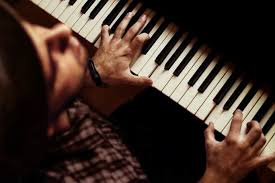
Boogie Woogie

Boogie Woogie is a style of music that emerged immediately after the abolition of slavery in the US in the 1870s. This makes the style – like gospel singing – one of the bridges between African-American music, jazz, rock ‘n’ roll and rhythm and blues from the beginning of the 20th century on. Boogie Woogie has endured over the years and played a major role in the pop music that emerged in the US around the 1960th and would also gain major influence in Europe.

Listen to a recent recording of the ‘Boogie Woogie Piano’ by Johan Blohm. just for fun.

Origin

Freed slaves migrated across America from 1870 in search of work.  At that time, cities developed rapidly and there was a need for lots of timber.  Logging camps sprang up, where many former slaves found work, but also provided musical entertainment in so-called ‘barrelhouses’. These are elementary pubs often just a roof, two beer barrels and a few boards over them, completed by an old piano. Pianists travelled around, telling stories about ‘the outside world”””, which gave them a certain status.  It took not long, before Boogie Woogie was also heard in pubs in the cities.

Boogie Woogie is very catchy and in its elementary form easy to play. Together with the beer (and the ladies) its sound contributed to the pleasure. The origin of the name Boogie Woogie is not clear.  Some think of ‘bogey man’, others hear in the monotonous bass parts the rhythm of the freight trains that carried pianists usually as stowaways from one camp to another. 

The first song in which the term Boogie Woogie appears explicitly is Pine Tops’ Boogie Woogie. ‘Pine Top’ (crown of pine tree) was the nickname of Clarence Smith, one of the piano players who also came to climb pine trees like no other.

Here the original 1928 performance on one of the first gramophone records of the time.

Musical style

Characteristic of Boogie Woogie is the tight rhythm on the piano of the left hand and the frivolous runs with the right hand.  Melody and rhythm are not that important.  The right hand mainly provides variation and inspired dancers to create figures. The lyrics were instructions for dancing. The piano is used like a percussion instrument. This is very well expressed in the following recording, in which piano and drums complementing each other particularly well.

Dance music par excellence

Rhythm, tempo and variation in tone are the key ingredients to put your body in a ‘dancing mood’. To this day, the Boogie Woogie inspires dancing. Nice to see professional dancers displaying their gifts

Boogie Woogie after logging camps and small pubs

Back to history for a moment. When logging camps became history, Boogie Woogie was confined to the many jazz clubs and dance parties.  Gramophone records gave its distribution an initial boost. Initially, Boogie Woogie stayed music by and for African-Americans. That changed in the late 1930s with a concert at Carnegie Hall called ‘From Spirituals to Swing’, which led to a huge uplift in the popularity of ‘black music’. Here is a recording of Mead Lux Lewis, one of famous Boogie Woogie players of that time:.

The bridge to pop music

In 1958, Little Richard provided a bridge between Boogie Woogie and pop music with the song Good Golly Miss Molly. This song was widely adopted by other groups and singers. It reached the 92th place of the ‘Rolling Stone Magazine’s hit list of all time.

Dance competitions

Dancing and on Boogie Woogie are inextricably linked. Sometimes visual effects take the leading role and there is no longer a splashing dance party but a show. This extreme form is also called acrobatic rock and roll. Finally, enjoy a recording of a Boogie Woogie competition from 2016.

Worksongs

Recently, I wrote a series of posts about the evolution of the music that immigrants from Europe brought to the US—country & western—and how it blended with rhythm & blues, which is mainly rooted in the African-American tradition. Rock ‘n’ roll, folk, ‘Americana’ and eventually Shania Twain and Taylor Swift positioned in this evolution. 

In the next episodes I take the opposite route. The starting point is the African-American tradition, beginning with the songs sung by slaves, which evolved through spirituals, gospel, and blues into rhythm & blues, Motown, funk, disco, and dance.

It is often said that jazz descended from African music. This is only partially true. Still, music in the Americas would have sounded completely different today if millions of slaves had not been deported to this part of the world. Slaves were not allowed to play the instruments they used in Africa. What was left of African music mixed with music brought by other immigrants and English replaced African languagesounded like, is only known since by a few gramophone records made in the 19de century. Earlier, though, there were wax rolls intended for pianolas, the first of which dates from 1826.

The most direct influence of African music on music in the United States, spirituals and gospel songs, in the first place,  comes from songs, which slaves sang while working. They did so for centuries, and the style has similarities with traditional African singing. Especially the role of a ‘cantor’ interacting with a ‘the choir’. As mentioned, drums are missing.

This recording is an example of a worksong, lyrics and music have been handed down.  The song ‘Po Lazarus’ is sung by James Carter & the Prisoners. The slaves pictured above were working to expand the railway network. Otherwise, they worked on plantations and building dykes.

This song is about a slave captured for the sheriff and shot dead. In other songs, slaves sing of their misery or give ‘disguised’ messages about ways to escape.  This was usually done by jumping on a train. Front singers were also hired who could rouse the slaves, so they worked harder.  

The song that follows next is also advice to slaves who want to escape. Namely wade through the water so the dogs cannot chase you. It is a contemporary rendition by an unknown artist.

The theme of trains played a role in many worksongs, as mentioned above, and much later after the abolition of slavery, this was still the case. This is Sister Rosetta Tharpe with “This Train”.  The recording is from 1964.

As more slaves converted, the songs more often took on a religious content. In the Bible, slaves found comparative material to their own suffering, for example the exile of the Jewish people in Egypt, hence titles such as: Example: Go Down Moses. The songs that emerged then were later sung by world-famous singing groups, like the Golden Gate Quartet here. This recording clearly explores the style of worksongs, but in highly polished form.

To some extent, the development of worksongs outlined so far was limited to what can be called ‘entertainment music’ and ‘religious music’.  But what happened in Europe with folk music, composers also drew inspiration from it. Performance no longer took place in pubs, churches and music halls, but in concert halls. There was talk of ‘Black Art Music’. 

Thus, in the mid-19de century, slavery had not yet been abolished, a choir, the Original Fisk Jubilee Singers, was founded at the University of Nashville.  This choir still exists to this day, more than 150 years later, and performs worldwide with, among other things, compositions dating back to the original worksongs, as far as surviving. You will also hear ‘Wade in the Water’ at a 2019 performance.

Incidentally, Miles Davis’ mother was also a member of the Fisk Jubilee Singers.

Finally, a performance by the Cannonball Adderley Sixtet from 1968. The song is called Work Song.  In content and form, it has nothing to do with a worksong. The composer Nathan Adderley, who plays cornet in his brother’s sixtet was inspired by it because in his youth he saw a group of prisoners working in front of their home in Florida. This was a ‘chain gang’, because of the chain with a steel ball at the end, with which they were connected. They too sang in songs in the tradition of the slaves.

Cannonball Adderly brings us right in the middle of the jazz tradition. Jazz is rhythmic music, partly improvised, with some members of the orchestra playing a solo. The chorus is often recognizable and easy on the ears; the interludes are complex and usually require a lot of technique. Jazz musicians usually seek to distinguish themselves from pop music through their craftsmanship, but the boundaries are fluid and repeatedly crossed deliberately and rightly.