

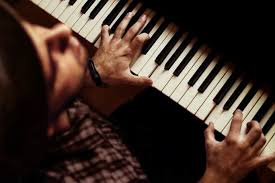
Boogie Woogie is a style of music that emerged immediately after the abolition of slavery in the US in the 1870s. This makes the style – like gospel singing – one of the bridges between African-American music, jazz, rock ‘n’ roll and rhythm and blues from the beginning of the 20th century on. Boogie Woogie has endured over the years and played a major role in the pop music that emerged in the US around the 1960th and would also gain major influence in Europe.
Listen to a recent recording of the ‘Boogie Woogie Piano’ by Johan Blohm. just for fun.
Origin
Freed slaves migrated across America from 1870 in search of work. At that time, cities developed rapidly and there was a need for lots of timber. Logging camps sprang up, where many former slaves found work, but also provided musical entertainment in so-called ‘barrelhouses’. These are elementary pubs often just a roof, two beer barrels and a few boards over them, completed by an old piano. Pianists travelled around, telling stories about ‘the outside world”””, which gave them a certain status. It took not long, before Boogie Woogie was also heard in pubs in the cities.
Boogie Woogie is very catchy and in its elementary form easy to play. Together with the beer (and the ladies) its sound contributed to the pleasure. The origin of the name Boogie Woogie is not clear. Some think of ‘bogey man’, others hear in the monotonous bass parts the rhythm of the freight trains that carried pianists usually as stowaways from one camp to another.
The first song in which the term Boogie Woogie appears explicitly is Pine Tops’ Boogie Woogie. ‘Pine Top’ (crown of pine tree) was the nickname of Clarence Smith, one of the piano players who also came to climb pine trees like no other.
Here the original 1928 performance on one of the first gramophone records of the time.
Musical style
Characteristic of Boogie Woogie is the tight rhythm on the piano of the left hand and the frivolous runs with the right hand. Melody and rhythm are not that important. The right hand mainly provides variation and inspired dancers to create figures. The lyrics were instructions for dancing. The piano is used like a percussion instrument. This is very well expressed in the following recording, in which piano and drums complementing each other particularly well.
Dance music par excellence
Rhythm, tempo and variation in tone are the key ingredients to put your body in a ‘dancing mood’. To this day, the Boogie Woogie inspires dancing. Nice to see professional dancers displaying their gifts
Boogie Woogie after logging camps and small pubs
Back to history for a moment. When logging camps became history, Boogie Woogie was confined to the many jazz clubs and dance parties. Gramophone records gave its distribution an initial boost. Initially, Boogie Woogie stayed music by and for African-Americans. That changed in the late 1930s with a concert at Carnegie Hall called ‘From Spirituals to Swing’, which led to a huge uplift in the popularity of ‘black music’. Here is a recording of Mead Lux Lewis, one of famous Boogie Woogie players of that time:.
The bridge to pop music
In 1958, Little Richard provided a bridge between Boogie Woogie and pop music with the song Good Golly Miss Molly. This song was widely adopted by other groups and singers. It reached the 92th place of the ‘Rolling Stone Magazine’s hit list of all time.
Dance competitions
Dancing and on Boogie Woogie are inextricably linked. Sometimes visual effects take the leading role and there is no longer a splashing dance party but a show. This extreme form is also called acrobatic rock and roll. Finally, enjoy a recording of a Boogie Woogie competition from 2016.
 Music: Listen, Look and Enjoy