

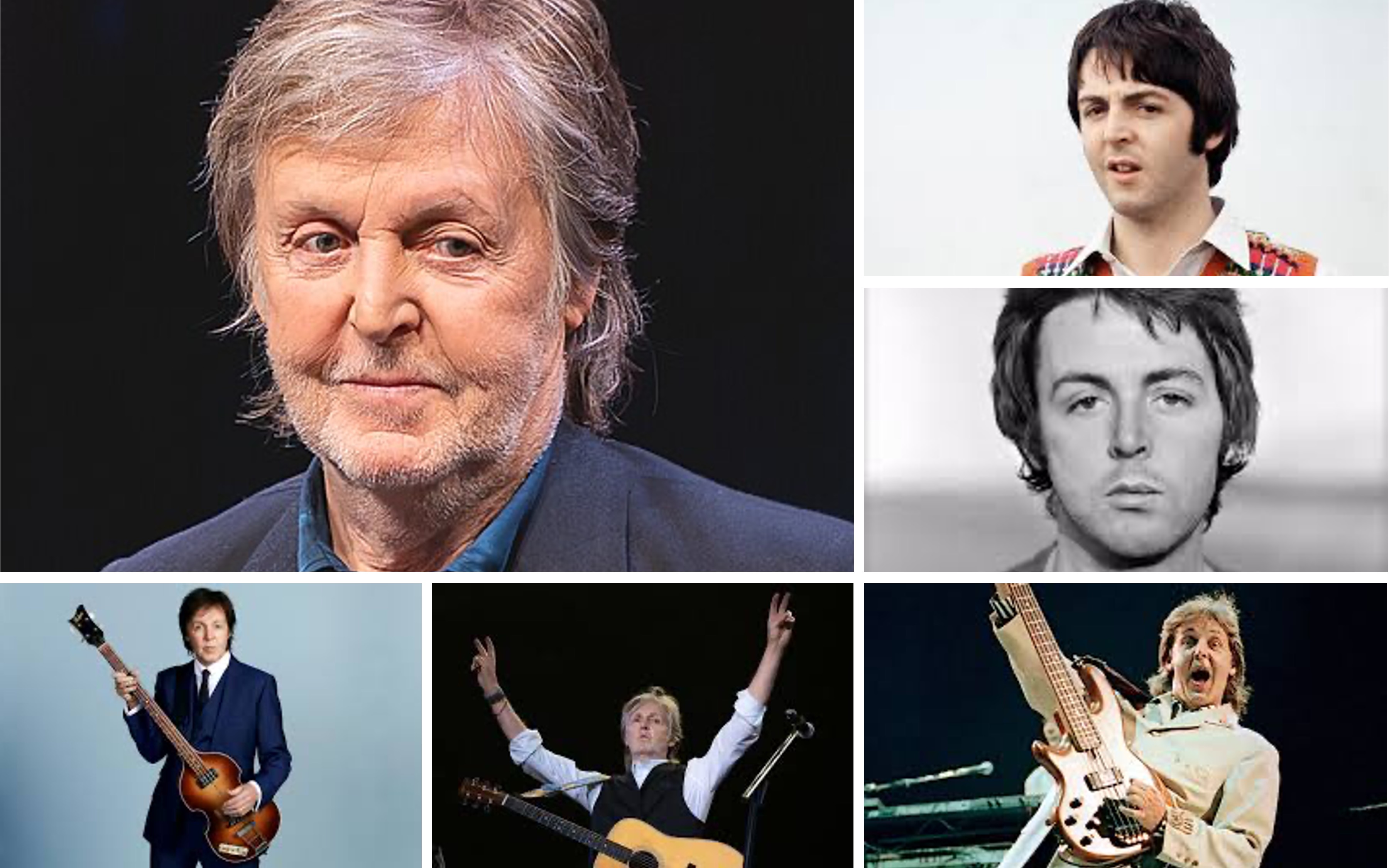
Paul McCartney is born in Liverpool on 18 June 1942. He taught himself to play the piano and guitar as a teenager. His father, a jazz musician, was a source of inspiration, as were rock & roll artists such as Little Richard and Buddy Holly. In 1957, he joined John Lennon’s skiffle group ‘The Quarrymen’.
It annoyed him that critics often attributed the success of his and/or John Lennon’s songs to the hype surrounding The Beatles. For this reason, he maintained a shadow discography for 60 years of songs he released under a pseudonym, initially Bernard Webb. Many of these songs were performed by others and became big hits, such as ‘Woman’, ‘A World Without Love’ and ‘Nobody I Know’ by Peter and Gordon, ‘One and One Is Two’ by The Strangles, ‘Come and Get It’ by Badfinger and ‘Love of the Loved’ by Cilla Black. When these songs received rave reviews, Paul laughed up his sleeve. Problems with the insincerity of some critics would haunt him throughout his life.
Discography
- McCartney (1970)
- Ram (1971)
- Wild Life (1971, with Wings)
- Red Rose Speedway (1973, with Wings)
- Band on the Run (1973, with Wings)
- Venus and Mars (1975, with Wings)
- Wings at the Speed of Sound (1976, with Wings)
- London Town (1978, with Wings)
- Back to the Egg (1979, with Wings)
- McCartney II (1980)
- Tug of War (1982)
- Pipes of Peace (1983)
- Press to Play (1986)
- Flowers in the Dirt (1989)
- Off the Ground (1993)
- Flaming Pie (1997)
- Driving Rain (2001)
- Chaos and Creation in the Backyard (2005)
- Memory Almost Full (2007)
- Kisses on the Bottom (2012)
- New (2013)
- Egypt Station (2018)
- McCartney III (2020)
McCartney (1970), Ram (1971) and Wild Life (1971)
Paul begins his solo career with the desire to make music without constraints. He does not want to immediately try to live up to the high expectations of critics and fans. The first album, McCartney (1970), consists of a series of intimate home recordings, including ‘Maybe I’m Amazed’, which you can listen to here:
This recording is made with members of his future band Wings.
The next album, Ram (1971), contains melodic and layered pop songs. Years later, it appeared that Paul made two versions of Ram. One of them has remained on the shelf. Paul was satisfied with the first version and wanted to focus on forming his new band so that he could go on tour.
The first album with Wings, Wild Life (1971), builds on the relaxed pop songs that had already been released. Here you can hear and see the performance of the title song ‘Wild Life’, filmed in The Hague (1972). Meanwhile, he made another single with Wings, ‘Hi, Hi, Hi’ (1973), which became a top 10 hit. The BBC boycotted the song for some time because of alleged references to drugs and sex.
Red Rose Speedway (1973) and Life and Let Die (1973)
With this album, Paul and Wings take a leap towards the quality that had become the norm during the last years of the Beatles. The album includes the mega-hit ‘My Love’. The album was a huge commercial success; critics thought that even more quality was within reach. Watch and listen to ‘My Love’ here:
Red Rose Speedway was intended to be a double album. Due to the moderate success of Paul McCartney and Wings’ previous album, the record company decided to release it as a single album, and once again some of the recordings ended up on the shelf. Many years later, when this album was remastered, the forgotten recordings resurfaced and the double album was finally released. Critics refer to it as a ‘forgotten masterpiece’. Listen to some of the ‘lost’ recordings here: ‘‘Out’ , ‘The mess’, ‘ Tragedy ‘, ‘Mama’s little girl’, ‘The medley’ and ‘Little lamb dragonfly‘.
After completing the recordings for ‘Red Rose Speedway’, Paul McCartney and Wings record the song ‘Life and Let Die’ from the James Bond film of the same name, which became a number one hit worldwide.
Band on the Run (1974), Venus and Mars (1975) and Wings at the Speed of Sound (1976)
Band on the Run (1974) is considered one of the best albums in rock and pop history. It is Paul McCartney’s most celebrated album in his post-Beatles era. Critics believe that the album approaches the level of the songs from the Beatles’ heyday. Listen to the title song:
Paul wanted to record the song somewhere abroad. It ended up being the EMI studio in Nigeria. Just before the crew was about to leave, drummer Danny Seiwell and guitarist Henry McCullough declined the honour. There was no time to find replacements, so Paul, his wife Linda Eastman and Denny Laine took it on together. The title of the album is often jokingly associated with the band members who left.
The album Venus and Mars (1975) was another big hit. The song ‘Listen to What the Man Said’ reached number one in the US.
McCartney & Wings went on a successful world tour after the release of these two albums. In the middle of this tour, the album ‘Wings at the Speed of Sound’ (1976) was released, which ended up in the upper echelons of the album charts. The single ‘Love Songs’ reached number one in the US.
The success of ‘London Town’ (1978) lagged somewhat behind that of previous albums. Although it reached number five in the US and the UK, the single ‘a Little Luck’ (1978) was the only one to become number one in the US. Most critics dismissed the album.
During the recording sessions, Paul also records the non-album single ‘Mull of Kintyre’ (1978). This song became the fourth best-selling single ever in the UK, scoring higher than old Beatles songs such as ‘She loves you’.
Listen to this last song here:
Back to the Egg (1979), McCartney II (1980), Tug of War (1982), Pipes of Peace (1983), Press to Play (1986), Flowers in the Dirt (1989)
The sales figures for ‘Back to the egg’ were not too bad, but critics dismissed this album. Timothy White (Rolling Stone Magazine) called it ‘the sorriest grab bag of dreck in recent memory’. After the release of this album, McCartney disbands his band Wings; he wants to move in the direction of electronic music, which required different forms of accompaniment.
Paul tries out various styles. McCartney II is experimental and, like McCartney I, a solo album in the true sense of the word: Paul plays all the instruments himself. The album was characterised as ‘new wave’, proto-electronica and eccentric synthpop. Composers such as John Cage, Cornelius Cardew and Luciano Berio were sources of inspiration. Others compared it to ‘Krautrock’, triple hop or called it ambient. The album rose to number one in the UK; the single ‘Up ‘ also became a number one hit. In my opinion, this song does not give a good impression of the album. Listen instead to ‘Secretary’ or ‘Nobody knows’.
You will hear the latter song here:
Critics were initially negative, but eventually the tide turned. Then, the album was hailed as a precursor to the sound of the 1980s: you should listen to it once in your life.
Tug of War (1982) This album also became number one in several countries and sold over a million copies in the US alone. Critics saw it as a distinct improvement on the standard Paul had set in recent years and were overwhelmingly positive: “the masterpiece everyone has always known Paul McCartney could make”, according to Stephen Holden (Rolling Stone). Three songs from the album reached the top: ‘Ebony and Ivory’ (with Stevie Wonder), ‘Tug of War’ and ‘Take It Away’. The recordings were suspended for two months when Paul learned that John Lennon had been shot dead.
Watch and listen to a studio recording of Tug of War here
Pipes of Peace (1983) This album was less well received than its predecessor, although two songs, ‘Say, Say, Say’ (featuring Michael Jackson) and the title track, reached the top of the charts. Jeff Strowe (Pop Matters) considers the album ‘most regrettable’.
Press to Play (1986) Sales of this album were lower than most of the previous ones, although it did reach the eighth place in the UK. The song ‘Press’ was the only top 30 hit. Critics were divided: ‘McCartney is dabbling in each of his strengths’ (Erlewine, All Music) and ‘No doubt about it, this is McCartney’s most rocking album in ages. Much of it’s catchy, most of it’s fun’ (Lynn Van Matre, Chicago Tribune).
Flowers in the Dirt (1989) received positive reviews; the album reached number one in the UK, among other places, and contained several hit singles, such as ‘My Brave Face‘.
The problem during the ten-year period in which these albums were released was that Paul lacks a counterpart to challenge him both in the creation and the performance of his music. He would continue his search for an inspiring producer while making his next albums.
His fans had not forgotten him. On 21 April 1989, he performs for 184,000 people in Rio de Janeiro during the ‘Paul McCartney World Tour’.
‘Classical’ music
The Royal Liverpool Philharmonic Orchestra asked him to write an oratorio for the orchestra’s 150th anniversary. Four other ‘classical’ compositions would follow. The reviews were negative: ‘too slow’, according to The Guardian. Nevertheless, the ‘Liverpool Oratorio’ took first place in the classical charts. Here it is:
McCartney’s second classical album, ‘Standing Stone’, was released in 1997.
The Fireman
Looking for a new challenge, Paul teams up with Martin Glover to form a new band, The Firemen. The group’s debut album, Strawberries oceans ships forest (1993), is an exploration of the emerging genre of electronic dance music, particularly ambient and trance. The album mainly uses samples from Paul’s latest album, Off the Ground, without mentioning his name or Martin Glover’s. This led to speculation, and eventually the record company confirmed McCartney and Glover’s involvement. You can listen here to ‘Universal Here, Everlasting Now’, a song typical of this album.
This album was followed by ‘Rushes’ (1998) and ‘Electric Arguments’ (2008), an intense experiment with a succession of soundscapes. The opening lyrics of the latter album, ‘Nothing Too Much Just Out of Sight’ is similar to ‘Helter Skelter’ (1968). The rough lyrics and uncompromising hard rock sound set an unexpected tone for The Fireman’s final album.
Off the Ground (1993), Flaming Pie (1997) and Driving Rain (2001)
These are mediocre pop albums. McCartney had a lot of fun making them, but they are neither innovative nor experimental.
Off the Ground (1993) This album did not achieve high chart positions, except for Germany, where it spent 20 weeks in the top 10. The single ‘Hope of Deliverance’ was also successful, particularly on the European mainland.
Flaming Pie (1997). This album reached number 2 in the US and UK charts. A total of 1.5 million copies were sold. The reviews from critics were positive. The best after Tug of War (1982). Three singles from the album reached the upper echelons: ‘Young Boy’, ‘The World Tonight’ and ‘Beautiful Night’.
Listen to ‘Young Boy’ here:
Driving Rain (2001)
On 11 September 2001, McCartney was on a plane in New York City when the terrorist attacks took place. He composed the song ‘Freedom’ and helped to organise the ‘Concert for New York City’, an all-star benefit concert at Madison Square Garden on 20 October 2001.
McCartney stopped pressing ‘Driving Rain’ so that ‘Freedom’ could be released as a hidden track (since the artwork had already been printed). ‘Driving Rain’ (2001) received good reviews, but sales figures remained at a historic low.
Paul toured extensively during this period, including in Eastern Europe, which explains the stagnation in album production in the first decade of the new millennium.
Chaos and creation in the backyard (2005)
Meanwhile, Paul continues to search for new musical challenges, so he sought collaboration with Nigel Goodrich, a ‘star producer’. He realised that he needed a sparring partner who was his equal. The two produced two songs to see if a collaboration would be fruitful. It turned out to be the case, although Nigel often wanted to go in a different direction and claimed veto rights on songs he didn’t like. Paul then thinks, “This is why I’m working with him.” The song ‘Friends to Go’ is dedicated to the late George Harrison. The first single released was ‘Fine Line’ (2005), followed by ‘Jenny Wren’, both of which appeared on the album and reached around 20th place in the charts.
Here you can hear a studio recording of Fine Line.
After the album’s release, critics responded positively for the fourth time in a row. The album is described as ‘unusually reflective and intimate-sounding’. In the US, the album scored high in the charts; in the UK, it scored much lower. Total sales reached 1.5 million copies.
Kisses on the Bottom (2012), New (2013), Egypt Station (2018) and McCartney III (2020)
Kisses on the Bottom (2012) contains only two original compositions by McCartney. The rest are covers of traditional pop music and jazz. It ens up in the highest echelons in both the US and the UK, with critics being positive, calling it “fun and touching” (Rolling Stone). Listen to McCartney’s song ‘My Valentine’ and to ‘Bye Bye Blackbird’ here:
New (2013) consists of new compositions only, and McCartney mainly choses young producers to work on it. This album and the single ‘New’ also scored high in the charts and critics were equally positive: “Most enjoyable record in years”.
Egypt Station (2018) A single featuring the songs ‘I Don’t Know’ and ‘On to Me’ was released a month before the album. The album reached number 1 in the US, for the first time since ‘Tug of War’ (1982). Once again, critics were positive: ‘The finest songs land here immediately and hum with urgency’ (Kitty Empire, The Observer).
McCartney III (2020)
McCartney III dates from the coronavirus period and, as in the previous instalments of the ‘McCartney trilogy’, Paul plays all the instruments. A nice detail is that Paul coordinated the release date of this album with that of Taylor Swift’s ‘Evermore’. It became his first number 1 solo album in the UK since ‘Flowers in the Dirt’ (1989); in the US it peaked at number 2. Critics were enthusiastic: ‘A playful gem’ (Rob Sheffield, Rolling Stone), ‘Weird, wonderful and whimsical: A real treat’ (Helen Brown, The Independent). Listen to the longer song ‘deep feeling’ and to one of the singles: ‘Find my way’below:
Special events (2010 – 2014)
- The Library of Congress Gershwin Prize for Popular Song is a prestigious award that has only been given to Stevie Wonder and Paul Simon before. In 2010 Paul McCartney was the third recipient of this award, presented by President Obama.
- In June 2012, McCartney closed Queen Elizabeth’s Diamond Jubilee concert outside Buckingham Palace with the songs ‘Let It Be’ and ‘Live and Let Die’.
- Paul closed the opening ceremony of the Summer Olympics in London on 27 July 2012 with ‘The End’ and ‘Hey Jude’ and invited the audience to join in the chorus.
- On 12 December 2012, McCartney performed with three former members of Nirvana (Krist Novoselic, Dave Grohl and Pat Smear) during the closing act of ’12-12-12: The Concert for Sandy Relief’ at Madison Square Garden in New York. The broadcast was watched by approximately two billion people worldwide. The concert was organised to raise money for the victims of Hurricane Sandy. Many artists participated in this benefit concert, including The Who, Bruce Springsteen, Alicia Keys, Eric Clapton, Billy Joel, The Rolling Stones and many others.
- A primetime special was recorded at the Ed Sullivan Theater on 27 January 2014 and broadcasted on 9 February 2014. The show celebrated the legacy of The Beatles and their groundbreaking performance on The Ed Sullivan Show in 1964. Entitled ‘The Night That Changed America: A Grammy Salute to The Beatles’, the show featured 22 classic Beatles songs performed by various artists, including Paul McCartney and Ringo Starr. You can watch and listen to the entire show here:
Another hidden gem: One Hand Clapping (1973, 2010, 2024)
This is yet another story about music and film recordings that have been gathering dust on the shelf for years. The film ‘One Hand Clapping’ was intended as a documentary about Paul McCartney and his band Wings. The film shows a live performance by the band at Abbey Road Studios, which was also recorded for release as an album. It features songs by McCartney, Wings and The Beatles. For some reason, the material was never released, although parts of the recording were included in several ‘special editions’ of other McCartney and Wings albums. This finally happened in 2010 with the original film.
The film ‘One Hand Clapping’ and the accompanying album have now been remastered and released. The film also premiered in cinemas on 26 September 2024, more than 50 years later than originally planned. The album and film are highly recommended. The album can be listened to here:
What else has Paul done?
Avant-garde art
While still at school in the 1950s, Paul was captivated by avant-garde artists such as Andy Warhol, Claes Oldenburg, Peter Blake, Willem de Kooning and Richard Hamilton. He has retained this interest throughout his life. In 1983, he started painting himself. His first exhibition was in Siegen in 1999. A year later, another exhibition opened in the UK. It included 500 canvases and took place at the Arnofini Gallery in Bristol.
Film music
In 1966, independently of the Beatles, he composed the film music for ‘The Family Way’. The soundtrack did not make it into the charts, but Paul won an Igor Novello Award for the best instrumental theme.
In 1981, Paul asked Geoff Dunbar to make a short, animated film, Rubert and the Frog Song. McCartney was the author and producer. The song ‘We All Stand Together’ from the film’s soundtrack was a big hit on the UK singles chart. You can listen to it here:
The controversial soundtrack to the film ‘Give My Regards to Broad Street’ flopped. One of the songs on it was ‘No More Lonely Nights’.
In 1992, he collaborated with Dunbar on an animated film about the work of French artist Honoré Daumier. This earned McCartney a BAFTA award.
Animal rights
Paul and Linda were committed vegetarians and supported international organisations working for animal rights. They also supported organisations fighting the spread of landmines and poverty, as well as music education.
Author
Paul has written several children’s books. His first was High in the Clouds: An Urban Furry Tail (2005), in collaboration with writer Philip Ardagh and animator Geoff Dunbar. The book is about a squirrel whose home in the forest is destroyed by property developers. McCartney and Dunbar turned it into an animated film consisting of several episodes.
Biographies
There are countless biographies about Paul McCartney. Two stand out because he collaborated on them himself. These are: ‘Many Years From Now’ by Barry Miles and, more recently, ‘The Lyrics’, which he wrote himself (2021).
Miles has spent hundreds of hours with McCartney. The poet Paul Muldoon helped Paul write the second book. Both books are completely different. ‘Many Years From Now’ is a factual account of Paul’s life and comprises 617 pages. ‘The Lyrics’ tell the story of his life through 154 old and new song lyrics, resulting in an equal number of standalone short stories.
Looking back
There is no doubt that Paul McCartney has the most versatile career of any former Beatle, both before and after the break-up of the Beatles. His work includes pop and rock songs and more experimental electronic tracks such as the McCartney trilogy and The Firemen.
Many of his songs became number one hits in the US or the UK, such as ‘Uncle Albert’ (1971), ‘My Love’ (1973), ‘Life and Let Die’ (1973), ‘Band on the Run’ (1973), ‘Listen to What the Man Said’ (1975), ‘Silly Love Songs’ (1978), ‘Mull of Kintyre’ (1978), ‘With a Little Luck’ (1978), ‘Coming Up’ (1980), ‘Ebony and Ivory’ (1982), Tug of War (1982), Pipes of Peace (1983), Take It Away (1982), Flowers in the Dirt (1989), Egypt Station (2018), McCartney III (2020).
Many albums also reached number one status on the album charts in the US or the UK, such as ‘McCartney I’ (1970), ‘Band on the Run’ (1974), ‘Venus and Mars’ (1975), ‘Wings at the Speed of Sound’ (1976), Flowers in the Dirt (1989), McCartney II (1980), Tug of War (1982), Egypt Station (2018) and McCartney III (2020).

 Music: Listen, Look and Enjoy