
From gospel to soul; from soul to funk

Joss Stone: Next queen soul?

I am looking for the origins of popular music. So far, I focused on the US. The reason is the unique fusion of styles with African and with European roots. Of the former, worksongs and spiritualsboogiewoogieragtime and rhythm & blues have already been covered. Regarding the styles with European roots, I paid attention to country & western. A lot of new variations have developed from these roots. From rhythm & blues and influenced by country & western, rock & roll emerged. Worksongs and spirituals laid the foundation for gospels, soul and then funk. From here, a line can again be drawn to disco and dance, but that will be done in the next exploration.

Spirituals and gospels

Many African slaves adopted Christianity over successive generations. Some songs (worksongs) they sang while working had therefore taken on biblical content. By singing about the hardships of the Jewish people, they could also express their own misery. Songs like these are called spirituals. They were handed down from generation to generation. 

Worksongs and spirituals were considered cultural heritage after the abolition of slavery in 1867. In my exploration of worksongs, I have shown how new popular songs emerged from spirituals but also how they influenced the performing arts, ranging from choral singing, symphonies, operas and musicals.

Spirituals have additionally given impetus to ‘gospels’, religious songs. The name ‘gospel’ is believed to have been first used in 1874. Listen to the Mississippi Mass Choir sing “When I rose this morning” here

Gospels were sung in concert halls as well as during church services. Famous are the Golden Gate Quartet (“Go down Moses“). Think also of Mahalia Jackson (“Precious Lord, Take my hand“). Elvis Presley also recorded several albums with gospels. Another example is Little Richard (“Silent  Night“).  A more recent and ‘contemporary’ rendition is “Open my heart” by Yolanda Adams. 

Soul

The term ‘soul’ refers to gospel-like secular music and has been used since the 1960s. You won’t note significant difference with gospel songs. Soul plays a role in the movement for equal civil rights and has ‘boosted’ the self-confidence of the black community. The sound of soul is inextricably linked to Ray Charles. Here he sings “Georgia on my mind”

Sam Cooke (“Bring it home to me“), Jackie Wlson (“She’s alright“), Solomon Burke, (“Cry to me” and “Just out of reach“) as well as Ike & Tuna Turner (“A fool in love” and “It’s gonna work out fine“) predominantly sing soul. Sly and the family Stone (“It’s a family affair“), Curtis Mayfield (“Move it up“) and, later, Prince (“Purple rain“) are called representatives of “progressive soul”, which is a bit more sophisticated and had somewhat higher artistic pretensions.

The most important soul singer was undoubtedly Aretha Franklin (“Respect” and “Do Right Woman, Do Right Man“). Here she sings “I Never loved a man (The way that I love you)” at the White House in the presence of President Obama.

Several local genres emerged during the 1960s. The most influential was the Motown style from Detroit (Motown was a record company). The songs were both rhythmic and melodic. The latter was enhanced by the addition of violins, brass and choruses. 

Artists from this “stable” include: the Supremes (“Baby love“), “The Temptations (“Papa was a rolling stone“), the Four Tops (“Reach out, I’ll be there), Stevie Wonder (“Superstition” and “Isn’t she lovely“), Marvin Gaye (“What’s going on“) and Diana Ross (“Upside down“).  

The motown style laid the foundations for disco, which I will go into later. You can already hear and see this in “Taste of bitter love” by Gladys Knight & The Pips, which you can listen to and watch here

By comparison, a recording by Booker T & the MGs (“Melting pot“) is an instrumental song just like the famous “Green onions“. You can immediately hear that this song is a lot sultrier. This is typical of the Memphis style. The Hammond organ comes strongly to the fore here. All the big cities had their own variant like this; I won’t go into that.

There are also several white soul artists in the UK and in the US – ‘blue-eyed’ soul acts. In the 1960s, these mostly adopted the sound of Motown. 

Examples of ‘blue-eyed soul acts are: The Spencer Davis Group (“Gimme  some  loving“), Steve Winwood, here with Carlos Santana (“Why  can’t we live together“), Van Morrison, here with Solomon Burke (“Fast Train“) and Them (“Gloria“). 

In the 1970s, among others, Petula Clark (“Downtown“), Cilla Black (“Anyone who has a heart“) and Tom Jones (“Green green grass of home“) can be mentioned with this in the same breath.  As the Years progressed, a more contemporary ‘soul’ sound emerged. Think of George Michael (“Freedom“), Sade (“Smooth operator“), Simply Red (“Holding back the years“) , David Bowie (“Heroes“). Again later followed the likes of Amy Winehouse (“You know I ‘am no good“) , Adele (“Rolling in the deep“), Duffy (“Mercy“) and the woman with the incomparable voice, Joss Stone (“Midnight train to Georgia” and “Son of a preacher man“). 

Joss Stone is a serious candidate to succeed Aretha Franklin as ‘Queen of soul’. Here you can see Josh in “Here comes the rain again”, together with guitarist Dave Stewart in a particularly expressive ‘soul’ performance. 

As the years progressed, soul blended with other genres, each of which, moreover, evolved. But the spirit of soul remains: expressive ‘narrative’ vocals, brass instruments and tight rhythm.

Funk

Several soul artists developed their style during the 1960s towards funk, even more rhythmic than soul and especially danceable. The powerful and complex rhythmic figures (‘grooves’) are more important than the chords and melody. These figures are initiated by the bass guitar and the drums and other percussion instruments. Because it is dance music, the songs tend to be long. Here, drummers, horns and guitarists were given plenty of room to improvise. The term ‘funk’ refers to the smell of a dancing crowd.

Of great significance for the development of funk was with James Brown. From him comes the accentuation of the first beat of each bar, the ‘downbeat’, where in other styles the second and fourth beats are accentuated, the ‘backbeat’. You can hear “Cold sweat” by James Brown & The Famous Flames” (1969) here. The rhythm characteristic of funk is easily recognisable and you can also enjoy James Brown’s famous dance moves. 

In the 1970s, funk reached maturity. Let me mention a few artists, which many will remember: Earth, Wind & Fire (“September“), Sly & the Family Stone (“Thank you“), Isley Brothers (“Its your thing“), Chaka Khan – the Queen of funk – (“I’ am every woman“) and Chic (“Le Freak“). 

Of course, we should not leave out Candy Dulfer and her band “Funky Stuff”. Here, she plays and sings “The neighbourhood”.
Ragtime

Jazz emerged in the early 20th century from a series of musical styles that in turn resulted from cross-pollination of African-American influences and music brought by other immigrants. One of these styles was ragtime, which in turn evolved from boogie woogie.

Look and listen by way of introduction, to the Harlem Rag, composed by Tom Turpin in 1897. He, like many others, had taught himself to play the piano. Here, the composition is played by Florian Krüger.

 Ragtime is portrayed in countless films as the sultry rhythm in a saloon, played by a straw-hat-clad pianist with his sleeves rolled up, surrounded by ladies waiting for gentlemen to join them upstairs. This was exactly how it was in ‘the Rosebud’, the saloon where Tom Purpin played his songs. There were dozens of such pubs in the red-light districts of St Louis and New Orleans. Ragtime was probably for this reason mainly music for the piano.

Ragtime music has a tight and simple bass part, more varied than the boogie-woogie’s one. The melody plays to the rhythm set by the bass. The notes of the playful melodies fall just a little earlier or a little later than you expect them. ‘Ragged time’ means as much as torn measures. I speak emphatically of melodies, because the boogie woogie consisted mainly of groups of melodic and rousing sounds. This was also because of the improvised nature of many boogie woogies. 

The founder of ragtime is undoubtedly Scott Joplin. He was born in Texas in 1868, the son of an ex-slave who tried to earn a living as a violinist; his mother played the banjo. Scott also learnt to play guitar and bugle and from the age of 13de led the existence of an itinerant musician. His second-best-known song is the Maple Leaf Rag, played here by Dario Ronchi to mark the 100th anniversary of his death, in 1916. 

Scott Joplin wrote 504 different ‘rags’ in his lifetime, one ballet opera – Ragtime Dance – and two ragtime operas, A Guest of Honour and ‘Treemonisha’. 

The ragtime went in different directions: inspiring ‘classical’ composers, incorporation into jazz as ‘dixieland’ music, and it was also the basis for simple pieces for wind orchestras. Western composers also became influenced by ragtime music. In 1918, Igor Strawinsky’s piece ‘Rag-Time’ was premiered. A musical work for 11 instruments. It lasts over 5 minutes.

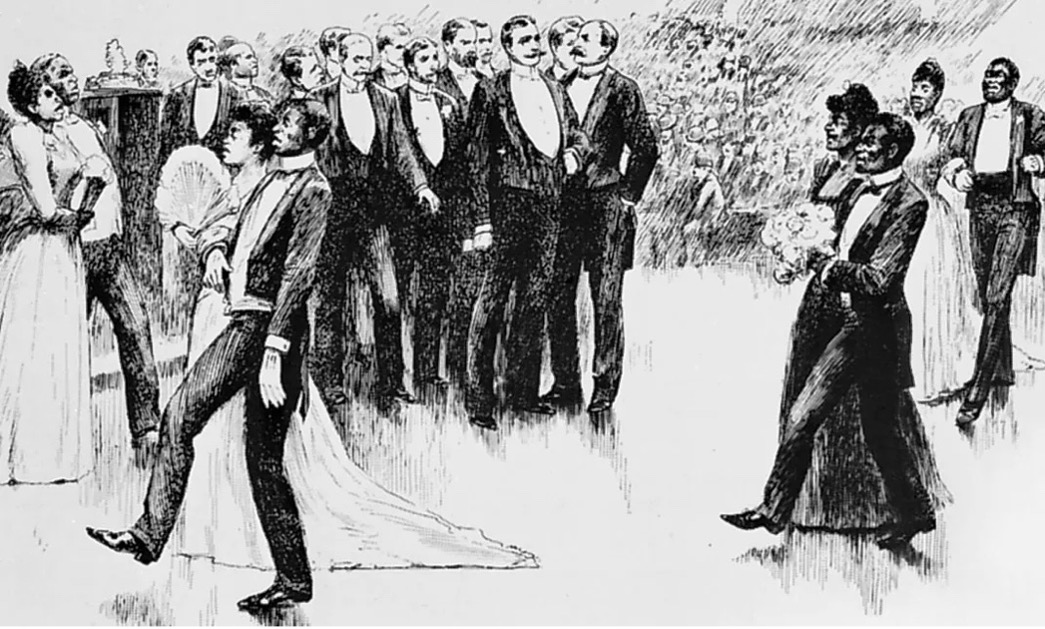
Early in the 20ste century, ragtime was discovered as the perfect dance music for the popular cakewalk. Essentially, dance couples form a square and each couple performs a silly dance around the square.  A jury judges the performance; among others by looking at the ladies’ elegance and the men’s ingenuity. The highest-rated couple received a richly-decorated cake. 

There were numerous variations. The cakewalk was originally performed by Negro slaves, for the amusement of their masters in which the classical form of ballroom dancing from the upper classes was somewhat ridiculed.

Slaves were still allowed to mock the ballroom of ‘high society; but as it went with all modern dances, ‘high society’ adopted them almost immediately. The dance below dates from around 1900 and played here by the Academy of Danse Libre.

Furthermore, the cakewalk can be practiced in some dance-schools and provides a lot of fun for both the dancers and the audience.  We are then approaching the true meaning of the English word ‘ro rag’, which is to have fun and walking back and forth wildly.

As mentioned, the Maple Leaf Rag is Scott Joplin’s second most popular ‘rag’.  In his time, it was probably the most popular. Listen now to the most popular ragtime melody at the present day. This one is also performed by Dario Ronchi.

The ambience is quite different from the brothels in which Tom Terpin and Scott Joplin played their ‘rags’ in the late 19de century.

Indeed, it is the title tune of the film ‘The Sting’ – exactly 50 years ago – directed by George Roy Hill, starring Paul Newman, Robert Redford and Robert Shaw. The film’s screenplay was written by David S. Ward and based on the true story of the scams of brothers Fred and Charley Gondorf, as described in David Maurer’s book “The Big Con: The Story of the Confidence Man” (1940). The film won seven Oscars in 1973 and revenues were huge for the time: $160,000,000. But since then, everyone knows what a “rag” is.

Worksongs

Recently, I wrote a series of posts about the evolution of the music that immigrants from Europe brought to the US—country & western—and how it blended with rhythm & blues, which is mainly rooted in the African-American tradition. Rock ‘n’ roll, folk, ‘Americana’ and eventually Shania Twain and Taylor Swift positioned in this evolution. 

In the next episodes I take the opposite route. The starting point is the African-American tradition, beginning with the songs sung by slaves, which evolved through spirituals, gospel, and blues into rhythm & blues, Motown, funk, disco, and dance.

It is often said that jazz descended from African music. This is only partially true. Still, music in the Americas would have sounded completely different today if millions of slaves had not been deported to this part of the world. Slaves were not allowed to play the instruments they used in Africa. What was left of African music mixed with music brought by other immigrants and English replaced African languagesounded like, is only known since by a few gramophone records made in the 19de century. Earlier, though, there were wax rolls intended for pianolas, the first of which dates from 1826.

The most direct influence of African music on music in the United States, spirituals and gospel songs, in the first place,  comes from songs, which slaves sang while working. They did so for centuries, and the style has similarities with traditional African singing. Especially the role of a ‘cantor’ interacting with a ‘the choir’. As mentioned, drums are missing.

This recording is an example of a worksong, lyrics and music have been handed down.  The song ‘Po Lazarus’ is sung by James Carter & the Prisoners. The slaves pictured above were working to expand the railway network. Otherwise, they worked on plantations and building dykes.

This song is about a slave captured for the sheriff and shot dead. In other songs, slaves sing of their misery or give ‘disguised’ messages about ways to escape.  This was usually done by jumping on a train. Front singers were also hired who could rouse the slaves, so they worked harder.  

The song that follows next is also advice to slaves who want to escape. Namely wade through the water so the dogs cannot chase you. It is a contemporary rendition by an unknown artist.

The theme of trains played a role in many worksongs, as mentioned above, and much later after the abolition of slavery, this was still the case. This is Sister Rosetta Tharpe with “This Train”.  The recording is from 1964.

As more slaves converted, the songs more often took on a religious content. In the Bible, slaves found comparative material to their own suffering, for example the exile of the Jewish people in Egypt, hence titles such as: Example: Go Down Moses. The songs that emerged then were later sung by world-famous singing groups, like the Golden Gate Quartet here. This recording clearly explores the style of worksongs, but in highly polished form.

To some extent, the development of worksongs outlined so far was limited to what can be called ‘entertainment music’ and ‘religious music’.  But what happened in Europe with folk music, composers also drew inspiration from it. Performance no longer took place in pubs, churches and music halls, but in concert halls. There was talk of ‘Black Art Music’. 

Thus, in the mid-19de century, slavery had not yet been abolished, a choir, the Original Fisk Jubilee Singers, was founded at the University of Nashville.  This choir still exists to this day, more than 150 years later, and performs worldwide with, among other things, compositions dating back to the original worksongs, as far as surviving. You will also hear ‘Wade in the Water’ at a 2019 performance.

Incidentally, Miles Davis’ mother was also a member of the Fisk Jubilee Singers.

Finally, a performance by the Cannonball Adderley Sixtet from 1968. The song is called Work Song.  In content and form, it has nothing to do with a worksong. The composer Nathan Adderley, who plays cornet in his brother’s sixtet was inspired by it because in his youth he saw a group of prisoners working in front of their home in Florida. This was a ‘chain gang’, because of the chain with a steel ball at the end, with which they were connected. They too sang in songs in the tradition of the slaves.

Cannonball Adderly brings us right in the middle of the jazz tradition. Jazz is rhythmic music, partly improvised, with some members of the orchestra playing a solo. The chorus is often recognizable and easy on the ears; the interludes are complex and usually require a lot of technique. Jazz musicians usually seek to distinguish themselves from pop music through their craftsmanship, but the boundaries are fluid and repeatedly crossed deliberately and rightly.