Automated cars; an uncertain future (7/8)

For more than a decade, car manufacturers have been working on technology to take over driver’s actions. A Lot  of money has been invested in this short period and many optimistic expectations have been raised, but no large-scale implementation of the higher SAE levels resulted so far. Commercial services with robotaxi’s are scarce and still experimental.

Misleading photo: This is not allowed in any country, unless the car is parked

The changing tide

Especially in the period 2015 – 2018, the CEOs of the companies involved cheered about the prospects; soon after, sentiment changed. In November 2018, Waymo CEO John Krafcik said that the spread of autonomous cars is still decades away and that driving under poor circumstances and in overcrowded cities will always require a human driver. Volkswagen’s CEO said fully self-driving cars “may never” hit public roads.

The companies involved are therefore increasingly concerned about the return on the $100 billion invested in the development of car automation until the end of 2021. The end of the development process is not yet in sight. Much has been achieved, but the last 20% of the journey to the fully autonomous car will require the most effort and much more investment. Current technology is difficult to perfect. “Creating self-driving robotaxi is harder than putting a man on the moon,” said Jim Farley, CEO of Ford, after terminating Argo, the joint venture with Volkswagen, after the company had invested $100 million in it.

The human brain can assess complex situations on the road much better than any machine. Artificial intelligence is much faster, but its accuracy and adaptability still leave much to be desired. Driverless cars struggle with unpredictability caused by children, pedestrians, cyclists, and other human-driven cars as well as with potholes, detours, worn markings, snow, rain, fog, darkness and so on. This is also the opinion of Gabriel Seiberth, CEO of the German computer company Accenture, and he advises the automotive industry to focus on what is possible. Carlo van de Weijer, director of Artificial Intelligence at TU Eindhoven, agrees: “There will not be a car that completely takes over all our tasks.”

Elon Musk, on the other hand, predicted that by 2020 all Tesla’s will have SEA level 5 thanks to the new Full Self Driving Chip. In 2023 we know that its performance is indeed impressive. Tesla may therefore be the first car to be accredited at SAE level 3. That is not yet SAE level 5. The question is whether Elon Musk minds that much!

The priorities of the automotive industry

For established automotive companies, the priority is to sell as many cars as possible and not to make a driver redundant. The main objective is therefore to achieve SAE levels 2 and possibly 3. The built-in functions such as automatic lane changing, keeping distance, and passing will contribute to the safe use of cars, if drivers learn to use them properly. Research shows that drivers are willing to pay an average of around $2,500 for these amenities. That is different from the $15,000 that the beta version of Tesla’s Full Self Driving system costs.

The automotive industry is in a phase of adjusting expectations, temporizing investments, downsizing involved business units, and looking for partnerships. GM and Honda are collaborating on battery development; BMW, Volkswagen and Daimler are in talks to share R&D efforts for autonomous vehicles; and Ford and VW have stopped developing an autonomous car and are working together on more realistic ambitions.

Safety issues at SAE level 3

But even with a focus on SAE level 3, the problems do not go away. The biggest safety problem may well lie at this level. Elon Musk has suggested for years that Tesla’s autopilot would allow drivers to read a book or watch a movie. All they must do is stay behind the wheel. They must be able to take control of the car if the automatic system indicates that it can no longer handle the situation. Studies in test environments show that in this case the reaction time of drivers is far too long to prevent disaster. An eye on the road and a hand on the wheel is still mandatory everywhere in the world, except in  few paces for cars accredited at SEA level 4 under specified conditions.

The assumption is that the operating system is so accurate that it indicates in time that it considers the situation too complex. But there are still many doubts as to whether these systems themselves are sufficiently capable of properly assessing the situation on the road at all times. Recent research from King’s College London showed that pedestrian detection systems are 20% more accurate when dealing with white adults than when dealing with children and 7.5% more accurate when dealing with white people compared to people with dark skin.

In the next post I will go into more detail about the legislation and what the future may bring.

First driverless taxis on the road 6/8

Since mid-2022, Cruise and Waymo have been allowed to offer a ride-hailing service without a safety driver in a quiet part of San Francisco from 11pm to 6am. The permit has now been extended to the entire city throughout the day. The company has 400 cars and Waymo 250. So far, it has not been an unqualified success.

A turbulent start

In a hilarious incident, an empty taxi was pulled over by police; it stopped properly, but kept going after a few seconds, leaving the officers wondering if they should give chase. The National Highway Traffic Safety Administration is investigating this incident, as well as several others involving Cruise taxis stalling at intersections, and the Fire Department reports 60 incidents involving autonomous taxis.

Pending further investigation, both companies are only allowed to operate half of their fleet. In addition to the fire department and public transport companies, trade unions are also opposed to the growth of autonomous taxis. California’s governor has rejected the objections, fearing that BigTech will swap the state for more car-friendly ones. It is expected that autonomous taxis will gradually enter all major US cities, at a rate just below that of Uber and Lyft.

Cruise has already hooked another big fish: In the not-too-distant future, the company will be allowed to operate autonomous taxis in parts of Dubai. 

The number of autonomous taxi services in the world can still be counted on one hand. Baidu has been offering ride-hailing services in Wuhan since December 2022, and robot taxis have been operating in parts of Shenzen since then.

Singapore was the first city in the world to have several autonomous taxis operating on a very small scale. These were developed by nuTonomy, an MIT spin-off, but the service is still in an experimental phase. Another company, Mobileye, also plans to start operating in Singapore this year. 

The same company announced in 2022 that it would launch a service in Germany in 2023 in partnership with car rental company Sixt 6, but nothing more has been heard. A survey by JD Power found that almost two-thirds of Germans do not trust ‘self-driving cars’. But that opinion could change quickly if safety is proven and the benefits become clear.

What is it like to drive a robotaxi?

Currently, the group of robotaxi users is still small, mainly because the range is limited in space and time. The first customers are early adopters who want to experience the ride. 

Curious readers: Here you can drive a Tesla equipped with the new beta 1.4 self-driving system, and here you can board a robotaxi in Shenzhen.

The robotaxis work by hailing: You use an app to say where you are and where you want to go, and the computer makes sure the nearest taxi picks you up. Meanwhile, you can adjust the temperature in the car and tune in to your favourite radio station.

Inside the car, passengers will find tablets with information about the journey. They remind passengers to close all doors and fasten their seatbelts. Passengers can communicate with remote support staff at the touch of a button. TV cameras allow passengers to watch. Passengers can end the journey at any time by pressing a button. If a passenger forgets to close the door, the vehicle will do it for them. 

The price of a ride in a robotaxi is just below the price of a ride with Uber or Lyft. The price level is strongly influenced by the current high purchase price of a robotaxi, which is about $175,000 more than a regular taxi. Research shows that people are willing to give up their own cars if robotaxis are available on demand and the rides cost significantly less than a regular taxi. But then the road is open for a huge increase in car journeys, CO2 emissions and the cannibalisation of public transport, which I previously called the horror scenario.

Roboshuttles

In some cities, such as Detroit, Austin, Stockholm, Tallinn and Berlin, as well as Amsterdam and Rotterdam, minibuses operate without a driver, but usually with a safety officer on board. They are small vehicles with a maximum speed of 25 km/h, which operate in the traffic lane or on traffic-calmed streets and follow a fixed route. They are usually part of pilot projects exploring the possibilities of this mode of transport as a means of pre- and post-transport.

Big Tech’s monopoly

Two recent books deal with this problem in depth and call for tailored actions. These books are Shoshana Zuboff’s The Age of Surveillance Capitalism: The Fight for a Human Future at the New Frontier of Power (2019) and Cory Doctorow’s How to destroy surveillance capitalism (2021). Zuboff describes in detail how Google, Amazon and Facebook collect data with only one goal, to entice citizens to buy goods and services: 

Big Tech’s product is persuasion. The services — social media, search engines, maps, messaging, and more — are delivery systems for persuasion.

The unprecedented power of Big Tech is a result of the fact that these companies have become almost classic monopolies. Until the 1980s, the US had strict antitrust legislation: the Sherman’s act, notorious for big business. Ronald Reagan quickly wiped it out in his years as president, and Margaret Thatcher did the same in the UK, Brian Mulroney in Canada, and Helmut Kohl in Germany. While Sherman saw monopolies as a threat to the free market, Reagan believed that government interference threatens the free market. Facebook joins in if it sees itself as a ‘natural monopoly’: You want to be on a network where your friends are also. But you could also reach your friends if there were more networks that are interoperable. Facebook has used all economic, technical, and legal means to combat the latter, including takeover of potential competitors: Messenger, Instagram, and WhatsApp.

In the early 21st century, there was still a broad belief that emerging digital technology could lead to a better and more networked society.

Bas Boorsma: The development of platforms empowered start-ups, small companies, and professionals. Many network utopians believed the era of ‘creative commons’ had arrived and with it, a non-centralized and highly digital form of ‘free market egalitarianism’ (New Digital Deal, p.52). Nothing has come of this: Digitalization-powered capitalism now possesses a speed, agility and rawness that is unprecedented (New Digital Deal, p.54). Even the startup community is becoming one big R&D lab for Big Tech. Many startups hope to be acquired by one of the tech giants and then cash in on millions. As a result, Big Tech is on its way to acquire a dominant position in urban development, the health sector and education, in addition to the transport sector.

Thanks to its monopoly position, Big Tech can collect unlimited data, even if European legislation imposes restrictions and occasional fines. After all, a lot of data is collected without citizens objecting to it. Mumford had already realized this in 1967: Many consumers see these companies not only as irresistible, but also ultimately beneficial. These two conditions are the germ of what he called the megatechnics bribe.

The only legislation that can break the power of Big Tech is a strong antitrust policy, unbundling the companies, an absolute ban on acquisitions and rigorous taxation. In addition, governments should take back control of technological development, as they did until the end of the last century. Democratic control of the development of technology is an absolute precondition! 

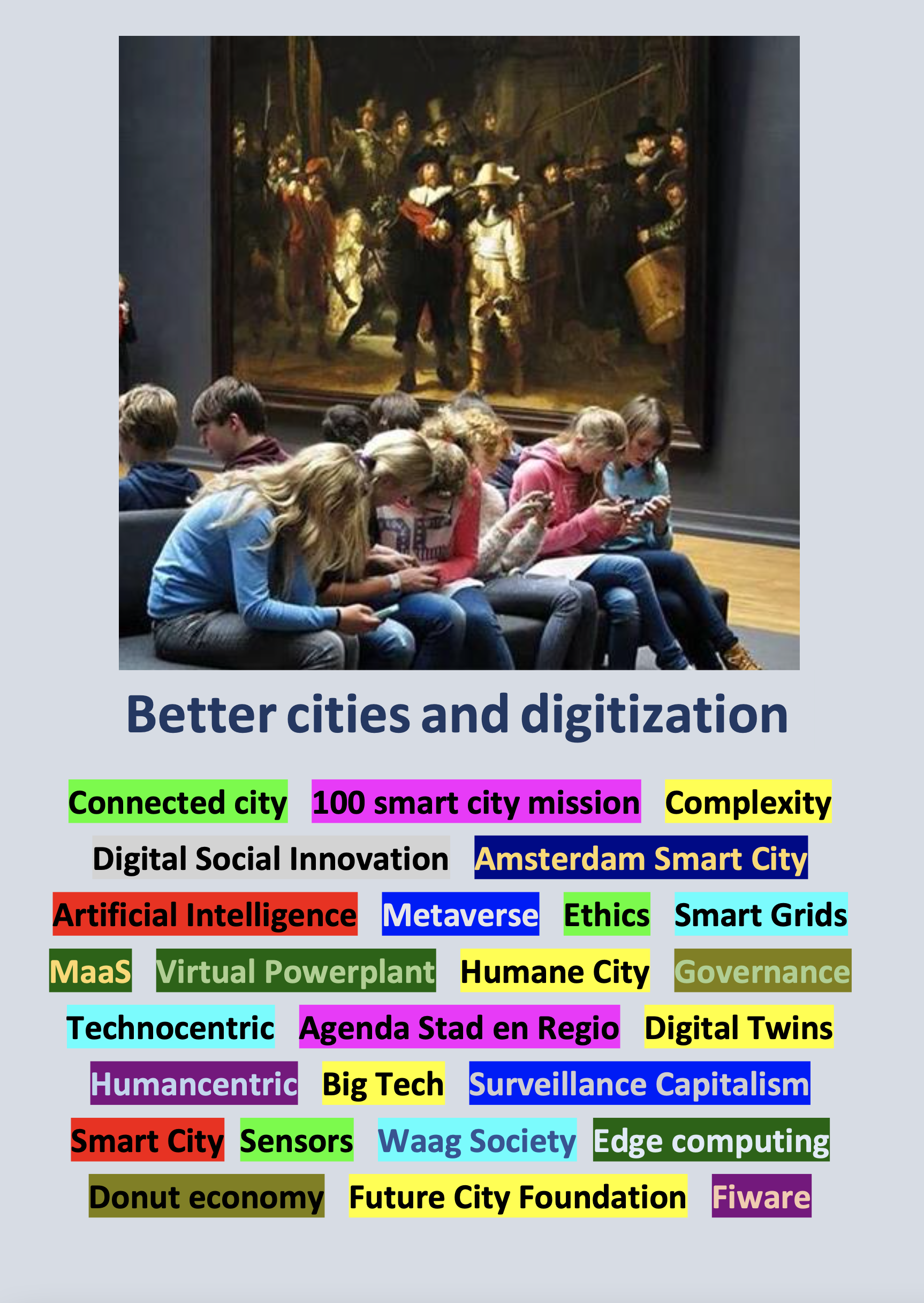
This post based on by the new e-book Better cities, the contribution of digital technology.  Interested? Download the book here for free (90 pages)

Content:

Hardcore: Technology-centered approaches

1. Ten years of smart city technology marketing

2. Scare off the monster behind the curtain: Big Tech’s monopoly

Towards a humancentric approach

3. A smart city, this is how you do it

4. Digital social innovation: For the social good

Misunderstanding the use of data

5. Digital twins

6. Artificial intelligence

Embedding digitization in urban policy

7. The steps to urban governance

8. Guidelines for a responsible digitization policy

9. A closer look at the digitization agenda of Amsterdam

10. Forging beneficial cooperation with technology companies

Applications

11. Government: How digital tools help residents regaining power?

12. Mobility: Will MaaS reduce the use of cars?

13. Energy: Smart grids – where social and digital innovation meet

14. Healthcare: Opportunities and risks of digitization

Wrapping up: Better cities and technology

15. Two 100 city missions: India and Europe

Epilogue: Beyond the Smart City