
From ‘rock & roll to ‘rock’

From ethnical to age group based division of musical preferences

in the second half of the 1950s rock & roll was a previously unprecedentedly popular type of music. But ‘rock & roll’ was played in the black community in the US much earlier and was simply called ‘rhythm and blues’, boogie-woogie or jazz. Examples include: “Roll ’em Pete” by Big Joe Turner and pianist Pete Johnson (1939), “Rocking this house” by Memphis Slim and the House Rockers (1946), “Rock and Roll” by Wild Bill Moore (1948), “Rock the joint” by Jimmy Preston (1949), “Saturday night fish fry” by Louis Jorden (1949) and “Rocket 88” by Jackie Brenston.

The following short film (15 minutes) shows many artists who can be retrospectively classified under the ‘rock & roll’ label. The influence of Afro-American roots, boogie-woogie in particular, is clearly audible.

While the term ‘rock and roll’ was well known, it did not refer to a type of music in the beginning. It was the name of the movement of a ship on the waves (‘rocking and rolling’) and later took on an explicitly sexual meaning when, among others, Trixie Smith sings ‘My (man) rocks me with one steady roll’ in 1922 or Billy Ward ‘I rock ’em roll ’em all night long’ in 1951.

Disk jockey Alan Feed was the first who used the term in 1951 as a designation for a type of music. His radio show was listened to by both white and black American youths. ‘Rock and roll’ has been said to be the first style of music to appeal to a specific age group and not an ethnic group as had been the case in the US until then. With that, the term is also linked to the development of a youth culture, with its own clothing, style of going out and dancing. The twist is inextricably linked to rock and roll. 

The genre’s breakthrough was caused by white musicians – or perhaps better their record labels – such as Bill Haley and his Commets with “Rock the joint“(1952), which had previously been sung by Jimmy Preston, “Rock around the clock” (1954), and “Shake, rattle and roll” previously sung by Big Joe Turner. 

The song “Rock around the clock” only became a world hit in 1955 thanks to the film ‘Blackboard Jungle’, a film in which later icon Sidney Poitier debuted. For the first time, riots broke out with fans wanting to attend a performance by the group. You can see Bill Haley and his Comets (and his audience) at work here

Bill Haley’s other hits included “See you later alligator” ,” Rock-a-beatin’ boogie“, “Rip it up“, “Hot dog buddy buddy” and more….

Bill Haley’s fame declined rapidly; when Elvis Presley appeared on the scene and appeared to have much greater sex appeal, his fans turned their backs on him. But first and foremost, he had a fantastic voice. Bill Haley was giant on whose shoulders, Elvis could glory. Here you can watch “Ready Teddy” (1957) on the Ed Sullivan Show. Usually only his upper body is in view, as people found the jerky movements with his lower body offensive to viewers.

In an earlier post, I  have explored his songs.

Rockability: Cross-over between rock and roll and hillbilly music

Others who rode the wave of rock & roll were Johnny Cash with “Folsom prison Blues” and, of course, Buddy Holly, whose career ended by a plane crash (1959). Buddy Holly gained great fame with songs “Peggy Sue“, “Oh boy” and “That will be the day“. Here you can listen to Peggy Sue during a performance on the Ed Sullivan show (1957).

Incidentally, some black artists did gain recognition as rock & roll artists, such as Little Richard, here with “Long tall Sally“(1955, with Bill Haley in the audience), Chuck Berry with “Johnny B. Goode“(1958) and Fats Domino. In 1957, the latter said: ‘What they call rock ‘n’ roll now is rhythm and blues. I’ve been playing it for 15 years in New Orleans’.

The now next song “Jambalaya” was certainly not meant to be rock and roll, but the musicians didn’t care about that and the audience even less. The musicians are none others than Fats Domino, Jerry Lee Lewis, Ray Charles, Ron Wood (now Rolling Stones) and Paul Shaffer. The totally revved-up audience provides the background ‘vocals’ (well, background….).

Elvis Presley was well acquainted with and greatly admire ‘black’ rock & roll artists.  When he was called ‘King of rock & roll’ he held it off by referring to Fats Domino, in his opinion (rightly) the only singer to whom this title was appropriate. 

The record industry, which was responsible for landing Bill Haley and Elvis Presley, later thought it would do well to launch a somewhat more polished version of rock & roll that was accessible to a wider audience and therefore more commercial. Partly as a result, artists like Ricky Nelson, here with “Hello Mary-Lou“(1959), and Del Shannon with “Runaway‘ (1959). 

This ‘new’ type of music was named ‘rockabilly’, a word that refers to the crossover of rock and country & western (‘hillbilly’ music). This is an example of how whites left their mark on historiography. Rock & roll music, as you have heard, was played from as early as the 1940s and has African-American roots.

Rather, whites, some of whom were country singers until then, were adopting the musical style of their black colleagues. 

Provider of a British rock and roll version was Harry Webb, who later adopted the stage name Cliff Richard, and his band ‘The Shadows’, previously called ‘the Drifters’. Their songs and instrumental numbers became world famous. They were widely imitated, especially in the rest of Europe.

Here, Cliff Richard sings with the Shadows “Move it” (1958), which was considered the first authentically British rock and roll song. 

The record company pushed Cliff Richard to impersonate Elvis, to dress as much as possible. It looks a bit forced, but he does his best. Here you can also see him in “Do you wanna dance“(1958).

It is fun to compare this performance of “Move it” from a performance by the same Cliff, now with Hank Marvin, one of the former Shadows in 1995. They perform at London’s Dominion Theatre with ‘The Queen’ in the front row. You can see it here.

But Great Britain had another answer….  

By the late 1950s, ‘skiffle’ music had gained high popularity. In essence, skiffle has the same roots as American country music, which in turn emerged from European folk music.  This can be well heard on a recording of Lonnie Donegan’s “Putting on thes tyle”(1957). 

The rise of skiffle was in response to the growing commercialization of mainstream pop music. The thousands of skiffle groups that sprang up all over the UK used simple instruments like guitar, mandolin and washboard or drums. For many, Lonnie Donegan was the role model. For ‘The Quarryman’ too.

Over time, ‘The Quarrymen’ developed their own sound, by adding a bit more ‘beat’ to their songs. They changed their name and with it music history. You can see their first gig at ‘The Cavern’ here (1962)

With their new name, ‘The Beatles’ conquered the world, at least musically, the ‘British Invasion’. Countless other English ‘beat groups’, such as Freddie and the DreamersHerman HermitsDave Clark Five traveled to the States. This list could also include the Rolling Stones, the Animals and the Yardbirds, but their music, especially in the early days, was more strongly inspired by the ‘rhythm & blues’ genre. All recordings date from the early 1960s.

The second half of the 1960s saw the emergence of many new styles of music, generally referred to by the term ‘rock’.  Within rock, a division tok place between ‘hard rock’, sometimes also referred to as ‘metal’, and ‘soft rock’, sometimes called ‘folk rock’.  Famous exponents of the former include Steppenwolf with, for example, “Born to be wild” and of the latter the Eagles with “Hotel California. From the turn of the century, the boundaries between pop and rock blurred and we also saw the rise of electronic (dance) music, with all its variations.   Of course, I will come back to all this later.

However, there are also musicians who keep the spirit of rock and roll alive. Some of them have recently formed the group “The Barnstones” and they made a brilliant album. This  super formation is featuring Jimmy Barnes, Slim Jim Phantom, Chris Cheney , Kevin Shirley and Jools Holland’, whose piano is unmistakably present.  Here you listen to the song ‘Johnny’s Gone ‘from this album, accompanied by a fast-paced cartoon. The best rock & roll ever from 2023….
The European roots of music in America: 100 years of Country & Western

In this and the following posts, I will discuss the spread of European folk music across the US and its subsequent cross-pollination with African-American music.

The emergence of the Hillbillies

Folk music is from always and everywhere. It was the main form of entertainment in past centuries, especially in rural areas and by poorer people.  Most of us know the often centuries-old songs, sang along and danced to them. When mass migration of Europeans to the US started during the 18de century, migrants took their music with them. Many settled in the eastern coastal region, the Appalachians and later they spread across the southern states. Music groups also emerged and were welcome guests at parties and pubs (honky tonks). In the early years of the 20ste century, the emerging gramophone record industry took notice of this music. Ralph Peer therefore travelled town and country to record the music. It was he who dubbed the inhabitants of the eastern and south-eastern United States ‘hillbillies’, and the name also became established for the type of music they made.

Musicians of the first hour were James Gideon ‘Gid’ Tanner (1885 – 1960), a chicken farmer who played the violin in his spare time in his band ‘the Skillet Lickers’ (‘Cotton-Eyed Joe’) and ‘Jimmie Rodgers (‘Kisses sweeter than wine’), who would be heard for many years to come. So was the Carter Family, a band in which successive generations would alternate until 1957.  Later famous guitarist Chat Atkins was also part of this band for a while. So was Johnny Cash after he married one of the members of the family.

Here, the Carter family sings ‘Wildwood Flower (1928)

The idealization of country & western life

In addition to the burgeoning record industry, the idealisation of the cowboy life captured in the growing number of westerns helped to popularise the genre. As a result, the term ‘hillbilly music’ was replaced by ‘country & western’ in the 1940s.

In the clip below, Patsy Montana sings ‘I want to be a cowboy’s sweetheart’ (1939) along with the Texas Rangers.

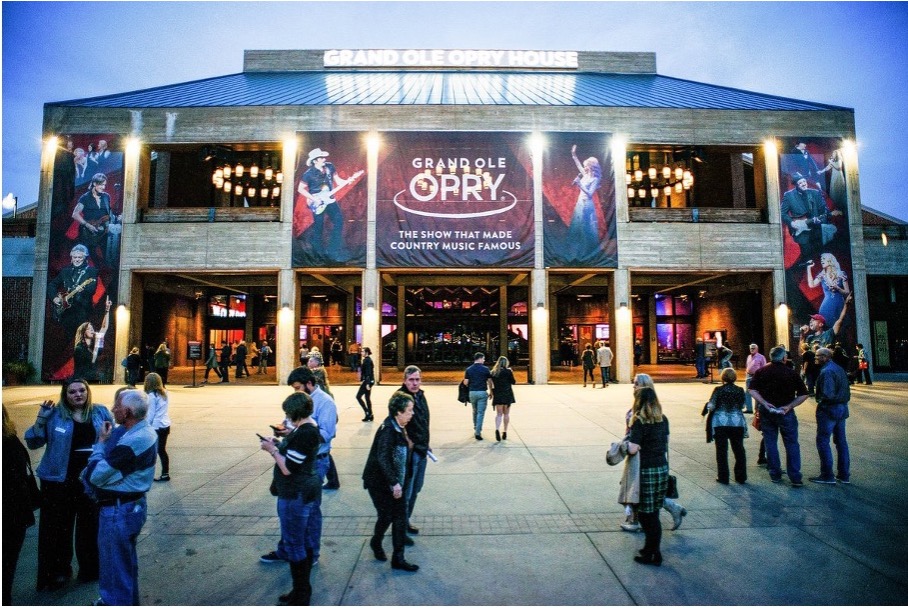
By now, the city of Nashville had become the hub of country & western, not least because many programs were broadcasted live from the Grand Ole Opry theatre, which, as the years progressed, became an arena with more than 4,000 seats (see title photo). Performances at this theatre launched many an artist and were also intended to preserve the traditional character of country & western. As a result, the genre has long remained the music of the conservative part of the American population. 

Country & western could be heard in every pub in the 1930s, and because of the volume, a (old) piano was often added a to the instrumentation that consisted of fiddle, guitar, dobro (a kind of steel guitar) and banjo or mandolin. It was also often referred to as honky tonk music. Bobb Wills (‘San Antonio Rose’), Ernest Tubb and Hank Williams sr were leading artists of this era. 

Here Hank Williams senior sings ‘Hey Good looking’

Preserving the traditional image of country and western music from the 1930s to the present day was the main aim of the CMA (Country Music Association) and its temple, the Grand Ole Opry.

At the other side many artists drew inspiration from other musical genres in search of their own sound.  The CMA was highly critical of this. For this reason, Billl Haley and somewhat later Elvis Presley were denied access to the theatre because of their emerging ‘rockability style’, one of these first ‘crossovers’ which laid the foundation for ‘rock ‘n roll’.

Here’s a performance by ‘rebel’ Bill Haley and his Comets: ‘Rock around the clock tonight’.

Back to ‘blue grass music’ of the 1940s

‘Excesses’ like this regularly led to a reappraisal of the ‘roots’ of country & western.  The ‘blue grass’ music of the 1940s, which would retain varying degrees of popularity for decades. Its founder is Bill Monroe (1911 – 1996) and his band The Blue Grass Boys, named after the nickname of the state of Kentucky, ‘Blue grass state’. This music stands out for the front singer’s high-pitched voice and perfect harmony singing with the background choir. The shrill voice initially had to compensate for the absence of a microphone. Another famous band was the Osborn Brothers (‘Rocky top’).

Here you can hear Bill Monroe and the Blue Grass Boys in ‘Blue moon of Kentucky’, a recording from 1975, the song had obviously been played for many years by then. 

The Nashville sound

The second crossover came from the capital of country & western itself, namely the record industry. During the 1950s, it saw with sorrow the popularity of rock ‘n roll and rhythm & blues grew. A team including Chat Atkins was hired to make country & western smoother. The steel guitar and fiddle gave way to background choirs and strings. But the great success of this approach was mainly due to the sweet-voiced Jim Reeves, Don Gibson (‘Oh Lonesome me’) and Patsy Cline. 

Here, Jim Reeves sings ‘He’ll have to go’. 

Soon there was talk of the “Nashville Sound”, which, at least for the moment, found favour with the country and western establishment., the Nashville sound was a great success.  However, the musician Atkins, who co-founded it, was increasingly unhappy with it because any move towards a jazzier sound was taboo. When asked to describe what was so typical of the Nashville sound, he rattled the change in his pocket and said, “That’s what it is. It’s the sound of money”.  The success came to a sudden end when Jim Reeves and Patsy Cline both died in plane crashes and music from the United Kingdom started to take the US by storm in the 1960’s.

Another step back to the ‘roots’

Many country & western fans felt ill-served by the slick Nashville sound on the one hand and the songs of the Beatles and their peers on the other. This again opened the way to steps back towards ‘roots’. Responsible for this were artists like Wynn Stewart, Buck Owens, Bob Wills and Merle Haggard. Their so-called ‘Bakersfield sound’ (named after Bakersfield in California), was in keeping with the rawer honky tonk of the 1940s. Bakersfield is an area where countless migrants had settled who had been expelled from the Midwest, which was ravaged by dust storms (‘Dustbowl’). The Bakersfield sound would resonate into the 1970s and helped form the basis of ‘folk rock’. But more on that later.

Here, Merle Haggttt and Bob Wills sing the classic ‘San Antonio Rose’.

The Nashville sound had by no means disappeared after the slump in the 1950s. The style was now called ‘countrypolitan’ and a host of artists, such as Lynn Anderson, Charly Pride, Donna Fargo, Ray Stevens and Chystal Gayle can be counted among them.  From the 1970s onwards, to this list can be added, among others, John Denver (‘Annie’s Song’), Kenny Rogers (‘Lucille’) and, from the 1990s onwards, Garth Brooks and the Dixie Chicks. 

All these artists contributed to stretching the gap between traditional country & western and other styles of music ranging from rock, soul, funk and, in the 1990s, hip-hop. The country & western watchdog at the ‘Grand Ole Opry’ watched suspiciously but could not do much against the artists who also topped the exclusive country & western lists. However, the Dixie Chicks’ popularity ended abruptly when, during a performance, they criticized President George W. Bush for his attack on Iraq. Country & western radio and television stations promptly stopped playing their songs.

Here the song ‘Cowboy take me away’ by the Dixie Chicks (2006), which still has country & western influences in terms of content and instrumentation, but whose melody can hardly be classified as such anymore.

The question therefore was at which point a song no longer belongs to the country & western genre and can be banned from dedicated radio stations and charts. Enough test cases of singers who could be described as ‘country stars’ like Shania Twain, Tayler Swift, Carrie Underwood and Maren Morse presented themselves in the early 21ste century. Their genre was called ‘country pop’.

I’ll limit myself to one of Tayler Swift’s first songs ‘Tim McGray’ (2006). Country or not?

‘Americana’ and other styles

Institutional pressure made a return towards more ‘traditional’ country & western music inevitable for less fortunate singers. This resulted in musical styles designated by the terms ‘folk’, ‘Americana’, ‘country folk’ and ‘country rock’. An additional feature was that some musicians who could be counted in this category also had a decidedly left-wing political stance, which did not help their popularity in country circles. Examples include Woody Guthrie, Pete Seeger, Donovan, Joan Baez and Bob Dylan. 

George Strait is still closest to the traditional country & western style, and you can hear his best-known song ‘Amarillo by morning’ here (a 2016 recording).

More along the lines of ‘country rock’ goes music by Gram Parsons, also a member of The Byrds and the Flying Burrito Brothers, also called the father of country rock. With Emmylou Harris, Gram has sung a series of duets. The Eagles also fit into this category.

An example of unadulterated ‘country rock’ is the Charlie Daniels Band, active from 1950 to 2020, the year of Charlie Daniels’ death. From this band, I showcase here its best-known song ‘The Devil went down to Georgia’ (1979).

Country & western has had a huge influence on contemporary music in the US, despite or perhaps because of the many crossovers and the fact that even the music of contemporary performers of ‘traditional’ country & western sounds very different from that of the Carter family or the Blue Grass Boys.  

Very different?  Again, not all.  There are several groups that draw full houses with their precise renditions of traditional country & western music. One such group is again a whole family with supporters: the Petersens.  They too have made their hobby their profession and with their enthusiasm they blow all the dust that may have settled on old songs. 

Here are the Petersens with Rocky Top, an authentic blue grass number from the 1940s. Incidentally, the Petersens also sing very different genres.  I have previously featured their rendition of the complete Bohemian Rhapsody on their traditional instrumental. That one also sounded like a bell.