
Between this and the former episode of my blog is a bigger gap than usual. The reason is that my wive and I moved to another house in another town. With a lot of pleasure, we have refurbished the house house. Without any doubt, it will stimulate me to provide you with lots of new posts.
Back to the music, this time a rather brief episode.
Music has several proven effects on human beings. Music that you like is reducing stress and makes you happier. This because of the production of a drug by your brain called dopamine. Music stimulates the functioning of the brain and therefore play a role in combating memory loss.
It is a very good idea for schools to engage children actively with music and for music to be final exam subject in secondary education. This is the case, among others, at the Marianum, a broad comprehensive school in Groenlo, the Netherlands.
Listen, by way of introduction, the school choir’s interpretation of Adiemus, a song whose words have no meaning. The choir consists of students from the upper classes, many of whom have music as their final exams.
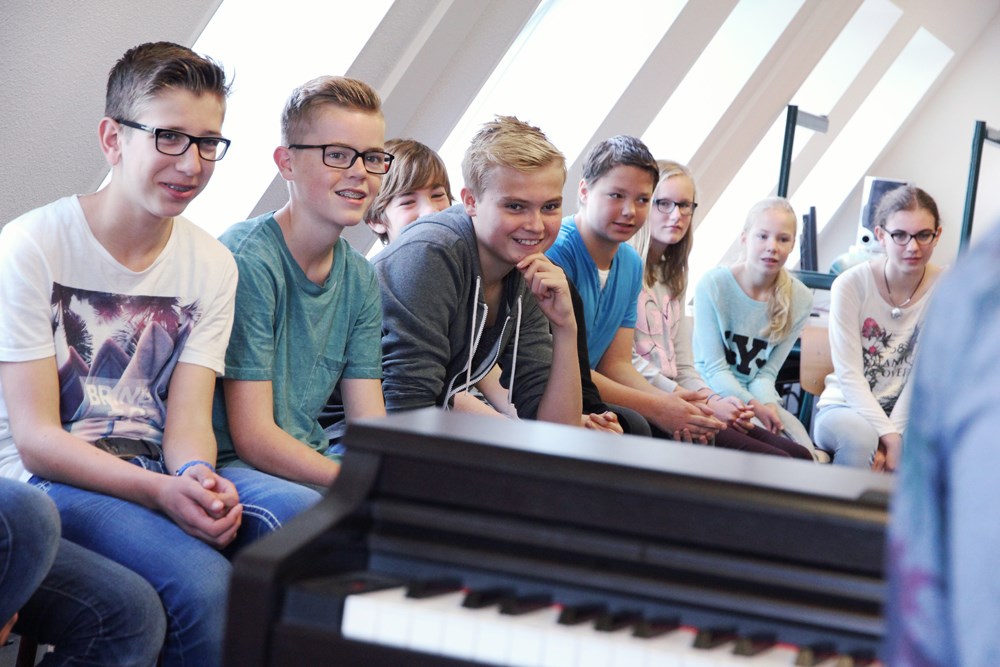
What does musical education look like in secondary school? In junior high, pupils develop several musical skills, with singing and playing a musical instrument having an important role. But they also write their own songs. In addition, there is general music theory and music history.
Students who choose music as their final exam spend about two-thirds of the time working towards one or more performances (the final exam concert). If they already play an instrument, this is useful, it is not necessary. In the theory section, students prepare for the final central written exam, which includes mastering musical notation, analyzing musical pieces and studying the diversity in music also in relation to (sub)cultures.
In the years 2120, 2012, 2014 and 2017, professional recordings of the final exam presentations were made at the Marianum under the MarianumLIVE banner. These were distributed on YouTube and have since been viewed more than 5 million times.
In this exploration, I show a choral number and an individual performance from the years 2012, 2014 and 2017. The video above dates from 2012. Here is an individual performance from the same year, in this case two students singing the song ‘Je veux’, which was very popular that year. It was sung by singer ZAZ (Isabelle Geffroy). It is an example of ‘gypsie jazz’, the only movement within jazz that had its origins in Europe.
Below, I highlight the year 2014. That year, choir and soloists sang Fauré’s Requiem among others. From this follows the song Libera me. The piano is played by Dennis Valenduuk, a former student of the school.
You can now watch the song ‘I put a spell on you’ This song dates from 1956 and has been sung by Nina Simone, Brian Ferry and the Alan Price group, among others. Rolling Stone Magazin ranked this song 318de among the 500 best songs of all time. This song exhibits almost heartbreaking vocals and impressive guitar playing at (almost) professional level.
Moving into 2017. You can first watch and listen to two soloists, singing together Steely Dan’s 1972 song ‘Do it again’. It’s about a schmuck who keeps falling back into the old sins of violence, drugs and the wrong women and always comes up short. The soloists therefore sing resignedly ‘do it again….’ Note the tight ‘funky’ playing and the solo by the ‘cool’ drummer.
Below, you can listen to Toto’s ‘Africa’ version by year group 2017 of the Marianum.
Although this is a performance for choir and soloists, many elements have been adopted from Toto’s performance, for example the marimbas at the beginning.
And then 2017 was over and the great promoter and stimulator of music at school Frits Maters retired. From then on, there are no more videos of musical presentations by the graduating students, as far as these concerts could go on in corona time. No videos, but there are photos.
MarianumLIVE is not the only way the school manifests itself musically. In the years when there was no MarinumnLIVE, students organised Students on Stage, outside the curriculum, but also of high quality. In 2018, a group of students and teachers organised Passion. They also resumed the tradition of the Music Café, in which mainly bands of students performed and a choral work was sung.
You can watch a large number of videos from the years 2010, 2012, 2014 and 2017 via this link. You will also be introduced to four former students who have become professional musicians.


 Music: Listen, Look and Enjoy