How Google connects with the smart city movement

Whatever we do, we know the world doesn’t need another plan that falls into the same trap as previous ones: treating the city as a high-tech island rather than a place that reflects the personality of its local population’.
These words are from Daniel Doctoroff. In 2016 Larry Page (Google) invited him to be chairman/CEO of a new Alphabet enterprise, Sidewalks Labs. This company aims contributing to the transformation of urban environments through technologies that can drive efficiency, raise accountability, and foster a deeper sense of community. In others words, connecting Google’s expertise to the Smart City movement.
 

Choosing Doctoroff as obvious. He was deputy mayor for city development in the Bloomberg administration. He is deeply concerned with the problems of American cities and at the same time he believes in the power of science and technology to solve them. In his view the Fourth Technological Revolution will integrate five core technologies:

  • ubiquitous connectivism
  • sensing
  • social networks
  • computer power
  • robotics.

Deployed together, these technologies will significantly decrease mobility costs for citizens and for the community at large as well, personalize services and improve safety.

Technologists and urbanists

The ultimate aim is improving the quality of life in cities and not the deployment of technology as such. Therefore Doctoroff carefully staffed Sidewalks Labs with technologists and urbanists. In his words, the first group is in general insensitive to the complexities of cities. The second group does not understand technology: Protecting the social fabric of cities comes first. Both groups talk different languages and do not communicate. Doctoroff believes that their successful collaboration can make the difference between Sidewalk Labs and technology-driven Smart City initiatives. 

Shortening decision making

It is too early to judge whether Sidewalk Labs will fulfill these promises. The published research so far (a couple of titles is shown in this article) shows a great deal of involvement in the problems of the American cities, like the crumbling infrastructure, the lack of accessible health care, and the unaffordability of housing. The modeling of these problems, taking into account realistic population data, enables fast simulations of the impact of solutions and thus shortening of length of the decision making process. This research has revealed ingenious redesign of the public transport network, new models of integrated heath care and proposals that might significantly lower construction costs.

The implementation of solutions

Labs does not limit itself to figuring out solutions; the company is also taking care of their implementation by creating start-ups. For instance, Flow is mapping traffic and (public) transport pattern to optimize networks and thus meaningfully increasing mobility. Link NYC is replacing the 7000 payphones with super-fast free Wi-Fi hubs, paid by advertising on the large hub displays.

In its health care research Sidewalk Labs made clear that most medical problems have social and environmental roots, for instance bad food habits and air pollution. At the same time health care in the US is more expensive than in any other OECD country and its quality, accessibility in particular, is unsatisfying. When it comes to solutions, Sidewalk Labs is focusing on e-health, for instance monitoring patients and consulting physicians at distance.

Mismatch between definition of problems and that of solutions?

At  this point I became aware of a growing feeling of discomfort with the strategy of Sidewalk Labs. 
Labs is brilliant in the realm of defining and modeling problems, freed from any reductionist bias. However, its search for solutions is technology-focused, for instance apps that offer real time affordable solutions for renting apartments or apps that shows vacant parking lots. Not to mention the free Wi-Fi facilities in New York. Flaws in the Smart City approach result partly from a technological bias in the definition of problems. Sidewalk Labs definitely cannot be blamed in this respect. But it fails to integrate technical and non-technical approaches in the the solution of problems. Exactly this is corresponding with distinction between Smart City 2.0 and Smart City 3.0 that I made recently.

I assume that the focus on technological solutions in inherent in Sidewalks Lab’s connection with Alphabet. The ultimate ambition of Sidewalks Labs is to reimagine cities from the Internet up. That is why Alphabet has created the company. In the end, Sidewalks Labs’ mission is paving the way for new services to develop or to deliver by Google.
However, cities, their administrators and inhabitants are yearning comprehensive solutions for their problems. These solutions demand an integrated approach deploying high-tech, low-tech and also no-tech solutions. Here Sidewalks Labs falls short, in spite of Daniel Doctoroff inspiring citation above. Probably ongoing discussion between the technologists and the urbanists will enable this integration in the end.

This is the 4th episode in a series of 6 posts dealing with the ambiguities in smart city development. They were published earlier in smart city hub

How stupid can ‘smart cities’ be ?

home for every new yorker
Demonstration for affordable housing – Photo: Getty Images

Smart cities intent deploying big data, information and communication technology to become more sustainable and livable. At best, they proceed not only in favour of their citizens but together with them in the first place. In addition, they enable citizens to develop initiatives of their own. So far so good.

Who is invited to the party?

The question is arising: who are those citizens? Or using Suketu Mehta’s words: Who is invited to the party? After all, making a living in big cities becomes unattainable for many. Buying an apartment in New York City is virtually beyond reach even for double-income couples. Not to speak about renting one. A mattress in a room in Chinatown NYC during an eight hours timeslot a day, costs you $ 200 a month.

Chinatown

Chinatown apartments – Photo: Getty Immages

Already now 50 percent of households in NYC spend more then 30 percent of their income at housing. Thirty percent of all households spend more than half of their income. As a consequence, 14 million households in the USA have already moved out of urban areas during the last decade. In the same period in Chicago only, the number of school children decreased by 145,000. We are in the middle of a large-scaled process of de-urbanization.

The real estate revolution

Saskia Sassen has been studying real estate in world cities since the eighties. Throughout this period, the size of speculative investments has increased annually. Over the past five years, rise has been spectacular. In 2015, it went up to $ 1 trillion, compared with ‘only’ $ 600 billion in 2014. More striking is that nowadays real estate transactions often include whole territories, for instance old industrial areas or railway yards. The purpose of these investments is demolishing existing structures and erecting fancy offices and expensive apartments. A recent example is the acquisition of Atlantic Yards in NYC for $ 5 billion. Currently a territory with small industries and homes. They will be replaced by fifteen giant apartment complexes.

Atlantic Yards

Atlantic Yards, NYC – Photo AP

A similar phenomenon can be observed in London. The sale of entire areas – for instance the area of the Battersea Power Station –  is accompanied by the privatization of public space. Granary Square near Kings Cross station is one of the biggest London ‘pops’ (private-owned public spaces) with its own rules and guards.

Granary Square, Kings Cross London – Photo: John Sturrock (the Gardian)

Booming housing costs: A global phenomenon

Booming housing costs are a global phenomenon. Even a sharp rise in rentals (sometimes 300%) indicates the beginning of gentrification in the favelas in Rio de Janeiro, which have become safer places due to pacification programs. The next next step will be large scale housing in cheap high-rise apartment buildings, as happened happening in many Asian cities. Leaving a lot of empty space for prestigous destinations.

The tragic human cost of smartification

In Africa, the process of smartification also took off. A number of smart cities are being built from ‘scratch’, for instance Eko-Atlantic City in Lagos (Nigeria). Bulldozers and police force are mighty tools in the process of their creation. Recently, the High Council of Nigeria has stopped the demolition of Mpape, a neighborhood of at least 300,000 inhabitants adjacent to the capital city of Abuja, because of the absence of any prospect of rehousing of the expelled residents.

The abolition of Otodo Gbame, Lagos (Nigeria) – Photo: Common Edge

In the end, the result of unbridled speculation might be that only the rich will benefit from smartification. Amsterdam too must be vigilant. During 2013 – 2014, property sales to investors increased by 248%. In 2016, the average price for housing increased by almost 23% compared with 2015 . Affordable rental is virtually non-existant.

Because of the exclusion of a large group of citizens, the process of smartifcation is at risk turning into a proces of foolification. Foolish cities are sterile cities, inhabited by a rich cosmopolitans. Without young people socializing at in the squares, craftsmen in their workshops, middle classes people in their shops and a diverse and plural group of inhabitants, they will become dead cities, in spite of all smart technology.

This is the second of a sequence of six reviewing aspects of the smartification of cities. Fiction or reality, mission or marketing, progress or illusion. This article has already been posted in The Smart City Hub.

If smart cities are the solution, what was the problem?

Looking for an answer to this question[1] I found the proceedings of the symposion Beware of Smart People! Redefining the Smart City Paradigm towards Inclusive Urbanism held in Berlin on 19 – June 20, 2015[2]. This post is partly based on this report, in which I recognize many ongoing discussions.

The world’s population is growing and concentrating in cities. Needless to say that this causes major problems, especially in emerging countries. At the same time, business also concentrates in urban areas. Consequently, cities compete at world level and – inspite of all problems – position themselves as global, affluent, mundane, and smart.

The concept of a smart city refers at a loosely connected set of confluences between data, digital and other technologies, and urban proceses. The promise is of the digitally-enabled data-driven, continually sensed, responsive and integrated urban environment and a manageable entity[3]

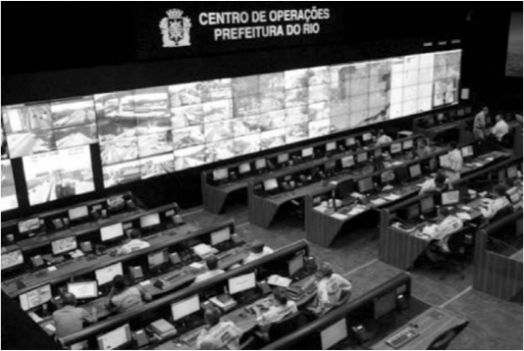
Whether this promise will be kept is questionable: What remains to be seen, is the extend to which the smart city agenda is anything else than another instantiation of corporate power grabs, entrenching surveillance, private control over urban management and repacking neoliberalism in the dressing of seductive technologies and reimagined municipalities and citizens[4]. The modern city is a battleground of market forces, an icon of consumerism, and it is characterized by growing inequality, alienation and intolerance. Digital technologies are associated with control and power.

Naamloos3
Control center in Rio de Janeiro

Opposite to the technology-dominated image of smart cities is the concept of commoning: Citizens share, shape and maintain their living space together based on principles of share-economics and direct democracy more than on the basis of technology. Residents’ initiatives to enforce an alternative land-use at the former Tempelhof airport in Berlin are a frequently cited exemple.

Naamloos 2
Commoning at the former Berlin airport Tempelhof

Another way to frame the smart city is the perspective of urban utopia. Examples are Songdo (South Korea), Mazdar (UAE), Dholera (India) and PlanIT Valley in Portugal, who are all developed from scratch. Investors value these cities as assets in global competition, because of attractive living conditions, full-featured office space, outstanding connectivity and accessibility and high environmental standards. Residents are considered as benificiaries but in a lesser degree as active participants. In spite of the huge investments, these smart utopias rarely are a successful. In some cases they turned intp ghost cities, like Ordos in China. Songdo (South Korea) is sucessfully attracting residents from the adjacent overcrowded town of Seoul but the number of international companies remains far behind expectations. Trafic on the $ 1.4 billion,12 km long six-lane suspension bridge connecting the city to the airport is low while a fast rail link with Seoul is seriously missed.

Naamloos 5
An artists’ view of Songdo

One might wonder whether these different approaches of smart city are compatible.

I believe that the the answer is confirmatory. However, four questions must be answered in advance:

  1. What is the most desirable use of urban space, seen from a multi-actor and multi-stakeholder perspective?
  2. How can all residents maximize their participation in urban life?
  3. What mix of companies generate the most diversified sustainable employment?
  4. What is the best way to involve as many citizens as possible in decision making at all levels?

The role of data, digital facilities and other technologies must be considered in conjunction with answering these four questions. The ‘real’ smart city needs to start with the city and its attendant social problems, rather than looking immediately to smart technology for answers[5]. Proceeding this way prevents narrow technologal thinking and opens the road to low-tech or no-tech solutions. Consequently, a city can claim to be ‘really’ smart if “… investments in human and social capital and traditional (transport) and modern (ICT) communication infrastructure fuel sustainable economic growth and a high quality of life, with a wise management of natural resources, through participatory government.[6]

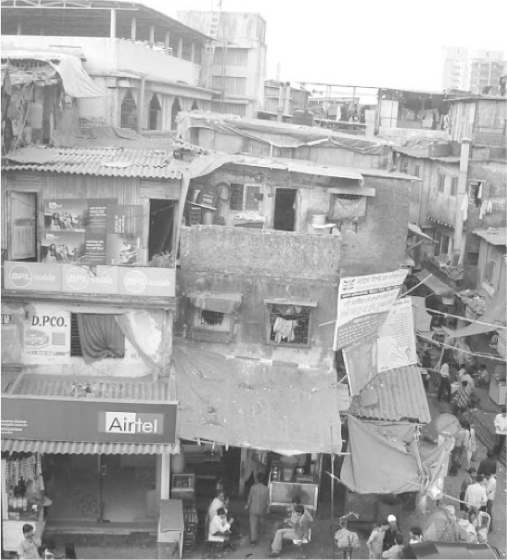
A special contribution during the symposium came from Gautam Bahm from India. In his opinion, the smart city does not exist; placeless concepts have no meaning. A smart city in India is something completely else than a German one. In Indian cities commoning is the norm: Big parts of cities are auto-constructed, deploying another logic than planners and architects do. However, there is a great need for a basic infrastructure: About 17% of the ground is covered with ramshackeled pipelines for water supply and sewerage. The same goes for the wires for electricity and telephone. Here is an tremendeous challenge for urban planning, which is willing to adapt the existing fabric of local communities, rather than destroying it, as is happened in China and many other places.

Naamloos 1
Commoning is the hard of many cities in India

The concept of ‘smart city’ might become an icon of a new digitally facilitated form of living in urban space. This requires a view of the city as a place that is inclusive, shared and negociated and that considers residents as active producers and contributors because of their thorough local knowledge, expertise, creativity, networking skills and entrepreneurship

This post has already been published in the Smart City Hub

[1] Free paraphrased expression of Cedric Price, architect (1933 – 2003) who wrote: “Technology is the answer, but what was the question?

[2] Find the report at https://goo.gl/cgDemx.

[3] This and the following quote are from Colin McFarlane’s contribution (p.89)

[4] Smart cities are strongly pushed by IT-companies. These companies are the main investors behing PlanIT Valley in Portugal.

[5] Robert Hollands: Critical Interventions into the Corporate Smart City Cambridge Journal of Regions, Economy and Society. Vol 8 (1) 2015, p. 61.

[6] Andrea Caragliu, Chiara del Bo en Peter Nijkamp: Smart Cities in Europe, Journal of Urban Technology, Vol 18(2), p. 652011, 70).