

Jazz emerged in the early 20th century from a series of musical styles that in turn resulted from cross-pollination of African-American influences and music brought by other immigrants. One of these styles was ragtime, which in turn evolved from boogie woogie.
Look and listen by way of introduction, to the Harlem Rag, composed by Tom Turpin in 1897. He, like many others, had taught himself to play the piano. Here, the composition is played by Florian Krüger.
Ragtime is portrayed in countless films as the sultry rhythm in a saloon, played by a straw-hat-clad pianist with his sleeves rolled up, surrounded by ladies waiting for gentlemen to join them upstairs. This was exactly how it was in ‘the Rosebud’, the saloon where Tom Purpin played his songs. There were dozens of such pubs in the red-light districts of St Louis and New Orleans. Ragtime was probably for this reason mainly music for the piano.
Ragtime music has a tight and simple bass part, more varied than the boogie-woogie’s one. The melody plays to the rhythm set by the bass. The notes of the playful melodies fall just a little earlier or a little later than you expect them. ‘Ragged time’ means as much as torn measures. I speak emphatically of melodies, because the boogie woogie consisted mainly of groups of melodic and rousing sounds. This was also because of the improvised nature of many boogie woogies.
The founder of ragtime is undoubtedly Scott Joplin. He was born in Texas in 1868, the son of an ex-slave who tried to earn a living as a violinist; his mother played the banjo. Scott also learnt to play guitar and bugle and from the age of 13de led the existence of an itinerant musician. His second-best-known song is the Maple Leaf Rag, played here by Dario Ronchi to mark the 100th anniversary of his death, in 1916.
Scott Joplin wrote 504 different ‘rags’ in his lifetime, one ballet opera – Ragtime Dance – and two ragtime operas, A Guest of Honour and ‘Treemonisha’.
The ragtime went in different directions: inspiring ‘classical’ composers, incorporation into jazz as ‘dixieland’ music, and it was also the basis for simple pieces for wind orchestras. Western composers also became influenced by ragtime music. In 1918, Igor Strawinsky’s piece ‘Rag-Time’ was premiered. A musical work for 11 instruments. It lasts over 5 minutes.
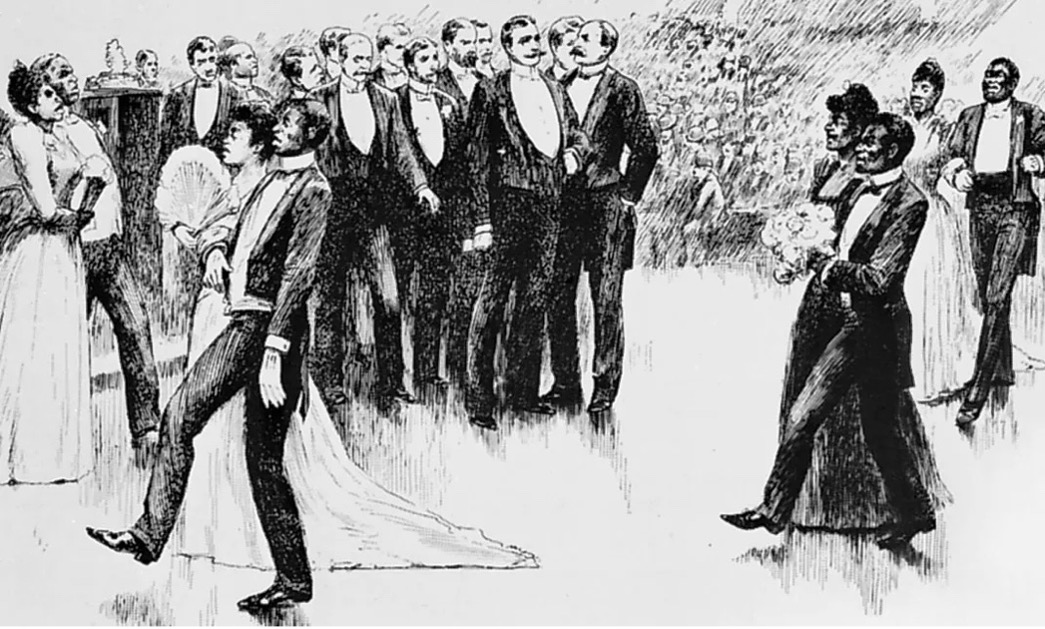
Early in the 20ste century, ragtime was discovered as the perfect dance music for the popular cakewalk. Essentially, dance couples form a square and each couple performs a silly dance around the square. A jury judges the performance; among others by looking at the ladies’ elegance and the men’s ingenuity. The highest-rated couple received a richly-decorated cake.
There were numerous variations. The cakewalk was originally performed by Negro slaves, for the amusement of their masters in which the classical form of ballroom dancing from the upper classes was somewhat ridiculed.
Slaves were still allowed to mock the ballroom of ‘high society; but as it went with all modern dances, ‘high society’ adopted them almost immediately. The dance below dates from around 1900 and played here by the Academy of Danse Libre.
Furthermore, the cakewalk can be practiced in some dance-schools and provides a lot of fun for both the dancers and the audience. We are then approaching the true meaning of the English word ‘ro rag’, which is to have fun and walking back and forth wildly.
As mentioned, the Maple Leaf Rag is Scott Joplin’s second most popular ‘rag’. In his time, it was probably the most popular. Listen now to the most popular ragtime melody at the present day. This one is also performed by Dario Ronchi.
The ambience is quite different from the brothels in which Tom Terpin and Scott Joplin played their ‘rags’ in the late 19de century.
Indeed, it is the title tune of the film ‘The Sting’ – exactly 50 years ago – directed by George Roy Hill, starring Paul Newman, Robert Redford and Robert Shaw. The film’s screenplay was written by David S. Ward and based on the true story of the scams of brothers Fred and Charley Gondorf, as described in David Maurer’s book “The Big Con: The Story of the Confidence Man” (1940). The film won seven Oscars in 1973 and revenues were huge for the time: $160,000,000. But since then, everyone knows what a “rag” is.
 Music: Listen, Look and Enjoy