
10. Health

Most important causes of death worldwide (Source: The Lancelet, le Monde)

This is the 10th episode of a series 25 building blocks to create better streets, neighbourhoods, and cities. In this post, I mainly focus on health problems which are directly related to the quality of the living environment

Are cities healthy places?

According to the WHO’s Global Burden of Diseases Study, 4.2 million deaths worldwide each year are caused by particulate matter. The regional differences are significant. Urban health depends on the part of the world and the part of the city where you are living. More than 26 million people in the United States have asthma and breathing problems as a result. African-American residents in the US die of asthma three times as often as whites. They live in segregated communities with poor housing, close to heavy industry, transportation centers and other sources of air pollution.

Globally, the increasing prosperity of city dwellers is causing more and more lifestyle-related health problems. Heart disease, and violence (often drug-related) has overtaken infectious diseases as the first cause of death in wealthy parts of the world.

The Netherlands

Very recently, Arcadis published a report on ‘the healthy city’. This report compares 20 Dutch cities based on many criteria, divided over five domains. The four major cities score negatively on many aspects. In particular: healthy outdoor space, greenery, air quality, noise nuisance, heat stress and safety. Medium-sized cities such as Groningen, Emmen, Almere, Amersfoort, Nijmegen, and Apeldoorn, on the other hand, are among the healthiest cities.

In Amsterdam, the level of particulate matter and nitrogen dioxide (NO2) in 2018 exceeded World Health Organization standards in many streets. The GGD of Amsterdam estimates that 4.5% of the loss of healthy years is the result of exposure to dirty air.

Collaborative measuring air quality

In various cities, groups of concerned citizens have started measuring the quality of the air themselves. A professional example is the AiREAS project in Eindhoven. An innovative measuring system has been developed together with knowledge institutions and the government. Sensors are distributed over the area of the city and the system provides real-time information. The AiREAS group regularly discusses the results with other citizens and with the city government. The measurement of the quality of the air is supplemented by medical examination. This research has confirmed that citizens in the vicinity of the main roads and the airport have an increased risk of mortality, reduced lung function and asthma.

The AiREAS project is linked to similar initiatives in other European cities. Occasionally the data is exchanged. That resulted in, among other things, this shocking video.

Future?

Could the future not be that we are busy doing the obvious things for our health, such as walking, cycling, eating good food and having fun and that thanks to wearables, symptoms of diseases are watched early and permanently in the background, without us being aware of it? The local health center will monitor and analyze the data of all patients using artificial intelligence and advise to consult the doctor if necessary. An easily accessible health center in one’s own neighborhood remains indispensable.

Followย this linkย /to find an overview of all articles.

9. Road safety

Vision Zero street

This is the 9th episode of a series 25 building blocks to create better streets, neighbourhoods, and cities.Casualties in traffic are main threats to the quality of the living environment. โ€˜Vision zeroโ€™ might change this.

Any human activity that annually causes 1.35 million deaths worldwide, more than 20 million serious injuries, damage of $1,600 billion and is a major cause of global warming would be banned immediately. Except for the use of the car. This post describes how changes in road design will improve safety.

The more public transport, the safer the traffic

Researchers from various universities in the US, Australia and Europe have studied the relationship between road pattern, other infrastructure features and road safety or its lack. They compared the road pattern in nearly 1,700 cities around the world with data on the number of accidents, injuries, and fatalities. Lead researcher Jason Thompson concluded: It is quite clear that places with more public transport, especially rail, have fewer accidents. Therefore, on roads too public transport must prioritized.

The growing risk of pedestrians and cyclists

Most accidents occur in developing and emerging countries. Road deaths in developed countries are declining. In the US from 55,000 in 1970 to 40,000 in 2017. The main reason is that cars always better protect their passengers. This decrease in fatalities does not apply to collisions between cars and pedestrians and cyclists, many of which are children. Their numbers are increasing significantly, in the US more than in any other developed country. In this country, the number of bicycle lanes has increased, but adjustments to the layout of the rest of the roads and to the speed of motorized traffic have lagged, exposing cyclists to the proximity of speeding or parking cars. SUVs appear to be ‘killers’ and their number is growing rapidly.

Safe cycling routes

In many American cities, paint is the primary material for the construction of bike lanes. Due to the proximity of car traffic, this type of cycle routes contributes to the increasing number of road deaths rather than increasing safety. The Canadian city of Vancouver, which doubled the number of bicycle lanes in five years to 11.9% of all downtown streets, has the ambition to upgrade 100% of its cycling infrastructure to an AAA level, which means safe and comfortable for all ages and abilities. Cycle paths must technically safe: at least 3 meters wide for two-way traffic; separated from other traffic, which would otherwise have to reduce speed to less than 30 km/h).  In addition, users also need to feel safe.

Street design

Vision Zero Cities such as Oslo and Helsinki are committed to reducing road fatalities to zero over the next ten years. They are successful already now: There were no fatalities in either city in 2019. These and other cities use the Vision Zero Street Design Standard, a guide to planning, designing, and building streets that save lives. 

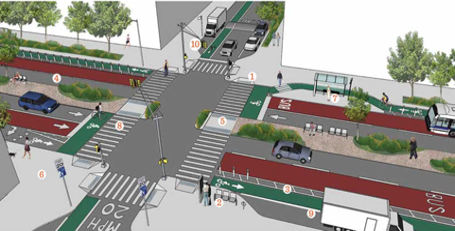
Accidents are often the result of fast driving but are facilized by roads that allow and encourage fast driving. Therefore, a Vision Zero design meets three conditions:

  • Discouraging speed through design.
  • Stimulating walking, cycling and use of public transport.
  • Ensure accessibility for all, regardless of age and physical ability (AAA).

The image above shows a street that meets these requirements. Here is an explanation of the numbers: (1) accessible sidewalks, (2) opportunity to rest, (3) protected cycle routes, (4) single lane roads, (5) lanes between road halves, (6) wide sidewalks, (7) public transport facilities, (8) protected pedestrian crossings, (9) loading and unloading bays, (10) adaptive traffic lights.

Enforcement

Strict rules regarding speed limits require compliance and law enforcement and neither are obvious. The Netherlands is a forerunner with respect to the infrastructure for bikes and pedestrians, but with respect to enforcement the country is negligent: on average, a driver of a passenger car is fined once every 20,000 kilometers for a speeding offense (2017 data). In addition, drivers use apps that warn of approaching speed traps. Given the risks of speeding and the frequency with which it happens, this remissing law enforcement approach is unacceptable.

Followย this link to find an overview of all articles.

8. Accessibility

This is the 8th episode of a series 25 building blocks to create better streets, neighbourhoods, and cities. The question is whether motorized traffic must be banned from central parts of the city to improve the quality of the urban environment. 

Most cities face a choice when it comes toย accessibilityย of their central parts: Whether they renovate the road infrastructure or they face a growing and lasting conflict between car traffic and visitors, whose numbers will decrease further as a result of prioritizing cars. This post deals with the first option.

Changing priorities in the use of road spac

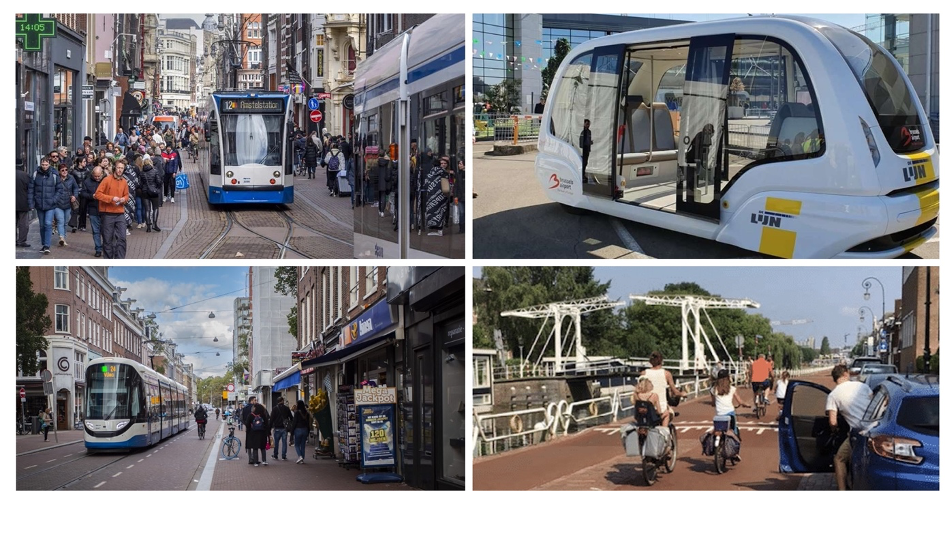
The starting point for this renovation is choosing the best experience for both residents and visitors. Therefore, the use of road space in all parts of cities must be under scrutiny. This also applies the connecting roads between centers and the other parts of the city. The distribution of space between pedestrians, cyclists, cars, and public transport has to be reconsidered. A good example is the Ferdinand Bolstraat in Amsterdam. Cars have been banned, the sidewalks are widened, cyclists have their own lanes and the tram uses a switch track (photo below left), just as in Leidsestraat (photo above left).

Accessibility

The rule of thumb is that the larger a city and the better public transport is functioning, the more the accessibility by car of the central parts and the residential areas as well can be reduced. Visitors who rely on the use of a car then store their vehicle in a parking on the edge of the center, preferably near supermarkets or other places where voluminous purchases can be made. From these parking spaces they enter the central area on foot. Incidentally, it is worth considering opening the entire center to cars until 11 a.m. to pick up orders.

Cyclists can be allowed deeper penetration in the central urban area, but not unlimited. They leave their bicycles in (guarded) parking facilities too.

Public transport never stops more than 300 meters from the middle of the center, where comfortable waiting areas are offered, and information is available.

Separation of traffic flows

A separation of traffic flows is required for the entire urban area. The most central streets will be exclusively intended for pedestrians, emergency services and occasionally the tram. Bicycles are allowed in streets in the center, depending on their wideness.

Public transport has always priority at traffic lights. It ensures not only transfer-free accessibility of the urban center, but also connects the most important residential and work areas with a minimum number of transfer. The possible arrival of autonomous minibuses will radically improve the flexibility of public transport (photo above right).

Intra-urban walking and cycling routes

Pedestriansโ€™ and cyclistsโ€™ safety and amenity are improved if the connections between the central and outlying parts of the city are accessible by separate routes too. In a city whose green space penetrates deep into the central area, these routes can partly run through nature. A good example is the cycle route from the center of Utrecht to Leidsche Rijn (photo bottom right). Pedestrians need an attractive route through the built-up area for reasons of social safety.

Follow this link  to find an overview of all articles.
7. Polycentricity

This is the 7thย episode of a seriesย 25 building blocks to create better streets, neighbourhoods, and cities.ย The question is whether a distribution of services over the whole area contributes to the quality of the urban environment.ย 

The central parts of cities like Siena, Amsterdam and Barcelona are overrun by visitors and tourists. Partly because Airbnb has increased its overnight capacity by withdrawing homes from their actual destination. As a result, these cities see their real estate prices rise ans residents leave, making room for expensive apartments, boutique hotels and corporate headquarters. Eventually, old city centers will become amusement parks that offer twenty-four hours of entertainment.

The need for distributed centers

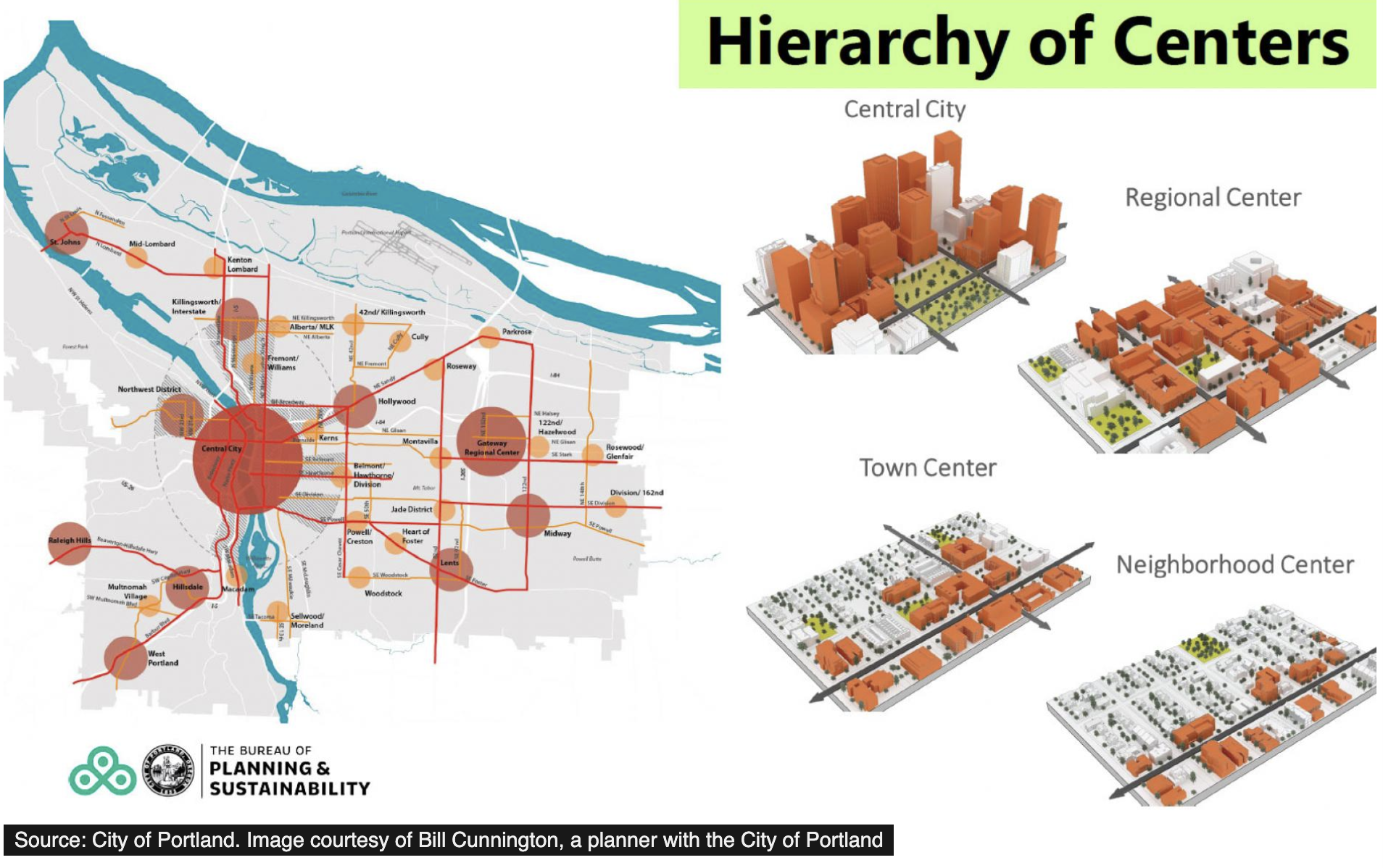
There are no objections against visiting nice cities. The underlying problem is that many of these cities have few other places of interest left, partly due to destruction in the Second World War and their rapid expansion afterwards. Therefore, some cities are in urgent need to create additional attractive places and become polycentric. This aligns with the intention of cities to become a 15-minute city. The figure above is a model developed for this purpose by the council of Portland (USA).

Because of this policy, the prospect is that residents can buy their daily necessities close to home. At the other hand, tourists will be spread. What attractive neighborhood centers look like will be discussed in a subsequent post.

Ancillary centers

Cities without an inordinate number of tourists and visitors also observe a steady grow in the number of events, all competing for the same locations. For this reason, it is advisable that cities have a few ancillary centers each with one or two crowd pullers that divide the stream of visitors. An example is the Guggenheim Museum in Bilbao and its newly developed public space around. In world cities such as London and New York, such centers have existed for years, but they are sometimes difficult to find because they are spread over a large area.

Amsterdam too urgently needs one or more ancillary centers. The area between Leidseplein and the Rijksmuseum has potential but lacks unity due to the chaotic intersections of roads and tram lines. The presence of a train or metro station is an advantage, that is why the area near Station Zuid also has potential.

Peripheral centers

Next decade, many visitors will still arrive by car and the best policy is to seduce them to leave their cars at safe transfer points to continue their journey by public transport. For visitors who intend to stay longer, this solution is not optimal. Many will dismiss the perspective of carrying their luggage to the hotel by public transport, although taking a cab is an alternative, albeit expensive. The alternative is the presence of a couple of affordable hotels next to the car park and the development of these areas into attractive public space, with shops, cafes, and restaurants, as a starting point to visit places of interest in the city. These centers can also accommodate major events, such as a football stadium, a music hall, cinemas and open-air festivities, because of the presence of large scale parking facilities. The Amsterdam Arena district is developing in this direction. It used to be a desolate place, but it’s getting better. There are excellent train and metro links.

And what about the old ‘old’ city center?

The public spaces in the old city centers must meet the same requirements as the whole city to prevent becoming an amusement park for tourists. Aside from its carefully maintained and functionally integrated cultural legacy, centers should provide a mix of functions, including housing, offices, spaces for craft and light industry and plenty of greenery dedicated to its inhabitants. The number of hotels should be limited and renting out by Airbnb prohibited. There will be shops for both residents and tourists, rents must be frozen, and the speculative sale of houses curbed. Space over shops must be repurposed for apartments.

Follow the link below to find an overview of all articles.
6. Weighted density

This article is part of the series 25 building blocks to create better streets, neighbourhoods, and cities. Read density (of inhabitants, activities or buildings) influence the quality of the urban environment. 

There is widespread agreement to use the available space more thoughtful than during the last decades. In the Nationale Omgevingsvisie (NOVI), the Dutch government has unambiguously expressed its preference for housing locations within existing built-up areas or in the vicinity of stations.

The need for density

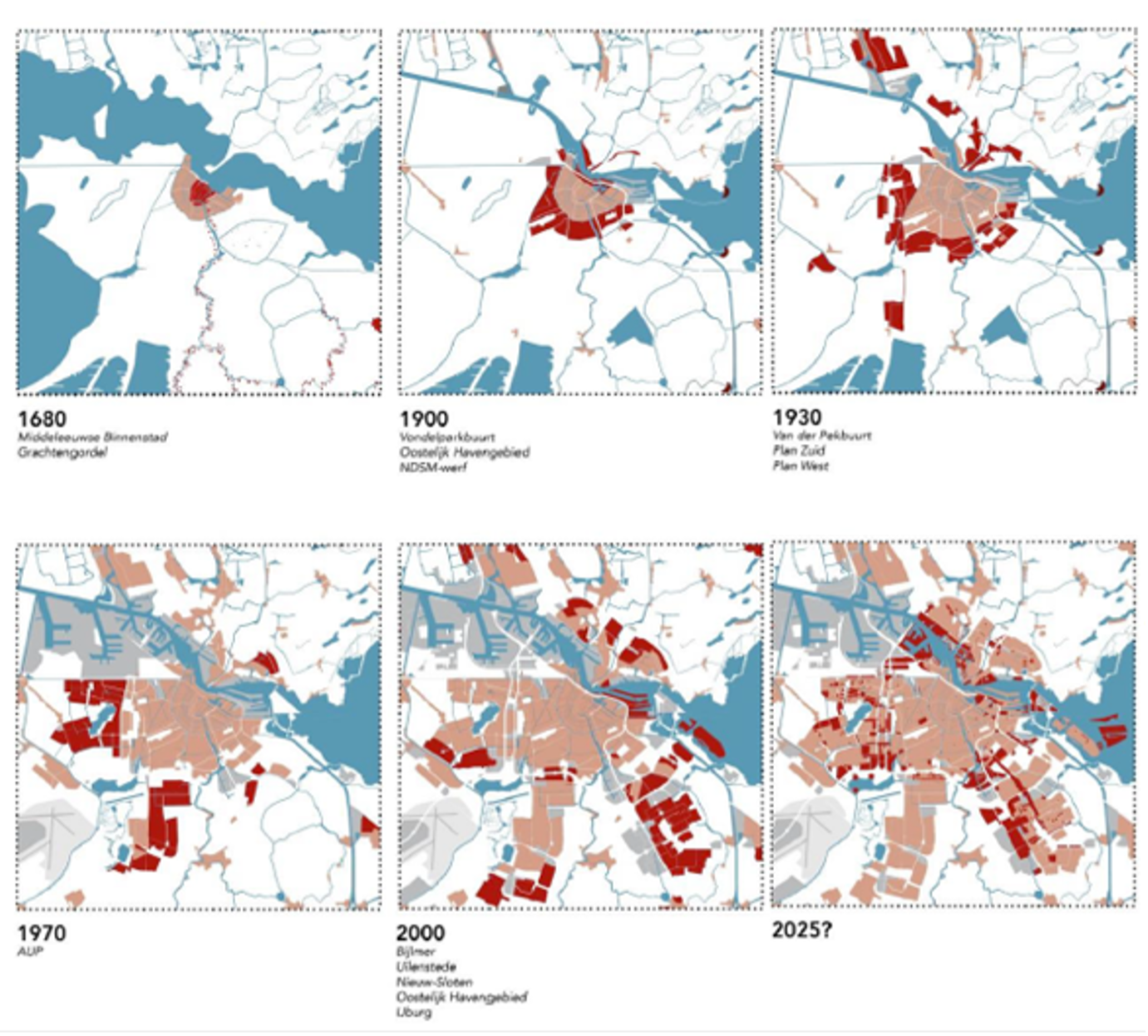
Frequently, references are made to the ghost image of โ€˜urban sprawl’ in the US but The Netherlands is also familiar with extensive growth of the urban area. The maps above show the growth of the Amsterdam area. Between 1900 and 2000, the population of Amsterdam grew from 317,000 to 727,000 inhabitants. Its surface from 560 to 11,500 hectares.

The spread of urban activities over an ever-increasing surface and the associated traffic movements have led to vast monotonous areas, car dependence, expansion of the road network, increasing congestion, impoverishment of social life, air pollution, emissions of greenhouse gases and decline of nature.

A summary of 300 OECD research projects shows that compactness results in more efficient use of facilities, but that there are also disadvantages in terms of health and well-being, usually as results of air pollution and traffic.

Advantages of density

Denser development is generally associated with the availability of amenities within walking distance, creating support for better public transport accessibility, and leading to more efficient use of utilities. Moreover – corrected for the composition of the population – CO2 emissions in urban areas are at least 30% lower than in the suburbs. An advantage that disappears in case of high-rises.

No necessity to expand building outside urban areas

According to many urban planners, there is no reason to divert to locations outside the existing built-up area. They claim that there is sufficient space in every city for new residential locations, for instance disused office buildings and factory locations. Many new homes can also come available through the division of oversized single-family homes and the renovation and raising of older (porch) homes.

These arguments only hold if at the same time the nuisance by densification is limited. For example, by reducing car use to prevent the roads from becoming even more crowded and the streets even more filled with parked cars. I don’t see that happening yet.

Competing claims on urban land use

There is another important objection to further densification and that is the fact that other forms of land use also appeal to available land within the urban space. For example, the expansion of industry, trade, research etcetera. preferably in the vicinity of living areas to reduce the length of trips.

The most important claim on the available space is the need to expand the cityโ€™s greenery. Research into the development of ‘green’ in Amsterdam and Brussels since 2010 shows that the open space ratio (OSR) in both cities has decreased. In Amsterdam this was 3.68 km2 (4.7%) and in Brussels 9.17 km2 (11.9%). This is in line with a recent study by Arcadis, which shows that the four major cities in the Netherlands score very poorly on healthy outdoor space, greenery, air quality, noise nuisance, heat stress and safety.

Inner- and outer-urban development revisited

The report therefore concludes that extension of the use of urban space for housing must be weighed up against other claims for the use of space, such as urban greening, urban agriculture, and the maintenance and expansion of business activities. At the same time, the objections to ecologically responsive building activities outside the already urbanized areas must be reconsidered. Three-quarters of the agricultural land is used for intensive livestock farming, not exactly creating valuable nature. I will come back to it later.

In the ‘Dossier leefbaar wonen’ (in Dutch)’ I wrote extensively about the subject of providing affordable housing. You can download this e-book using this link below:

5. Integration of high-rises

This article is part of the seriesย 25 building blocks to create better streets, neighbourhoods, and cities.ย Read how the design of high-rises might comply with the quality of the urban environment.ย 

High-rises are under scrutiny in two respects. First, its necessity or desirability. Secondly, their integration in the urban fabric. This post is about the latter.

Options for high-rises                                     

Suppose you want to achieve a density of 200 housing equivalents in a newly to build area of one hectare. A first option is the way in which Paris and Barcelona have been built: Contiguous buildings from five to eight floors along the streets, with attractive plinths. In addition, or as an addition, others prefer high-rises because of their capacity of enhancing the metropolitan appearance of the area. Not to increase the density in the first place.

Integrative solution

Almost all urban planners who opt for the latter option take as starting point rectangular blocks, which height along the streets is limited to 4-6 storeys, including attractive plinths. The high-rise will then be realized backwards, to keep its massiveness out of sight. The image at top left gives an impression of the reduced visibility of high-rises at street level on Amsterdam’s Sluisbuurt. According to many, this is a successful example of the integration of high-rises, just like the Schinkelkwartier under development, also in Amsterdam(picture top right).

Separate towers

The last option is also recognisable in all urban plans with a metropolitan character in Utrecht and Rotterdamand more or less in The Hague too. This represents a turnaround from the past. Research by Marlies de Nijsshowed that only 20% of all high-rises built before 2015 met this condition. These buildings consist of separate towers without an attractive plinth. What you see at ground floor-level are blank walls hiding technical, storage or parking areas. The Zalmtoren in Rotterdam, the tallest building in the Netherlands, exemplifies this (picture below right). This kind of edifices is mostly surrounded by a relatively large space of limited use. Other disadvantages of detached high-rises are the contrast with adjacent buildings, their windy environment, the intense shadows, its ecological footprint, and the costs. 

Paris

Two extreme examples of disproportionate high-rises can be found in Paris. Paris has always applied a limitation of the building height to 37 meters within the zone of the Pรฉrifรฉrique. The exception is the Eiffel Tower, but it was only meant to be temporary. In the two short periods that this provision was cancelled, two buildings have risen: The first is the 210-meter-high Tour Montparnasse, which most Parisians would like to demolish immediately. Instead, the building will be renovated at a cost of โ‚ฌ300 million in preparation for the Olympic Games. After 10 years of struggle, construction of the second has started in 2021. It is the 180-meter-highย Tour Triangle, designed by Herzog & de Meuron, so-called star architects. The photos at the bottom left and centre show the consequences for the cityscape.

Followย this linkย to find an overview of all articles.
4. Informative plinths

This article is part of the series 25 building blocks to create better streets, neighbourhoods, and cities. Read how design, starting from street-level view contributes to the quality of the urban environment. 

Plinths express the nature of activities inside

The visual quality, design and decoration of the plinth, the ‘ground floor’ of a building, contributes significantly to the quality of the streetscape and to the (commercial) success of the activities that take place at plinth level. This also applies, for example, if the activities of a workshop can be observed through the windows. Blank walls speed up visitors’ pace, unless this wall has attractive art. Vacancy is disastrous.

A plinth displays the destination of a building or a part of it (photo bottom left). Fashion stores and suppliers of delicacies depend on its ability to attract buyers. There is nothing against allowing the plinth to expand slightly onto the street – think of beautiful displays of fresh vegetables – if a sufficiently wide barrier-free pedestrian route is maintained.

The total length of streets that must generate customers and visitors must not be too long in order to keeps vacancy to a minimum. This may mean that still profitable shops in streets where the number of vacancies is increasing must consider moving if revitalization of the street is infeasible. The space left behind can best be revamped into space for housing or offices to prevent further dilapidation.

Plinth of non-commercial destinations

The need for an attractive plinth also applies to non-commercial spaces. This may concern information centers, libraries, day care centers for children or the elderly, places where music groups rehearse, etcetera. Co-housing and co-working centers might also concentrate several activities in a semi-public print. In an apartment building, you might like to see an attractive portal through the glass, with stairs and elevators and a sitting area.

Residential plinths

Houses in the more central parts of the city can also have an attractive plinth. In practice, this happens often by placing plants and creating a seat on the sidewalk. The so-called Delft plinths are narrow, sometimes slightly raised additional sidewalks for plants, a bench, or stalling bicycles (photo bottom middle). The worst is if the plinth of a private house is mainly the garage door.

The aesthetics of the plinth

In many pre-war high streets, the plinth was designed as an integral part of the building. In the โ€˜60s and โ€˜70s, many retailers modernized their businesses and demolished entire ground floors. The walls of the upper floor, sometimes of several buildings at the same time, rested on a heavy steel beam and the new plinth was mainly made of glass (photo top left). Often a door to reach the upper floors is missing, complicating the premisesโ€™ residential function. Initially, these new fronts increased the attractivity of the ground floor. However, the effect on the streetscape has turned out to be negative. In Heerlen, artist and ‘would be’ urban planner Michel Huisman (the man behind the Maankwartier) is busy restoring old shopfronts together with volunteers and with the support of the municipality (photos top right). In Amsterdam, shopfronts are also being restored to their original appearance (photo bottom right).

Plinths policy

The sky is the limit for improving plinths, as can be seen in the book Street-Level Architecture, The Past, Present and Future of Interactive Frontages by Conrad Kicker and the Superplinten Handbook , commissioned by the municipality of Amsterdam.

In 2020, a plinth policy was introduced in the Strijp-S district in Eindhoven from a social-economic background. 20% of the available plinths is destined for starters, pioneers and ‘placemakers’.  Continuous coordination with the target group is important here. In The Hague, 100 former inner-city shops have now been transformed into workplaces for young and creative companies. Differentiating rents is part of the plinth policy too.

Followย this linkย to find an overview of all articles.
2. Human dimension

Human dimension means that residents nor visitors feel overwhelmed by the environment. An urban planner must avoid them thinking that it is all about other things, such as commerce, traffic, or the buildings themselves, which unfortunately often is the case indeed. Constructions by ‘star architects’ can be crowd pullers but usually also result into a disproportionate use of space. Cities therefore better tolerate only a limited number of such edifices. Alexander Herrebout (OTO Landscape) believes that space has a human dimension if you experience attention for you as a human being and that there are objects you can connect with. For many, this will be more often a historic building (church, town hall) than a modernist one.

Compactness (โ€˜enclosureโ€™)

Compact streets and squares give a sense of security. They encourage people to linger there, increasing the chance of unforeseen encounters. Sjoerd Soeters considers squares in the first place as a widening in the street pattern and therefore they are preferably no larger than 24 by 40 meters. A round or oval shape enhances the feeling of security. If the height of the surrounding buildings is also in line with this, there may be contact between residents and people on the street. Good examples are the square he designed in the Oostpoort shopping center in Amsterdam, but also a square in The Point, a new shopping center in Utah (US), resp. bottom left and bottom center and of course the Piazza der Campo in Siena.

If streets are too wide or narrow or buildings are too high?

Trees, for example a double row all around, will help if a street is too wide or a square is too big. Trees are also a source of reducing urban heat. The extent to which trees contribute to the sense of intimacy is expressed by comparing the images at the top left (Herring Cove Road, Halifax, Canada) and the top right (Course Mirabeau, Aix-en-Provence). A square or a street that is too wide can be further visually reduced by the construction of terraces, the placement of a pavilion or the presence of water features, such as on the Brusselplein, Leidsche Rijn (bottom right). Sometimes also by allowing destination traffic and public transport.

A street that is too narrow can be widened psychologically by designing sidewalks and a carriageway in the same level and shades, possibly separated by a narrow band, as illustrated in the image of the Sluisbuurt in Amsterdam (top center).

If case of high-rises, the human dimension can be respected by planting trees and by placing taller buildings back from the plinth to limit their visibility from the street.  This is also illustrated by the image of the Sluisbuurt (top center).

Density

Compactness presupposes a certain density. In a very dense city center is only room for pedestrians and not for traffic, in some cases except for the tram. Though, these areas must be always accessible to emergency services. Waste removal, deliveries and parking must be solved differently, for example on the inner space of blocks or by introducing strict time slots. Every city also needs space for events such as concerts, fairs, etcetera. Accessibility is more important than a central location.

New series: 25 building blocks to create better streets, neighbourhoods, and cities.

It often strikes me how much people agree about the quality of the living environment. Many, especially younger ones, prefer a house built in the ’30s. Older neighbourhoods almost always score higher than modern ones, due to the alleged lack of atmosphere, sociability, and intimacy in the latter. Urban planners, architects and politicians would like to change this, and they are doing so. Slowly.

In urban planning a breeze of fresh air comes in.

How cities in Europe currently look stems largely from the ideas of Le Corbusier through his role in the Congrรจs Internationaux d’Architecture Moderne (CIAM). The Dutch architect and urban planner Cornelis van Eesteren was also a prominent representative. The influence of the Congress is visible in the spacious post-war residential areas with their long rows of single-family houses and medium-rise buildings. The underlying idea was to design a functional city in which living, working, shopping and recreation all have their own separated places.

Slowly, the voice of a new generation of urban planners in which Jane Jacobs and Jan Gehl (pictures above) play a prominent role became louder. They detest post-war urban expansion and advocate mixing urban functions.  70 years after the publication of her book The Death and Life of Great American CitiesPlanetizen magazine predicated urban activist Jane Jacobs as the most influential urban planner ever, even though she never studied this field. Jan Gehl, who did, follows in second place. By the way, Anne Hidalgo, the mayor of Paris, is in 7th place; not because of what she studied but of what she put into practice.

Many others, including representatives of New Urbanism, play an important role in further developing the ideas of Jacobs and Gehl. For instance, they put back on the agenda the return to the 15-minute city. โ€˜New urbanistsโ€™ also top the list: Andres Duany, the author of Suburban Nation at four and Jeff Speck, who authored Walkable City, at ten.

The concept of high-quality living environment

Many contemporary ideas about urban development come together in the concept of high-quality living environment. A compact definition of this concept isย improving human well-being in a condensing city. I have collected and clustered references to characteristics of high-quality living environments in many recent publications into 25 building blocks. Each block deals with one aspect of the quality of the living environment, or in other words the creation of better streets, neighbourhoods, and cities.

I hope you get inspired and support the use of these building blocks.         

You will find a link HERE that refers to an overview of all upcoming posts.

Plastics: The unnecessary paragon of the take-make-waste economy

Next months, these posts deal with the quest for bringing humane cities closer. These posts represent the most important findings of my e-book Humane cities. Always humane. Smart if helpful, updates and supplements included. The English version of this book can be downloaded for free here and the Dutch version here

Plastics are versatile materials. However, their production contributes to greenhouse gas emissions and plastic waste threats our health. The way in which plastics have developed and are distributed illustrates that a circular economy stands or falls with product design. So far, the design of plastics reflects the โ€˜take-make-wasteโ€™ principle: Every year more than 300 million tons of plastic are produced worldwide, half of which are for single use. Only 10% or all plastics are made from recycled material. It can be different.

Plastic waste that ends up in nature degrades into micro plastics – plastic soup – and retains its chemical composition and toxic nature. Micro plastics eventually end up in the food cycle. More than 100 million tons of plastic already float in the oceans.

In the meantime, alternatives are being searched for, albeit far too late. Unilever leads the way[1]. The company currently produces 700,000 tons of plastic packaging. This will be reduced by 100,000 tons in 2025. Moreover, the company wants that all its plastic packaging becomes reusable, recyclable or compostable and that at least 25% recycled plastic is used in the production of new plastic[2].

Below is a brief overview of the different options.

Recycling

Preventing plastics from entering nature requires an extensive and costly system for collecting and separating waste and technology for high-quality recycling of the collected plastic waste.

The separation of waste

In case of a single-stream collection system, people throw plastic, glass, metals and paper into one collection bin. As a consequence, these items have to be separated. The video below shows the operation of a large-scale separation line.

As can be seen, quite a lot or human assistance is needed. New machines limit this unattractive work thanks to artificial intelligence. They are able to separate 20 different types of plastics[3].

Chemical recycling

One of the biggest hurdles in recycling plastics is its pollution, for instance as a result of added dyes. The Dutch company Ioniqa can chemically reduce PET waste to โ€˜virginโ€™ PET[4]. Large plastic users like Coca-Cola intent to co-operate with Ioniqa. The video below shows how chemical recycling works.

Use of sustainable raw materials (biobased plastics)

The advantage of using sustainable raw materials (biomass) in the production of plastic is the reduction of CO2 emissions. However, biomass is becoming increasingly scarce and its production can compete with food crops and forestry. Moreover, most bio-based plastics are not biodegradable. If they end up in litter, the effects are as harmful as those of other plastics. For these and reasons mentioned below, there are quite some disadvantages associated with biobased plastics.

Biologically degradable plastics

Ideally, these biologically degradable plastics are biobased materials, which are safely broken down in nature in short time. PHA for example. Unfortunately, years of research have not yet led to its large-scale production. 

Some other types of plastics such as PLA (biobased) and PBAT (not bio-based) are compostable, but only in an industrial environment. These types of plastics may be added to the organic waste. However, most consumers cannot distinguish between biodegradable, biobased and other types of plastics. As a result, many plastics unintendedly end up in the plastic soup.

Reuse

If plastic had been designed for a circular economy from the start, the emphasis would undoubtedly have been on reuse. This also applies to industrial applications such as PVC. Thanks to a substantial deposit, the majority of all plastics could be reused than.

Back to reusable packaging?

Together with Coca-Cola, Proctor & Gamble, Nestlรฉ, Unilever has joined Loop, a platform that develops refillable packaging[5]. Supermarkets that deliver products at home can easily include them in their range. The video below shows how the system works.

Ban on some types of plastics

The collection of plastics still is still seriously inadequate and a large proportion of plastics ends up in nature as visual litter and return to our food chain as toxic plastic soup. This applies in particular to plastic bags, cups, trays for snacks and soft drinks bottles without a deposit. A ban seems to be the only way-out.


[1] https://www.duurzaambedrijfsleven.nl/recycling/32505/unilever-reductie-co2?q=%2Frecycling%2F32505%2Funilever-reductie-co2&utm_source=nieuwsbrief&utm_medium=e-mail&utm_campaign=Daily+Focus+9+Oktober

[2] https://medium.com/fast-company/250-organizations-are-joining-forces-to-end-plastic-waste-103736e5771d

[3] https://medium.com/scientific-american/can-robots-help-pick-up-after-the-recycling-crisis-aace4210472b

[4] https://www.duurzaambedrijfsleven.nl/industrie/31471/innovatie-ioniqa

[5] https://www.duurzaambedrijfsleven.nl/future-leadership/32641/verduurzaming-succesfactoren?q=%2Ffuture-leadership%2F32641%2Fverduurzaming-