Ten years of smart city technology marketing

This post is the third episode in the series Better cities: The contribution of digital technologies. It deals with the rise of the smart city movement, the different forms it has taken and what its future can be.

The term smart cities shows up in the last decade of the 20th century. Most definitions  refer to the use of (digital) technology as a tool for empowering cities and citizens, and a key to fuel economic growth and to attract investments. Some observants will add as an instrument to generate large profits.

Barcelona, Ottawa, Brisbane, Amsterdam, Kyoto, and Bangalore belong to the forerunners of cities that flagged themselves as โ€˜smartโ€™. In 2013 approximately 143 โ€˜self-appointedโ€™ smart cities existed worldwide. To date, this number has exploded over more than 1000.

Five smart city tales

In their article Smart Cities as Company Story telling Ola Sรถderstrรถm et al. document how technology companies crafted the smart city as a fictional story that framed the problems of world cities in a way these companies can offer to solve. Over time, the story has multiplied, resulting in what I have called the Smart city tales, a series of narratives used by companies and city representatives. I will address with five dominant ones below: The connected city, the entrepreneurial city, the data-driven city, the digital services city and the consumersโ€™ city. 

The connected city

On November 4th 2011, the trademark smarter cities was officially registered as belonging to IBM. It marked a period in which the company became the leader of the smart city technology market. Other companies followed fast, attracted by an expected growth of this market by 20% per year from over $300bn in 2015 to over $750bn to date.  In the IBM vision cities are systems of systems: Planning and management services, infrastructural services and human services, each to be differentiated further, to be oversighted and controlled from one cenral point, such as the iconic control center that IBM has build in Rio de Janeiro.  All systems can be characterized by three ‘I’s, which are the hard core of any smart city: Being instrumented, interconnected and intelligent.

The corporate smart city

In many cities in the world, emerging and developing countries in the first place, administrators were dreaming about building smart towns from scratch.  They envisioned being ‘connected’ as a major marketing tool for new business development. 

Cisco and Gale, an international property development company, became the developers of New Songdo in South Korea. New Songdo was in the first place meant to become a giant business park and it is set out to enable a decent corporate lifestyle and business experience for people from abroad, offering houses full of technical gadgets, attractive parks, full-featured office space, outstanding connectivity and accessibility. 

Quite some other countries took comparable initiatives in order to attract foreign capital and experts to boost economic growth. For example, India, that has planned to build 100 smart cities.

The data driven city

The third narrative is fueled by the collection and refined analyses of data that technology companies โ€˜tapโ€™ for commercial reasons from citizensโ€™ Internet and mobile phones communication. Google was the first to discover the unlimited opportunities of integrating its huge knowledge of consumer behavior with city data. 

Sidewalk Labs – legally operating under the umbrella of Alphabet – responded to an open call for a proposal for redevelopment of Quayside, brownfield land around Toronto’s old port, and  won the competition. Its plans were on par with contemporary urbanist thinking. However, that was not Sidewalk Labsโ€™ first motive. Instead, its interest was โ€˜ubiquitous sensingโ€™ of city lifeโ€™, to expand Googleโ€™s already massive collection of personalized profiles with real-time geotagged knowledge of where people are, what they are whishing or doing in order to provide them with commercial information. 

As could be expected, privacy issues dominated the discussion over the urbanist merits of the plan and most observers believe that therefore the company put the plug out of the project in May 2020. The official reason was investorsโ€™ restraint, due to Covid-19.

The consumersโ€™ smart city

The fourth narrative is focusing on rise of urban tech targeted on consumers. Amazon, Uber and Airbnb are forerunners disrupting traditional sectors like retail, taxi and hotel business. They introduced a platform approach that decimated the middleclass in in the US. Others followed, such as bike- and scooter-sharing companies Bird and Lyme, co-working companies like We Work and meal delivery services like Delivero.

City tech embodies the influence of entrepreneurship backed by venture capitalists and at the same time the necessity for city governments to establish a democratic legitimized framework to manage these initiatives.

The smart services city

Thanks to numerous โ€˜appsโ€™, cities started to offer a wealth of information and services to citizens concerning employment, housing, administration, mobility, health, security and utilities. These apps enable city administrators, transit authorities, utility services and many others to inform citizens better than before. With these apps, citizens also can raise questions or make a request to repair broken street furniture.

Some cities, for instance Barcelona and Madrid, started to use digital technologies to increase public engagement, or to give people a voice in decision making or budgeting. 

All aforementioned narratives suggest a tight link between technology and the wellbeing of citizens, symbolizing a new kind of technology-led urban utopia. In essence, each narrative puts available technology in the center and looks for a good-looking rationale to put it into the market. Probably, the fifth one witnesses an upcoming change into a more human-centric direction.

An upcoming techlash or a second wave of smart cities

It is unmistakably that business leaders, having in mind a multi-billion smart city technologies market overstate the proven benefits of technology. Garbage containers with built-in sensors and adaptive street lighting are not that great after all, and the sensors appearing everywhere raise many questions. According to The Economist, it is not surprising that a techlash is underway. As I accentuated in last weekโ€™s post, politicians are becoming more critical regarding behemoths like Google, Amazon and Facebook, because of their treatment of sensitive data, their lack of transparency of algorithm-based decision making, their profits and tax evasion and the gig economy in general. Skepticism within the general public is increasing too. 

Nevertheless, a second wave of smart cities is upcoming. The first wave lacked openess for the ethics of urban technology and the governance of urban development. The second wave excels in ethical considerations and intentions to preserve privacy. Intentions alone are insufficient, politics will also have to break the monopolies of Big Tech

Besides, in order to gain trust in the general public, city governors must discuss the cityโ€™s real challenges with residents, (knowledge) institutions, and other stakeholder before praising the role of technologies of all kind.  Governance comes prior to technology. As Francesca Bria, former chief technology officer of Barcelona said: We are reversing the smart city paradigm. Instead of starting from technology and extracting all the data we can before thinking about how to use it, we started aligning the tech agenda with the agenda of the city

Apart from Barcelona, this also happens in cities such as Amsterdam, Boston, Portland and the Polish city of Lublin. The question is no longer which problems technology is going to solve, but which exactly are these problems, who is trusted to define them, which are their causes, whose intersts are involved, who is most affected, and which ones must be solved most urgently. Only after answering these questions, the discussion can be extended to the contribution of (digital) technology. In a next contribution, I explore digital social innovation, as a contribution to a revised smart city concept.

This post is a brief summary of my article Humane by choice. Smart by default: 39 building blocks for cities in the future. Published in the Journal of the American Institution of Engineers and Technology, June 2020. You will fine a copy of this article below:

https://www.dropbox.com/s/3rmrwnzdoph114w/SMC-2020-0030-FINAL.pdf?dl=1

Scare off the monster behind the curtain: Big Techโ€™s monopoly๏ฟผ

This postย is about the omnipotence of Big Tech. So far, resistance mainly results in regulation of its effects. The core of the problem, the monopoly position of the technology giants, is only marginally touched. What is needed is a strict antitrust policy and a government that once again takes a leading role in setting the technology agenda.

To read this post, press here

Beyond smart cities: Digital innovation for the Good of citizens[1]

Next months, these posts focus on the challenges of Earthlings of to bring humane cities closer. These posts represent the main findings of my e-bookย Humane cities. Always humane. Smart if helpful, updates and supplements included. The English version of this book can be downloaded for freeย hereย and the Dutch versionย here.

Citizens involved in a participative policy formulation process

About ten years ago, technology companies started to provide cities with technological tools, luring them with the predicate โ€˜smart(er)โ€™, now a registered trademark of IBM.ย ย At that time Cisco’s vice-president of strategyย Inder Sidhu described the companyโ€™s โ€˜smart city playโ€™ as its biggest opportunity, a 39,5 billion dollar-market. During the years, that followed, the prospects rocketed: The consultancy firm Frost and Sullivan estimated the global smart city technology market to be worth $1.56 trillion by 2020.ย 

The persistent policy of technology companies to suggest a tight link between technology and the wellbeing of the citizens, angers me. Every euro these companies are chasing at, is citizensโ€™ tax money. What has been accomplished until now is disappointing, as I documented in the IET Journal.  According to The Economist it is not surprising that a โ€˜techlashโ€™ is underway: Many have had it with the monopolistic dominance of behemoths like Google, Amazon, Facebook and the like, because of their treatment of sensitive data, the lack of transparency and accountability of algorithm-based decision making and the huge profits they make from it. 

Regaining public control

However, let’s not throw out the baby with the bathwater and see how digital innovation can be harnessed for the Good of all citizens. Regaining public control demands four institutional actions at city level.

1. Practicing governance

Before even thinking about digitalization, a city must convert into best practices of governance. Governance goes beyond elections and enforcing the law. An essential characteristic is that all citizens can trust that government represents their will and protects their interests. Therefore, it is necessary to go beyond formal democratic procedures and contact stakeholders directly, enable forms of participatory budgeting and deploy deliberative polling. 

Aligning views of political parties and needs and wants of citizens takes time and a lot of effort. The outcome might be a common vision on the solution of a cityโ€™s problems and the realisation of its ambitions, and a consecutive political agenda including the use of tools, digital ones included. 

2. Strengthening executive governmental power

Lack of cooperation within the departmental urban organizations prevents not only an adequate diagnosis of urban problems but also the establishment of a comprehensive package of policy instruments, including legislation, infrastructure, communication, finance and technology. Instead, decisions are made from within individual silos, resulting in fragmented and ineffective policies. Required is a problem-oriented organization instead of a departmental one and a mayor that oversees the internal coherence of the policy.

3. Level playing field with technology companies

Cities must increase their knowledge in the field of digitization, artificial intelligence in particular. Besides,  but they should only work with companies that comply with ethical codes as formulated in the comprehensivemanual, Ethically Aligned Design: A Vision for Prioritizing Human Well-being with Autonomous and Intelligent Systems, drafted by the influential Institute of Electric and Electronic Engineers (IEEE)

Expertise at city level must come from a Chief Technology Officer who aligns technological knowledge with insight in urban problems and will discuss with company representatives on equal foot. Digitalisation must be part of all policy areas, therefore delegating responsibility to one alderman is a bad idea. Moreover, an alderman is not an adequate discussion partner for tech companies.

4. Approving and supporting local initiatives

Decentralization of decision-making and delegating responsibility for the execution of parts of the policy to citizenโ€™s groups or other stakeholders helps to become a thriving city. Groups of citizens, start-ups or other local companies can invoke the right of challenge and might compete with established companies or organizations.

Steps towards seamless integration of digitalization in citizen-orientated policy

  1. Define together with citizens a vision on the development of the city, based on a few central goals such as sustainable prosperity, inclusive growth, humanity or – simply – happiness.
  2. Make an inventory of what citizens and other stakeholders feel as the most urgent issues (problems and ambitions).
  3. Find out how these issues are related and rephrase them if desirable.
  4. Deepen insight in these issues, based on available data and data to be collected by experts or citizens themselves.
  5. Assess ways to address these issues, their pros and cons and how they align with the already formulated vision.
  6. Make sure that digital technology has been explored as part of the collected solutions.
  7. Investigate which legal, organizational, personnel and financial barriers may arise in the application of potential solutions and how to address them.
  8. Investigate undesired effects of digital techniques, in particular long-term dependence (‘lock-in’) on commercial parties.
  9. Formulate clear actions within the defined directions for dealing with the issues to be addressed. Involve as many expert fellow citizens as possible in this.
  10. Make a timetable, calculate costs, and indicate when realization of the stated goals should be observable.
  11. Involve citizens, non-governmental and other organizations in the implementation of the actions and make agreements about this.
  12. At all stages of the process, seek support from those who are directly involved and the elected democratic bodies.
  13. Act with full openness to all citizens.

I can’t agree more than with the words of Lรฉan Doody (smart city expert Arup Group): I don’t necessarily think ‘smart’ is something to strive for in itself. Unlike sustainability or resilience, ‘smart’ is not a normative conceptโ€ฆ. The technology must be a tool to deliver a sustainable city. As a result, you can only talk about technological solutions if you understand which problems must be solved, whether these problems are rooted in the perceptions of stakeholders and how they relate to other policy instruments.


[1] This article was posted before at the Amsterdam Smart City website

Resilience and prediction of hazards

Next months, these posts focus on the challenges of Earthlings of to bring humane cities closer. These posts represent the main findings of my e-bookย Humane cities. Always humane. Smart if helpful, updates and supplements included. The English version of this book can be downloaded for freeย hereย and the Dutch versionย here.ย 

In my last post, I elaborated on resilience. Resilience has two sides. At the one hand it has to do with policy aimed at anticipation and mitigation hazards. At the other hand, it refers to the capacity of both government and citizens to deal with their impact.

Anticipating hazards

The most difficult problem in anticipating hazards is knowing what hazard to anticipate. This is difficult, given the long list of chronic stressors and acute shocks that can affect a city. Emergency plans should focus not only on the most likely disasters, but on all conceivable ones. Listing possible threats is not that difficult: plane crashes, terrorists blowing up a dam or shooting visitors during a football match, previously unknown massive and violent protests, outbreak of a hitherto unknown deadly disease, an attack by a foreign power or, if you want, aliens, et cetera.

It is impossible to make separate plans for all these threats. The preparation should take place on a more abstract level. For example, what to do if roads are impassable, many people have died, there is no electricity, water and gas, an evacuation must take place within a few hours, et cetera. Agreements must be made in advance about outside assistance, and which means of communication can be used permanently.  

Citizens should be involved in these activities. Otherwise, they will become dependent on government initiatives, which will not come as the command center is destroyed.  Citizens should be trained in self-management complementary โ€“ or in case of emergency โ€“ to replace official actions.

Anticipating hazards is easier if some types of hazards are a recurring phenomenon, such as flooding. Activities include installing early warning systems, preparing emergency services, providing scenarios for the evacuation of the elderly and the sick, allocating places for temporary housing, gathering tents, organizing access to food, drinking water and to medical care. The faster and more accurate the prediction is, the better the preparations can be.

Flood Concern creates map-based visualizations of places where floods can hit hardest, up to five days before an approaching storm using artificial intelligence. These are simulations in the form of time-lapses of how the water will rise, at what speed and in which direction.  These maps also indicate which parts of the infrastructure will flooded or wash away, and how mitigation efforts โ€“ from sand backs to opening locks โ€“ will turn out. With this data, emergency services can determine which roads are still accessible, and plan evacuation routes accordingly. 

Dealing with impact

If accurate forecasts are available, the government, together with citizens, can implement previously designed and trained plans to mitigate the effects of the flooding. However, anybody must stay vigilant to respond to unexpected changes in the anticipated course of events.ย 

One of the most dramatic cases to discuss is the massive earthquake that devasted all of Haiti on January 12, 2010, claiming 316,000 lives, injuring another 300.000 and displacing more than 1.5 million people. The earthquake was just the beginning:ย ย In the following years other devasting natural disasters caused thousands of new deaths, engraved famine, and a deadly cholera epidemic, wiping out ongoing efforts to rebuild the country. Until now, millions of Haitians are still in need of humanitarian aid and many still live in camps without proper sanitation and drinking water. To date, the international community has raised โ‚ฌ 8 billion in aid.ย What it was used for is unclear, in spite of aย large number of helping hands. It seems that the rebuilding of the country is mainly due to the inhabitants themselves, who started rebuilding their primitive huts again and again by using the remains of their previous emergency shelters. The government infrastructure was destroyed by the dictatorial regimes of father and son Duvalier and led, among other things, to the depart of most residents with some education. So the country had done nothing to prepare for a possible disaster, and there was no policy to cope with its consequences.

It is evident that dealing with the impact of hazards depends from te degree of anticipation. Otherwise, full reliance on social capital is the only hope.

How can cities make the difference, regarding the realization of circular goals

Next months, these posts deal with the challenges of Earthlings of bringing humane cities closer. These posts represent the most important findings of my e-bookย Humane cities. Always humane. Smart if helpful, updates and supplements included. The English version of this book can be downloaded for freeย hereย and the Dutch versionย here.ย 

Cities can make the difference

Firstly, by bringing parties together, developing inspiring goals, removing barriers arising from existing regulations, facilitating sharing, stimulating innovative research, supporting start-ups that contribute to circular solutions and providing financial incentives, for example, by differentiating tax rates.

Secondly, by making circular plans in areas where the city government is primarily responsible. Local authorities have a large and direct influence through legislation and investments related to urban planning, issuing building permits, mobility systems, urban infrastructure, district heating, energy production and distribution, waste collection, municipal taxes and the local labour market[1].

For instance: Amsterdam

The city of Amsterdam is a shining example. It has committed itself to the circular economy as an important pillar of its sustainability policy. The city wants to be a forerunner and has a good starting position because many citizens, businesses, start-ups, and (knowledge) institutions are convinced by the necessity of a circular economy[2].


The municipality applies the following principles:

  • All materials are part of an infinite physical or biological cycle.
  • All energy comes from renewable sources.
  • Modular and flexible design of production chains to increase the adaptability of systems.
  • New activities that enable the shift from possession of goods to use of services.
  • Logistical systems that switch to more region-oriented services.
  • Human activities that contribute to the regeneration of “natural capital”.

Together with external parties, such as TNO and Circle, the city has evaluated existing value chains with respect to ecological impact, economic importance, value retention and transition potential. This resulted in a selection of two fields (โ€˜chainsโ€™) in which the greatest circular impact can be achieved, namely the construction chain and the organic residual chain. 

Construction chain

By organizing the construction chain in a circular fashion and at the same time realizing 70.000 new homes by 2040, a 3% productivity gain is feasible representing a worth of โ‚ฌ 85 million per year. This is the result of reusing material and efficiency improvements. The table below is mentioning the main activities to be developed in the next years.

Organic residual streams chain

High-value processing of organic residual flows over a period of five to seven years, will result in an added value of 150 million euro per year. This is the result of source separation of organic waste in all households and in the food processing industry. The organic residual flow is used to produce proteins for animal feed, biogas and building blocks for the production of bioplastics. 

Is a circular city also a humane city?

There is no doubt that in the long run everyone benefits from a circular economy. However, in the short term it can weaken the purchasing power of the poor. Poor people around the world have already created an informal circular economy by buying or exchanging worn-out goods such as cars, refrigerators, furniture, and clothing. Goods that are available at flea markets, thrift stores or through family and friends. As soon as these goods become part of a regular circular process, their availability will decrease and their prices rise. Not to mention a ban on selling these goods for environmental or safety reasons. 

This problem is not inherent in the circular economy, but arises from the growing gap between the rich and poor part of humanity. Consequently, policies aimed at the development of a circular society must also create the conditions for a more just and egalitarian society.


[1] https://www.ellenmacarthurfoundation.org/assets/downloads/publications/Cities-in-the-CE_An-Initial-

[2] https://www.circle-economy.com/wp-content/uploads/2016/04/Circular-Amsterdam-EN-small-210316.pdf

Energy-neutral houses are within reach

Next months, these posts deal with the challenges of Earthlings of bringing humane cities closer. These posts represent the most important findings of my e-book Humane cities. Always humane. Smart if helpful, updates and supplements included. The English version of this book can be downloaded for free here and the Dutch version here

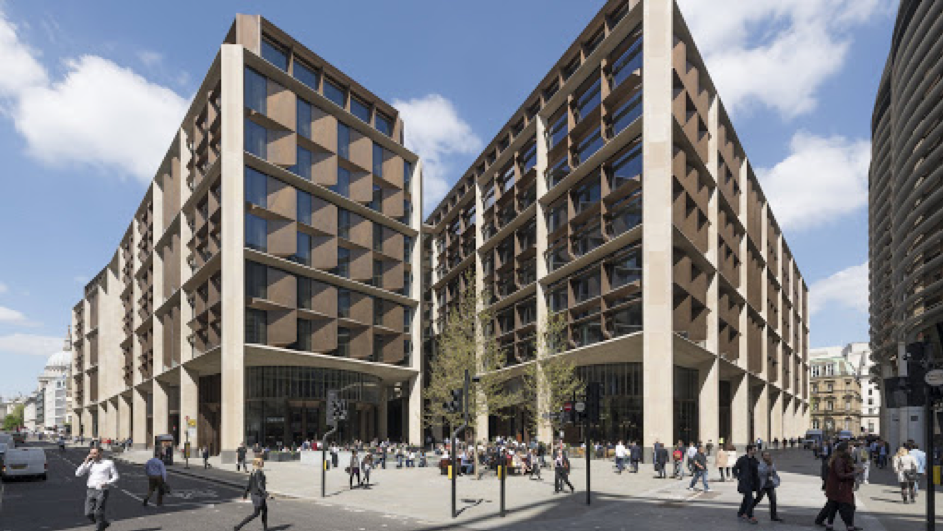
An example of anย almost fully sustainable buildings (according to BREEAM) is the Bloomberg HQ in London (see photograph). Among the many (technological) means to achieve this is, are a green living wall, natural ventilation systems, and 4,000 integrated ceiling panels that combine heating, cooling, and lighting.ย 

Buildings and residential houses are the largest energy consumers in cities (heating, warming, cooling and lightning), not to speak about the production of building materials. They account for 40% of the global energy consumption. Massive realization of energy-neutral buildings (NZEBs) is therefore top priority for urban developers.

Copenhagen plans to be CO2-neutral in 2025 and is on track despite significant growth in population and jobs[1]. District heating and cooling of almost the whole city is the most important tool to achieve this, along with the limitation of car-use. Copenhagen implements a smart thermal grid, that uses all the residual heat that comes from industrial and commercial activities. Seawater is used for cooling.

Copenhagen is a shining example for the rest of Europe. There is sufficient residual heat to supply 90% of the heat demand of all houses and buildings. The Heat Europe project tries to link areas with a surplus of residual heat to areas with a shortage. The video below shows the ambitions, contours and outcomes of this project.

New York is exemplary in another way. The Dirty Buildings Bill requires that 50,000 buildings reduce emissions by 40% by 2030 and 80% by 2050[2]. This includes the installation of new windows, insulation, and other retrofit procedures. The law applies to buildings over 25,000 square feet, and together they account for half of all emissions from buildings, although they cover only 2% of total number of buildings in the city[3].

Building permits are useful instruments to influence energy consumption and to promote circularity. In a building permit, requirements can be set for the use of less cement and steel and to limit energy consumption. Switching to sustainable timber is an option for 90% of homes and 70% of offices being built. At the other hand, building in an energy neutral, or even positive way offers many advantages. That is why 37% of British developers are convinced that in a few yearsโ€™ time their portfolio will largely consist of green buildings. 

Besides, a city like London could save over $ 11 billion over the next 5 years by using existing buildings more efficiently and avoiding new construction, which won’t be a problem in the post-Covid era when one or two days working from home will be the new normal.


[1] https://medium.com/everything-thats-next/this-is-how-copenhagen-plans-to-go-carbon-neutral-by-2025-70849d2d67dc

[2] https://www.fastcompany.com/90336307/new-york-city-is-about-to-pass-its-own-green-new-deal?utm_source=postup&utm_medium=email&utm_campaign=Fast%20Company%20Daily&position=5&partner=newsletter&campaign_date=04182019

[3] https://www.archdaily.com/915656/new-york-citys-mayor-is-planning-to-ban-new-glass-skyscrapers?utm_medium=email&utm_source=ArchDaily%20List&kth=

Climate policy, where fighting global warming and poverty meet

Next months, these posts deal with the challenges of Earthlings of bringing humane cities closer. These posts represent the most important findings of my e-book Humane cities. Always humane. Smart if helpful, updates and supplements included. The English version of this book can be downloaded for free here and the Dutch version here

Neighborhood Poverty and Household Financial Security | The Pew Charitable  Trusts

Challenges

After the eradication of Covid-19, the world must focus again on the two epoch-making challenges, mitigation of global warming and fighting poverty. According to the World Economic Forum, the mayor threats of humanity. By selecting proper policy tools, both challenges can be addressed at once

The termination of greenhouse gas emissions in 2050 requires huge investments, roughly $ 50 to $ 200 per ‘saved’ cubic meter CO2-equivalents.  At the same time, these investments provide a global economic stimulus of $ 16,600 billion.

Addressing global warming

In summary, municipal authorities worldwide have to work together with all stakeholders, citizens not in the last place, to reduce global warming, and implement a series of activities such as:

  • Covering all suitable roofs with solar panels;
  • Installing wind turbines in seas adjacent to densely populated areas;
  • Creating sufficient storage options for the short and medium term;
  • Creating ‘smart grids’ to manage the production and consumption of electricity;
  • Heating houses with district heating systems powered by industrial residual heat, hydrogen or heat pumps;
  • Reducing energy use through insulation, efficient use of buildings and smart thermostatic systems;
  • Scrutinizing the necessity of new construction and take care that it apples to BREEAM requirements;
  • Using โ€˜greenโ€™ hydrogen for industrial processes
  • Using biotechnology to remove oil, coal and gas from industrial production
  • Reducing use of cars (electric ones included) by urban design, enabling walking and cycling opportunities by public transport and by MaaS.
  • Replace where possible flying by traveling by train
  • Reuse of waste at the highest possible level;
  • Intensification of responsible production of food;
  • Adjustment of consumption patterns like mitigating the use of meat.

Despite the magnitude of the challenge involved by the transition to climate-neutral cities, there is reason for optimism. Money is not the big issue. The required investments will pay for themselves in the long term and the transition to clean technology will contribute to responsible economic growth. Howeverโ€ฆ.

Addressing poverty

The overriding limitation is the lack of skilled labor and here is the connection with fighting poverty. The transition to an energy-neutral society will offer ample job opportunities. That is why care for jobs, a reasonable income, adequate housing and education go hand in hand with combating global warming. Jobs are the best guarantee for a reasonable income and job opportunities are an incentive to invest in education. 

It is already ten years ago, that the United nations called for a โ€˜Global Green New Dealโ€™ in which developed countries would invest at least 1% of GDP on reducing carbon dependency, while developing economies should spend 1% of GDP on improving access to clean water and sanitation for the poor as well as strengthening social safety nets. 

At this moment Green New Deal programs are at the brim of implementation in the US (What a relief!!!!), Canada and Europe as well.ย These programs are achieving net-zero carbon emissions in the next decades and potentially create millions of well-paying jobs in order to create the necessary infrastructure and to reduce the number of poor, work- or homeless people correspondingly. Add to that protection against monopolies, investments in public transport, access to affordable housing and healthy food, and justice for the historically marginalized people in the transition to a new economy.

If these promises become true, the eradication of Covid-19 will be followed by significant steps towards a more humane world.ย 

Cities are unhealthy places but poverty makes it worse.

Next months, these posts deal with the challenges of urban life but also with the prospects of bringing humane cities closer. These posts represent the most important findings of my e-bookย Humane cities. Always humane. Smart if helpful, updates and supplementary reading included. The English version of this book can be downloaded for freeย hereย and the Dutch versionย here.ย ย 

Polluted air: Photo by Holger Link on Unsplash

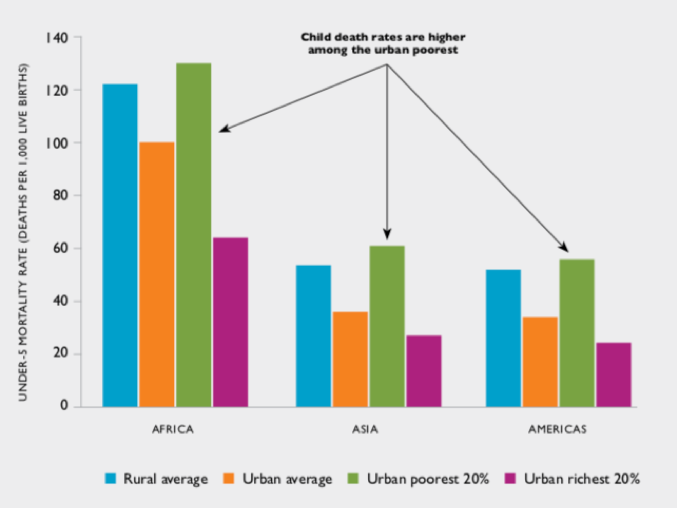
During the last decades, health has improved significantly. Globally, between 1990 and 2015, the worldwide mortality rate of children below the age of 5 dropped from 90 deaths per 1,000 live births to 43. But this is an average and hiding large differences between countries and within countries as the graph below illustrates[1].

Under 5-year child mortality rate โ€“ Source: The Urban Disadvantage, 2015.

The global decrease in child mortality resulted from successfully combatting infectious diseases, better medical care, more breastfeeding, measles vaccination, vitamin A supplementation, and the use of impregnated mosquito nets. At the same time, the AIDS epidemic threatened to reverse the progress made, in particular in eastern and southern Africa[2]. Moreover, in developing countries in particular, improvements in health of the poorest groups were not accompanied by improvement of income, job opportunities and living conditions, which resulted in a huge and persistent increase in family size, making the poverty even worse. 

The poverty of the rural population in developing and emerging countries triggered an unprecedented urbanization. Unfortunately, cities appeared to be unhealthy places, in particular migrants and other poor inhabitants. Infectious diseases are still widespread. In developing countries, they are associated with the lack of sanitation and drinking water. The presence of mosquitos is a lasting danger. Polluted air is threatening health in each city. According to the Global Burden of Diseases Study of the World Health Organization, 4.2 million deaths worldwide every year are caused by particulate pollution[3].

India

Take India for example. Air pollution is the direct cause of 627.000 deaths annually. Moreover, an official study of 1,405 cities reveals that only 50% of urban areas have water supply connections and that water is supplied on an average for only three hours a day. Waste disposal and sewage treatment plants are missing in most Indian cities: 30% of the households have no toilets, the coverage of the sewage network is merely 12% while the treatment of sewage is even lower at 3%. Most of the untreated sewage is discharged into rivers, ponds or lakes, which are also the main source of potable water[4].

In the past, cities in emerging and now developed countries where extremely unhealthy places too, characterized by frequent outbreaks of epidemics that regularly killed large sections of the population. Yet, living conditions, including sanitation and availability of clean drinking water and medical care have improved. Growing prosperity and deliberate policies were accompanies by decreasing family size.  The air has become cleaner but air pollution continues to be a major problem. Still, large wealth related differences in health persist.

Asthma

Many chronic diseases in emerging and developed countries are associated with air quality. More than 26 million people in the U.S. have asthma, and therefore difficulties with breathing. African-American residents die three times more from asthma than whites. They often live in segregated communities with poor housing, near heavy industry, transportation centers and other sources of air pollution[5]. The concentration of particulate matter near main road arteries is irresponsibly high, especially on warm, windless days.


Amsterdam

In Amsterdam too, the level of pollution from particulate matter and nitrogen dioxide (NO2) exceeded the standards of the World Health Organization (WHO). As a consequence, the life of an average citizen is shortened with one year [6]. Moreover, 4.5% of the loss of healthy years is the result of exposure to polluted air too. To put this outcome in context: The percentage is less than the damage to public health caused by smoking (13.1%) and overweight (5.0%), but more than the damage caused by lack of movement (3.5%) and excess drinking (2.8%)[7].


Lifestyle-related health problems

At the same time, growing prosperity of city-dwellers comes with lifestyle related health problems, the abuse of alcohol and drugs included, like heart problems, cancer, obese and  stress.  Their solution requires major changes in the design of cities and the behaviour of citizens, and include the provision of parks and other green spaces, making cities more walkable, a general reduction of cars, the transition to electric vehicles, and changing food and moving habits.

As a consequence, improving health implies improving the availability and affordability of care and fighting poverty as well. Many diseases are directly related to living conditions, which in turn are related to wealth. A billion city dwellers worldwide live in slums, on sidewalks or below bridges. Nearly all of them lack drinking water and sanitation.

Therefore, a humane city will focus on providing adequate care and for all its citizens, accompanied by healthy living conditions, shelter, work and income. 


[1] https://www.savethechildren.org/content/dam/usa/reports/advocacy/sowm/sowm-2015.pdf

[2] https://data.unicef.org/resources/levels-trends-child-mortality-2017/

[3] http://ghdx.healthdata.org/gbd-2016

[4] http://www.thehindu.com/opinion/columns/smart-cities-dont-make-me-laugh/article19897715.ece

[5] https://nextcity.org/features/view/why-racial-disparities-in-asthma-are-an-urban-planning-issue

[6] https://www.infomil.nl/onderwerpen/lucht-water/luchtkwaliteit/regelgeving/wet-milieubeheer/beoordelen/grenswaarden/

[7] https://www.parool.nl/nieuws/verwachte-verbetering-blijft-uit-lucht-in-de-stad-nog-net-zo-vies~bea8f836/

Looking for a humane city

Introducing a free new book

An ever-increasing part of the global population lives in cities. At one side the cities are engines of economic growth. At the other side, a large part of their population lives in poverty. At one side, technology is propagated as a mighty enabler and cities must be โ€˜smartโ€™, at the other side it has replaced craftsmanship by dull jobs, as long as these are note wiped away too. These sides belong to one type of coins, which is the predominant disconnection between the interests behind economic growth and social and ecological values. 

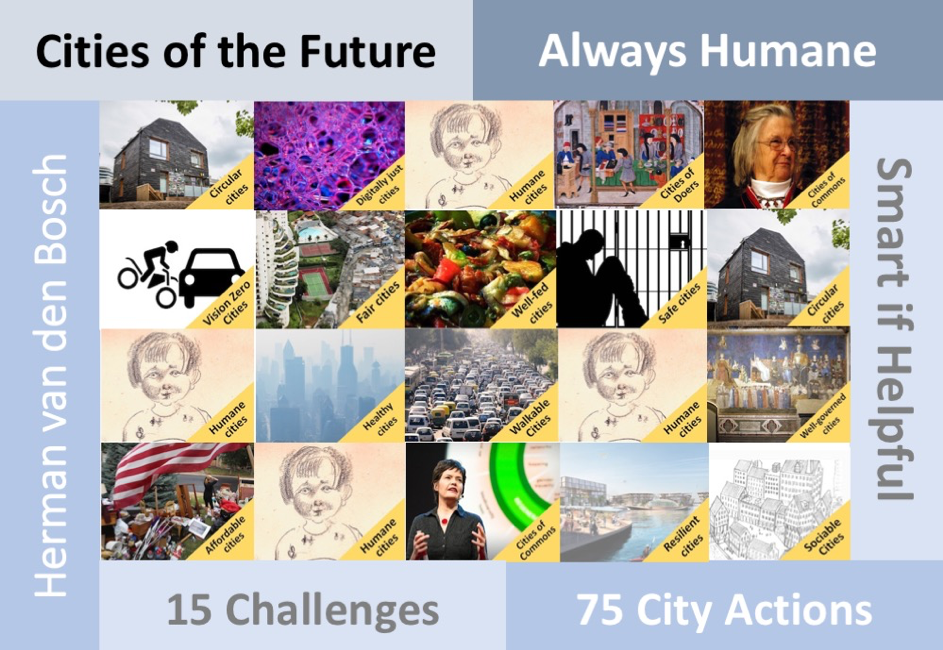
I have tried to forge another coin, the humane city, were all citizens live decently and children have equal chances. The fifteen chapters of the book Future Cities, Always Humane. Smart if helpful.  provide a comprehensive picture of the development of humane cities. 

Anybody interested can download for free the English versionย hereย and the Dutch versionย hereย (both optimized for screen use). A Dutch version (optimized for printing) can be foundย here.ย 

During the next months, this blog enables you to reed posts representing the tragic of urban life but also the prospects of improvement, which ultimately will bring humane cities closer. These posts represent the most important findings in my book, updating and supplementing them.

This post is illustrated with two sketches that my father made in 1939 of children in Maastricht Stokstraat quarter, then a slum-like neighborhood, now gentrificated. 

When I was writing about the humane city, I always had in mind these and the hundreds of millions other children who still live on the brink of poverty. Only in the US – which is said to be โ€˜the greatest country in the worldโ€™ – we are talking about 40% of all children. Unfortunately, the fate of their children will not be much better.

Writing the book has depressed me and also made me angry at those who believe that technology can solve all problems. Instead, societal changes at all levels are necessary preconditions. Still, each chapter illustrates that well-chosen technologies that might support the de development of humane cities. 

The most important question is, what is the main challenge to become a humane city? The best answer is in Julian Agyeman’s definition of just sustainability: The need to ensure a better quality of life for all, now and in the future, in a just and equitable way, while living within the boundaries of supporting ecosystems[1].

Unequal opportunities for the inhabitants of the earth are a recurring theme in most chapters. Many attempts have been made already to improve the fate of mankind. Some were successful, many failed. For instance, social housing projects were counterproductive because social housing has increased segregation and came without (better) work, liveable income and education. 

The only way towards a humane city is indeed the most difficult one: An approach that tackles all problems at once, considering their interrelatedness. Cities are the right place for such an approach, as the interdependence of their problems is obvious. Still, it will take many years, provided the preconditional societal reforms occur.


[1] Ducan McLaren & Julian Agyeman: Sharing Cities, A case for Truly Smart and Sustainable Cities.  MIT, 2015, p. 200

Digital technology eats politics for breakfast.

This short essay is looking for an answer to the question “Does technology develop autonomously or can society be in control?

This issue takes a central position in two thought-provoking books to be discussed below [1].

The first book is Radical Technologies, written by Adam Greenfield (Verso, 2017). The second one is A New Digital Dealby Bas Boorsma (Rainmaking Publications, 2017). Both authors have been involved in the development of smart cities for many years. Bas Boorsma among others in various global and regional roles in Cisco. Adam Greenfield โ€“ also author of Against the Smart City[2]has been working among others as an information architect for Nokia. Nowadays he is teaching at London School of Economics. Both books go beyond smart cities and focus on the role of digitalization in society.

Setting the stage

Bas Boorsma has a strong belief in the – until now only partially realized – potential of digital technology. Adam Greenfield refuses to discuss any such hypothetical value. He refers at Stafford Beer’s famous phrase The purpose of a system is what it doesand that is the colonization of the daily life by technology giants and near-monopolists like Google, Apple, Amazon, and Facebook, called ‘the Stacks’ and other big technology companies.

Digitalization

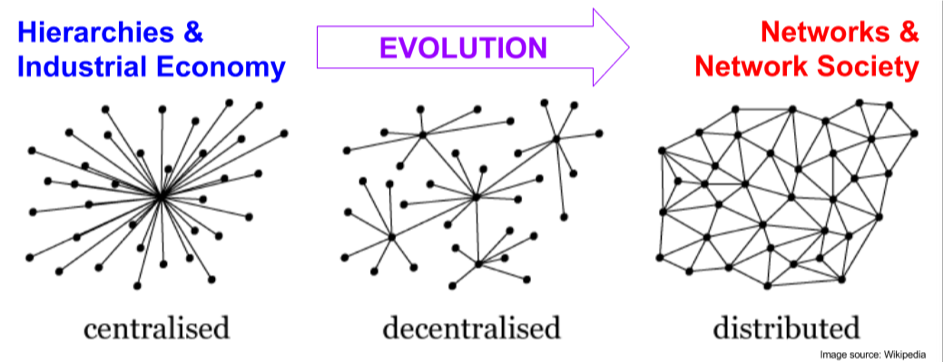
The essence of digitalization is restructuring economy and society with digital communication and infrastructures. According to Bas Boorsma, the network paradigm will replace centralist thinking by the development of many connected nodes, in society and in the digital world as well. The organisation of society and the principles behind the Internet will reinforce each other. 

Many expected digitalization to facilitate the emergence of a ‘true’ free market, i.e. an economy based on peer-to-peer principles, collaboration, with small enterprises relying of the network effect and digital tools to conduct business in ways previously reserved for large corporationsย (New Digital Deal, p.52). This is what initially happened indeed: The development of platforms empowered start-ups, small companies and professionals.ย Many network utopians believed the era of ‘creative commons’ had arrived and with it, a non-centralized and highly digital form of ‘free market egalitarianism’(New Digital Deal, p.52).

Some already predicted the decline of capitalism.

Bas Boorsma

However, the network paradigm and the platform economy have been appropriated to a large extend by โ€˜the Stacks’ and other big companies. As a consequence, the workings of capitalism, revitalizing monopolism and oligarchy have been amplified. Digitalization-powered capitalism now possesses a speed, agility and rawness that is unprecedented(New Digital Deal, p.54). In this respect Bas Boorsma’s en Adam Greenfield’s visions do not divert much. 

A New Digital Deal

According to Bas Boorsma digitalization cannot be countered, but steering is needed and feasible. He applies the analogy of a skillfully steered canoe sailing an incredible fast-flowing river, harvesting its energy. A New Digital deal must steer the further development and impact of digitalization to deliver on its promise in full, and we have to do this in a moral contextโ€ฆ (New Digital Deal, p.42). In order to deploy digitalization and to manage platforms for the greater good of the individual and society as a whole, new regulatory approaches will be requiredโ€ฆ (New Digital Deal, p.46). This has to enable us to manage technological growth, regulate platforms, celebrate recalibrated free market principles, prepare for the emergence of new and better jobs, harvest digitalization generated wealthโ€ฆ and to tax wealth and platform rather than labor(New Digital Deal, p.65).

Thus the New Digital Deal requires strong regulatory power to bridge the tension between at one side the initial expectations and hopes for a post-capitalist society, dominated by many connected small actors and at the other side the appropriation of the digitalization and the platform-economy by โ€˜the Stacks’ and other companies. The question is what does this regulatory power include. 

Bas Boorsma deals in depth with the societal impact of digitalization in domains like healthcare, education, transport, and energy. In each case he explores the content of the New Digital Deal. In the meantime I searched in vain for the answer to the question about the regulation of free markets and growing monopolism of ‘the Stacks’. The answer to this question is particularly important because it is exactly the unrestricted growth of monopolism that feeds Adam Greenfield’s deep pessimism with respect to the societal benefits of digitalisation. Adam Greenfield does not answer this question either, presumably because there is no answer. Still, I think there is one.

The vanity of a digital paradise

Adam Greenfield

Before returning to the New Digital Deal, I go deeper into the reason of Adam Greenfield’s pessimism. In consecutive chapters of his book he unveils how big companies โ€“ sometimes in cooperation with the state – have taken possession of digital technologies: Where previously everything that transpired in the fold of the great city evaporated in the moment it happened, all of these rhythms and processes are captured by the network and retained for inspection (Radical Technologies, p.5). This because of the combined effect of smartphones, sensors, security cameras, ‘wearables’ – like Hitatchi’s Business Microscope – and the fast increasing capabilities of the algorithmic production of knowledge. 

Was blockchain technology intended as the foundation for newly to develop decentralized peer-to peer distributed organizations, is it actually captured by large companies. They embrace it as a fundamentally improved entrusted framework for identity and data sharing (contracts and databases). 

However truly transformative circumstances will arise not from any one technology standing alone, but from multiple technical capabilities woven together in combination (Radical technologies, p.273). Again ‘the Stacks’ will benefit most. Their innovation capacity is larger than any other company and their cash is unlimited. They are turning the entire planetary-scale entrepreneurial community into a vast distributive R&D lab… At any given moment there are thousands of startups busily exploring the edges of technological possibility, and shouldering all the risk of involved in doing so. (Radical Technologies, p.281) By focusing on the development of ‘minimum viable products’ they anticipate to be taken over by one of ‘the Stacks’ or other technology companies and cash the millions these companies offer. The start-up community is more vital than ever before but is nothing like the decentralized occupants of the nodes of the network on the eve of a new liberalized order. In stead they support the dominance of ‘the Stacks’. 

The failing of politics

The influence of politics โ€“ other then incidental support – in western countries with respect to the growing power of ‘the Stacks’ is negligible. Maybe with the exception of the European Union that is entangled in rearguard actions by fining some eye-catching forms of monopolism. In contrast, the Chinese gouvernment is molding technology to its own aims, albeit not in an exemplary way. Supported by China’s own ‘Stacks’ – among them Alibaba and Baihe – the government is integrating smartphones, wearables and social networking services to establish the degree of ‘social credit’ of all of its citizens.

I expect a negative answer from Adam Greenfield to the question whether technological development is an autonomous force like the fast-floating river in Bas Boorsma’s analogy. In the USA large-scale scientific programs supervised by state-institutions like the legendary DARPA enabled major technological development. This carefully planned process resulted not only in the nuclear bomb but also in the discovery of all components of the later iPhone, which initial development – by the way – has been subsidized by the state too, as has been disclosed in detail byย Mariana Mazzocato[3].Nowadays the development of technology and its impact on employment is predominantly instigated by strategic choices made by ‘the Stacks’ and other technological companies.

As a consequence, any ‘deal’ regarding steering technological development or safeguarding the interest of citizens and society at large will have to target ‘the Stacks’.

The New Digital Deal revisited

This brings us back to the New Digital Deal. Targeting ‘the Stacks’ has to be preceded by decisive lawmaking at national or supranational level with respect to the aim and the conditions of digitalization for the purpose of society at large. Referring at Bas Boorsma the aim is enabling a networked and connected society with thriving activity in all nodes and free markets in between. A far from complete – list of conditions includes:

  • A strong and enforced anti-trust policy.
  • The discouragement of acquisitions in favor of collaboration within networks.
  • Unbundling heterogeneous conglomerates of companies (‘to big to fail’).  
  • Governance guidelines discouraging short-termism, the stock markets included.
  • Considerable taxes on profits, which might be released by participation in state-coordinated research programs together with universities and other stakeholders.
  • A basic-income combined with the right at paid work for adult citizens.

An emerging digital community

I seriously doubt the ability of the bitterly divided European states to settle conditions as mentioned above in the near future. Meanwhile my expectations of lower level governments – cities in particular – are higher. At this level, high and low tech digital tools might be applied and enabled to prove their value in relation to challenges as traffic, healthy air, sustainable energy and safety. Bas Boorsma’s 20 building blocks of community digitalization will prove their value here. Each of these building blocks is actionable. The ‘community digitalization’ approach puts citizen’s needs and wants in the center and their fulfillment will come from a network of stakeholders. The local government can be held responsible for robust connectivity and digital safety and also for interoperability and the deployment of non-proprietary protocols. 

Somewhere at an undetermined but eagerly awaited moment in the future a world of collaborating cities might force states to take their responsibility and issue the laws that are necessary to establish a New Digital Deal. 

Did your appetite grown?

Start reading both books! Those who are attuned to practical solutions better start with Adam Greenfield’s because his well-documented approach to technology definitely will put practice in a new light. Also his way of phrasing is excellent. Readers with a more academic mind-set are advised to start with Boorsma’s book, because his life-long experience will be helpful in making theory actionable. And that is where many of us are waiting for.


[1] The title of this short essay is inspired by the phrase ‘Culture eats strategy for breakfast’ attributed to management guru Peter Drucker. This post has been published before at Smart City Hub.

[2]https://www.goodreads.com/book/show/18626431-against-the-smart-city

[3]https://wp.me/p32hqY-6p