

Many are convinced of the value of sustainable energy and the number of proponents continues to grow. Nor is energy storage an issue anymore. In this short essay, I discuss three different methods for storing energy[1].
A forth solution, storage in hydrogen, will be dealt with in a next article.
Storage in batteries
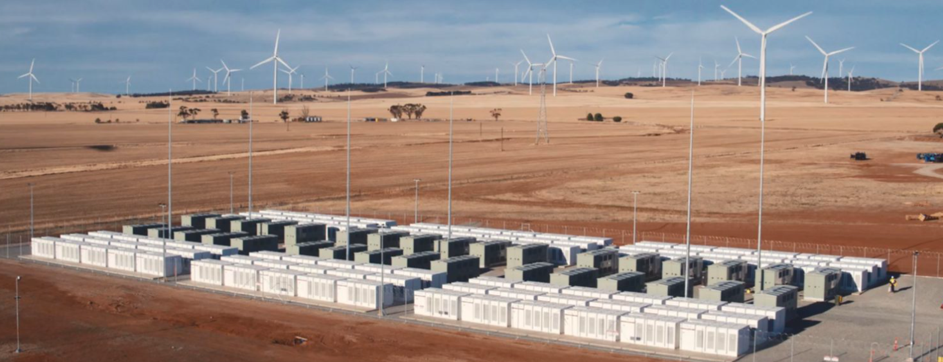
For the time being, Tesla has built the largest energy storage battery in the world in South Australia with a power of 100 megawatts and a storage capacity of 129 megawatt-hours[2]. The electricity comes from a local wind farm. The battery has immediately proven its value. In the event of a recent power outage, it restarted the supply of energy many times faster and without any problems for the users than the available gas turbines. Moreover, for a price that is 90% lower. It is very plausible that a storage system of sufficient size could have prevented the problems at Schiphol half a year ago due to a short-circuit in a Tennet cable[3].
Vattenfall uses 500 BMW i3 batteries for its energy storage project in Wales[4]. Their joint power is 22 megawatts and they are fed by of 76 wind turbines. They supply 13% of the electricity needs of all households in Wales annually.
The projects mentioned-above are examples of centralized storage facilities for large-scale delivery of renewable energy. The Amsterdam virtual power plant is a small-scale example[5]. Here 50 households produce electricity with solar panels, store them in-house and trade them if the price on the energy market is the most favorable. Tesla will do the same in Australia, but with 50,000 households[6]. The company is working on a huge virtual power plant. Each household has solar panels, with a power of 5 kilowatts and a Tesla Powerwall 2 battery with 13.5 kilowatt-hours capacity. The power of plant as a whole is 250 megawatts and its storage capacity 675 megawatt-hours.

Energy production and storage in the Netherlands will contain both large and small-scale elements. In the report Feasibility and scalability of the neighborhood battery, DNV GL investigates the contribution to the storage of energy in the Netherlands of small-scale energy storage systems, also known as neighborhood batteries[7]. Their construction is simple and the impact on the environment is limited. The concept of the neighborhood battery is well applicable in residential areas. It enables peer-to-peer exchange and trading of electricity.
The Amsterdam Energy Arena is an example of the application of a neighborhood battery. Its storage capacity is 3 megawatts[8]. Energy comes from 4200 solar panels on the roof of the stadium. This virtual power plant will supply power in the immediate vicinity and is also a buffer for the grid.

All projects that have been discussed up to now deploy Litihum (li’ion) batteries. The fast-growing demand makes lithium increasingly scarce and expensive. That is why alternatives are sought. One is the manganese-hydrogen battery[9], another the silicon battery[10]. The latter might have a storage capacity that is ten times larger than that of the li’ion battery. However, it will take years before both are on the market.
Heat storage in salt
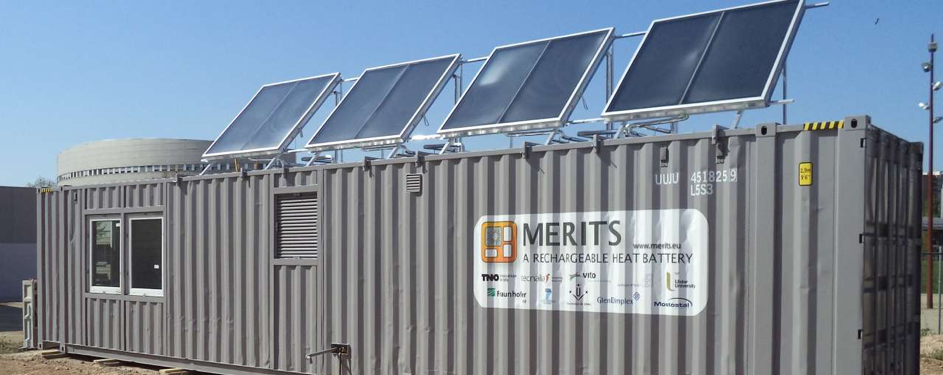
The storage of heat is very simple. All you need is a block of salt of two cubic meters. This will provide enough energy to heat your home throughout the winter: Thermal solar collectors convert sunlight into heat. The heat causes a chemical reaction in the salt, resulting in its dehydration. Conversely, adding water to the dry salt releases heat.
PhD student Pim Donkers (TU / e) investigated how that process works exactly and which salt you can use best[11]. The biggest problem was the degeneration of the salt, which gradually reduced its storage capacity.
The Dutch research institute TNO has solved this problem by influencing the properties of the salt used[12]. The advantage is obvious; salt is cheap and widely available. TNO is collaborating with nine companies in eight European countries to develop this invention into a market-ready product within the framework of the European project CREATE. A demo house that is supplied with heat in this way will be open for the public in short notice.
For several years, Marnix ten Kortenaar has been working on the development of the sea salt battery in his company Dr. Ten[13]. In all its simplicity, the principle is a container with dissolved sea salt and carbon electrodes. The Gridflex project is a pilot in the Dutch village of Heeten, deploying 25 salt batteries and that aims to create a local energy market[14]. The solar energy is generated, stored, traded and consumed completely locally. For this pilot, Energy cooperative Endona was granted exemption from the Dutch Electricity Act[15].
A third example comes from the German company EWE that intends to use salt domes for the storage of electricity[16], based on the principle of the redox battery[17].

The project is called brine4power. A positive and a negatively charged electrolyte form the basis for this ‘natural’ battery, starting from the ions of ordinary salt[18].
A test set-up is realized in containers. Their storage capacity will gradually be increased to 2500 kilowatt-hours. Next, the storage of the electrolytes in salt domes will be piloted . This trial will take place in Jemgum along the Ems, near Groningen. EWE now uses these domes for the storage of gas. In 2023 ultimately, the battery will consist of two salt domes with a volume of 100,000 m3 and a total storage capacity of 700 megawatt-hours. As far as is known yet, no harmful effects are attached to this form of sustainable energy management.
Energy storage with water

One of the oldest and still most common way of storing energy is pumping water to reservoirs with the help of surplus electricity. In times of energy scarcity, this water is used to generate hydro-energy. In the early 1980s, Luc Lievense designed a number of applications for this principle that could be used by the Netherlands[19]: Artificial lakes in the Markerwaard and even in the North Sea varying in height from a few ten to hundred (!), meters.
It soon became clear that maintaining one or two conventional power plants for peak capacity was much cheaper.
Nowadays, the idea of heat storage in water or in another liquid, follows another track: Excess energy is converted into heat which is that is stored in water[20]. The company Ecovat has developed a storage vessel (‘the ecovat ©’) in which 1500 m3 of water is stored underground for a period of 6 months with a temperature of 90 ° C and a yield of 90%.[21]

The ecovat © is a double-walled vessel. Heat exchangers between the double wall provide for the extraction or addition of heat to the water in the vessel. The water that runs through the heat exchanger is heated with sustainable heat from local geothermic sources , waste heat and solar energy. The ecovat © is also equipped with control software. This ensures, among other things, that action is taken on the basis of current weather forecasts and energy prices.
A demonstration project has been realized in the Dutch village of Uden. This project has a capacity of 88,000 kilowatt-hours and can supply up to 1,000 homes with heat. Ecovat works together with Enexis, a regional grid operator in the Netherlands. Ecovat is part of a consortium called Flexible Heat and Power (FHP). This consortium is co-financed under Horizon 2020.
The reduction of the production of natural gas production in the Netherlands has increased the urgency of the question from where we will get our heat in the future. Sustainable sources like wind, sun and earth are plentiful, provided huge investment to make them available. For the purpose of storing several alternatives are available too, which enables making locally-adapted choices.
[1]https://www.lazard.com/perspective/levelized-cost-of-energy-2017/
[2]https://www.duurzaambedrijfsleven.nl/energie/27113/tesla-gaat-voor-grootste-virtuele-energiecentrale-bestaande-uit-50000-huishoudens
[3]https://www.volkskrant.nl/nieuws-achtergrond/ik-weet-het-even-niet-zegt-ict-schiphol~bdcf9424/?utm_campaign=shared%20content
[4]https://www.duurzaambedrijfsleven.nl/energie/23689/alfen-levert-mega-energie-opslag-van-bmw-batterijen-aan-nuon
[5]https://www.expirion.nl/blog-3–burgers-bouwen-eigen-virtuele-elektriciteitscentrale.html
[6]https://electrek.co/2018/02/04/tesla-powerwall-solar-virtual-power-plant/
[7]https://www.dnvgl.nl/publications/haalbaarheid-en-schaalbaarheid-van-de-buurtbatterij-113722
[8]https://www.duurzaambedrijfsleven.nl/stad-van-de-toekomst/29203/hoe-148-tweedehands-elektrische-auto-accus-de-arena-van-stroom-voorzien
[9]https://www.duurzaambedrijfsleven.nl/energie/28415/nieuwe-batterij-voor-goedkope-opslag-hernieuwbare-energie
[10]https://www.duurzaambedrijfsleven.nl/energie/28421/duitse-onderzoekers-ontwikkelen-silicium-accu-met-hoge-opslagcapaciteit
[11]https://www.cursor.tue.nl/nieuws/2015/november/sluitstuk-zout-als-verwarming/
[12]https://www.tno.nl/nl/aandachtsgebieden/bouw-infra-maritiem/roadmaps/buildings-infrastructure/energiepositieve-gebouwde-omgeving/warmtebatterij-doorbraak-opslag-duurzame-energie/
[13]https://www.buurkracht.nl/nieuws/thuis-energie-opslaan-met-een-zeezoutbatterij
[14]https://www.natuurenmilieuoverijssel.nl/friksbeheer/wp-content/uploads/2017/10/energievoorziening-in-de-toekomst-GridFlex-Heeten.pdf
[15]https://www.rvo.nl/subsidies-regelingen/projecten/grid-flex-heeten
[16]https://www.ewe.com/de/presse/pressemitteilungen/2017/06/ewe-plant-größte-batterie-der-welt-ewe-ag
[17]https://www.deingenieur.nl/artikel/redoxbatterij-levert-buffer-boerenstroom
[18]https://www.ewe-gasspeicher.de/home/b4p
[19]https://www.deingenieur.nl/artikel/lievense-de-man-van-het-opslagbekken
[20]http://www.dgem.nl/nl/andere-duurzame-energie-oplossingen/thermische-energieopslag-systemen


 Music: Listen, Look and Enjoy