This article is part of the series 25 building blocks to create better streets, neighbourhoods, and cities. Read how design, starting from street-level view contributes to the quality of the urban environment.
Plinths express the nature of activities inside
The visual quality, design and decoration of the plinth, the ‘ground floor’ of a building, contributes significantly to the quality of the streetscape and to the (commercial) success of the activities that take place at plinth level. This also applies, for example, if the activities of a workshop can be observed through the windows. Blank walls speed up visitors’ pace, unless this wall has attractive art. Vacancy is disastrous.
A plinth displays the destination of a building or a part of it (photo bottom left). Fashion stores and suppliers of delicacies depend on its ability to attract buyers. There is nothing against allowing the plinth to expand slightly onto the street – think of beautiful displays of fresh vegetables – if a sufficiently wide barrier-free pedestrian route is maintained.
The total length of streets that must generate customers and visitors must not be too long in order to keeps vacancy to a minimum. This may mean that still profitable shops in streets where the number of vacancies is increasing must consider moving if revitalization of the street is infeasible. The space left behind can best be revamped into space for housing or offices to prevent further dilapidation.
Plinth of non-commercial destinations
The need for an attractive plinth also applies to non-commercial spaces. This may concern information centers, libraries, day care centers for children or the elderly, places where music groups rehearse, etcetera. Co-housing and co-working centers might also concentrate several activities in a semi-public print. In an apartment building, you might like to see an attractive portal through the glass, with stairs and elevators and a sitting area.
Residential plinths
Houses in the more central parts of the city can also have an attractive plinth. In practice, this happens often by placing plants and creating a seat on the sidewalk. The so-called Delft plinths are narrow, sometimes slightly raised additional sidewalks for plants, a bench, or stalling bicycles (photo bottom middle). The worst is if the plinth of a private house is mainly the garage door.
The aesthetics of the plinth
In many pre-war high streets, the plinth was designed as an integral part of the building. In the ‘60s and ‘70s, many retailers modernized their businesses and demolished entire ground floors. The walls of the upper floor, sometimes of several buildings at the same time, rested on a heavy steel beam and the new plinth was mainly made of glass (photo top left). Often a door to reach the upper floors is missing, complicating the premises’ residential function. Initially, these new fronts increased the attractivity of the ground floor. However, the effect on the streetscape has turned out to be negative. In Heerlen, artist and ‘would be’ urban planner Michel Huisman (the man behind the Maankwartier) is busy restoring old shopfronts together with volunteers and with the support of the municipality (photos top right). In Amsterdam, shopfronts are also being restored to their original appearance (photo bottom right).
Plinths policy
The sky is the limit for improving plinths, as can be seen in the bookStreet-Level Architecture, The Past, Presentand Future of Interactive Frontages by Conrad Kicker and the Superplinten Handbook , commissioned by the municipality of Amsterdam.
In 2020, a plinth policy was introduced in the Strijp-S district in Eindhoven from a social-economic background. 20% of the available plinths is destined for starters, pioneers and ‘placemakers’. Continuous coordination with the target group is important here. In The Hague, 100 former inner-city shops have now been transformed into workplaces for young and creative companies. Differentiating rents is part of the plinth policy too.
Follow this link to find an overview of all articles.
This article is part of the series 25 building blocks to create better streets, neighbourhoods, and cities. Read how design, starting from the physical aspects of the streetscape and -pattern contributes to the quality of the urban environment.
Streets and squares are appreciated best if there is cohesion between several elements, such as the block height, the number of floors, the type of houses, the building line and the colour. When some elements work together, others can vary. Uniformity without variation results in people avoiding a street.
Coherence and variation in balance
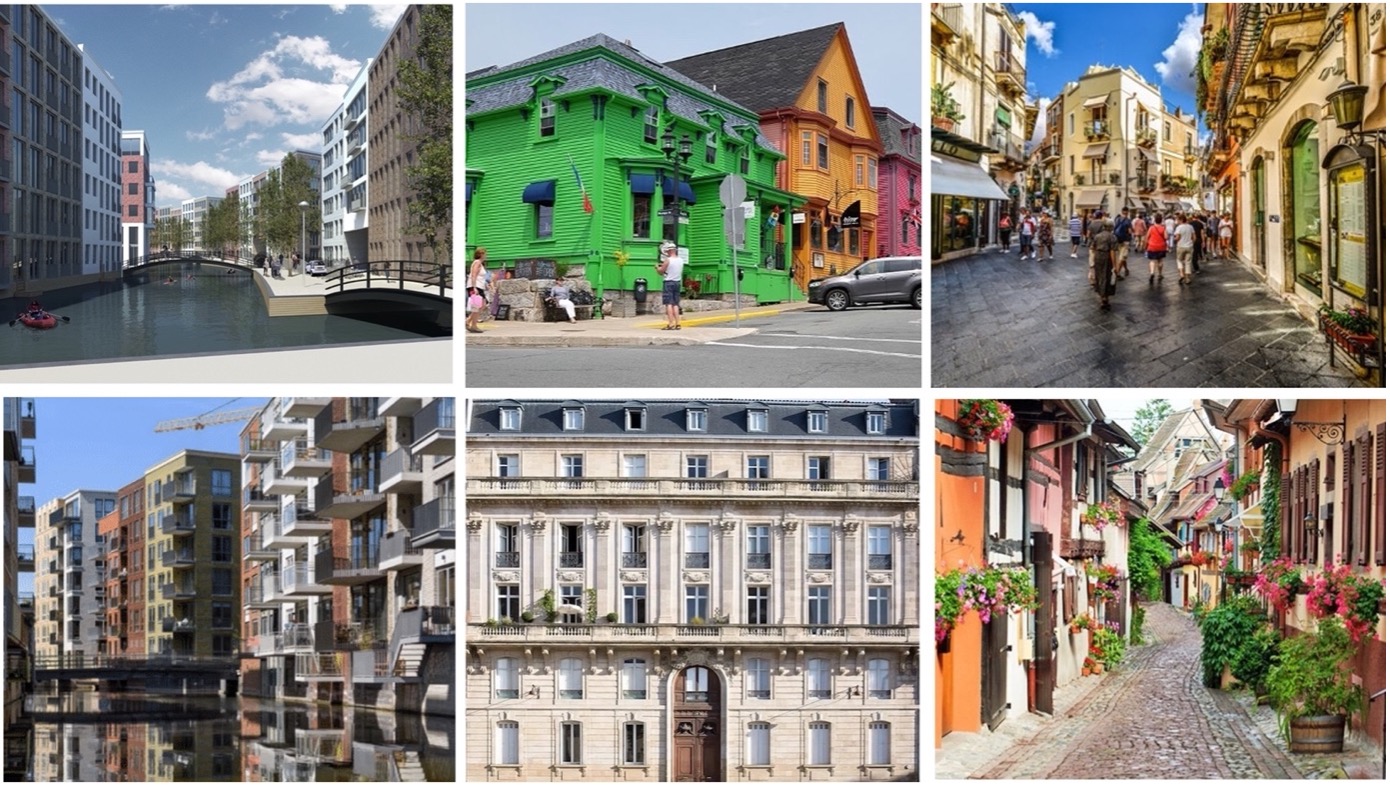
Variation creates liveliness and will extend the time visitors spend on a street. This principle is applied almost everywhere in the world. Walls are fitted with arches, pillars, porches, porches, pitched roofs, windowsills, canopies, balustrades, cornices, dormer windows, linear and vertical elements, see the bottom-centre image of a Paris’ building. At the same time, the attributes of separate buildings that provide variety are most effective against a coherent background. The Parisian avenues illustrate this too, because most edifices are built according to the same principles while the ornamentation of each facade differs. The attractive streetscape in Sicily (top right) and in the Alsace (bottom right) demonstrate an almost perfect balance between similarity and difference.
Use of colour
A good example are the painted houses in the Canadian settlement of Lunenburg, which was founded in the 18th century by German woodworkers and is a UNESCO world heritage site today (top centre). The nature of the construction and the type of buildings ensure cohesion; the colour provides the variation.
Street pattern
A manageable pattern of similarly important streets contributes to the spread of visitors and provides a level playing field for shops and restaurants. A mesh, which does not necessarily have to be rectangular, facilitates orientation. A rectangular street pattern is at the expense of the element of surprise and detracts from the feeling that there is something to discover. Squares will often be found at street intersections.
Landmarks
Understanding of the pattern of the streets is reinforced by providing intersections with landmarks, such as statues, fountains, or distinguishing buildings (photo, top right). These elements help visitors developing a mental map. Maps every here and there are more helpful than signposts. The fewer poles in the ground, the better.
Canals and moats
Canals and moats also contribute to the attractivity of the streetscape. They restore the human dimension in too wide streets, also in new parts of the city. The images on the left show a central street in Zaandam (top) and a ‘waterway’ in the Amsterdam Houthavens quarter (bottom). The edges of waterways should never be used as parking spaces. Definitely not in Amsterdam, because its unique streetscape.
Follow this link to find an overview of all articles.
Human dimension means that residents nor visitors feel overwhelmed by the environment. An urban planner must avoid them thinking that it is all about other things, such as commerce, traffic, or the buildings themselves, which unfortunately often is the case indeed. Constructions by ‘star architects’ can be crowd pullers but usually also result into a disproportionate use of space. Cities therefore better tolerate only a limited number of such edifices. Alexander Herrebout (OTO Landscape) believes that space has a human dimension if you experience attention for you as a human being and that there are objects you can connect with. For many, this will be more often a historic building (church, town hall) than a modernist one.
Compactness (‘enclosure’)
Compact streets and squares give a sense of security. They encourage people to linger there, increasing the chance of unforeseen encounters. Sjoerd Soeters considers squares in the first place as a widening in the street pattern and therefore they are preferably no larger than 24 by 40 meters. A round or oval shape enhances the feeling of security. If the height of the surrounding buildings is also in line with this, there may be contact between residents and people on the street. Good examples are the square he designed in the Oostpoort shopping center in Amsterdam, but also a square in The Point, a new shopping center in Utah (US), resp. bottom left and bottom center and of course the Piazza der Campo in Siena.
If streets are too wide or narrow or buildings are too high?
Trees, for example a double row all around, will help if a street is too wide or a square is too big. Trees are also a source of reducing urban heat. The extent to which trees contribute to the sense of intimacy is expressed by comparing the images at the top left (Herring Cove Road, Halifax, Canada) and the top right (Course Mirabeau, Aix-en-Provence). A square or a street that is too wide can be further visually reduced by the construction of terraces, the placement of a pavilion or the presence of water features, such as on the Brusselplein, Leidsche Rijn (bottom right). Sometimes also by allowing destination traffic and public transport.
A street that is too narrow can be widened psychologically by designing sidewalks and a carriageway in the same level and shades, possibly separated by a narrow band, as illustrated in the image of the Sluisbuurt in Amsterdam (top center).
If case of high-rises, the human dimension can be respected by planting trees and by placing taller buildings back from the plinth to limit their visibility from the street. This is also illustrated by the image of the Sluisbuurt (top center).
Density
Compactness presupposes a certain density. In a very dense city center is only room for pedestrians and not for traffic, in some cases except for the tram. Though, these areas must be always accessible to emergency services. Waste removal, deliveries and parking must be solved differently, for example on the inner space of blocks or by introducing strict time slots. Every city also needs space for events such as concerts, fairs, etcetera. Accessibility is more important than a central location.
This article is the first in the series 25 building blocks to create better streets, neighbourhoods, and cities.Read how lively places contribute to the quality of streets and squares. Follow this link below to find an overview of all articles.
The public space is like a stage. The Dutch architect and urban planner Sjoerd Soeters, known for the Amsterdam Houthavens, likes to say that. He meant that it is the inhabitants and visitors of cities who provide the liveliness, but that streets and squares must ensure that they come. This apparently worked out well on the Rue Sainte-Catherine in Bordeaux (photo above right).
Shopping facilities and catering
Research shows that the quality of the shopping facilities, also for ‘fun shoppers’, is still the main driver to visit the center of cities. A varied catering offer follows in second place (photo bottom left). A welcome addition are spaces with a non-commercial purpose, such as museums, galleries, art lending, information centers of municipalities or companies, etcetera.
Sidewalks
Sidewalks use to be too narrow, due to the perceived need to accommodate motorized traffic. A sidewalk in central parts of the city must be at least 20 feet wide, such as that of Fillmore Street, San Francisco (top left photo). In that case, sufficient space is offered for greenery, free passage for passers-by and tables or chairs, billboards, and street vendors, who make a welcome contribution to the liveliness of the street.
Opportunity to rest
Places that invite you to linger increase the attractiveness of the area and the chance of unforeseen encounters (collision spaces). These can be terraces, but also non-commercial places such as tree-lined squares with benches, games, buskers (acoustic), an ice cream cart etcetera. One of the most famous examples is the Spanish Steps in Rome. Such spaces usually arise ‘by themselves’, but they can also be designed as such, for instance, squares in Barcelona and Shanghai (photos bottom center and bottom right). By no means it is certain that they will also be used as such.
Minimize traffic noise
In the more centrally located parts of a city, a certain level of sound is part of the experience, but traffic noise is a source of nuisance and drives away visitors. Through traffic is not compatible with all other (inner) urban functions; destination traffic must be reduced, channeled and its speed limited. Noise at events must also be reduced to an acceptable level for visitors, residents, and passers-by, knowing that events attract many people, but can also repel others as well.
Places with a different character
In an atmospheric city center you will find quiet places and others where it is bustling at the same time. Those quiet places can be small parks with playgrounds and benches to rest, but also publicly accessible courtyards of residential blocks.
Exploiting iconic places
Most cities have places with special characteristics. These are often historic or modern buildings, monuments, fountains etcetera. Sometimes it is a well-known square, such as the Vrijthof in Maastricht. Sometimes it is also the boulevard along a river or special viewpoints (photo top middle) that both city dwellers and visitors like to include in their route and where they linger for a while.
Art
All parts of a city with a central function should be amply supplied with art. For this purpose, also (temporarily) empty shops can be used, which also serve as an information center. Think of art objects on the street (possibly replica’s) and fascinating paintings on blind walls, which number must be limited by the way. In the evening, light art can be imagined on the facades of buildings surrounding streets and squares.
It often strikes me how much people agree about the quality of the living environment. Many, especially younger ones, prefer a house built in the ’30s. Older neighbourhoods almost always score higher than modern ones, due to the alleged lack of atmosphere, sociability, and intimacy in the latter. Urban planners, architects and politicians would like to change this, and they are doing so. Slowly.
In urban planning a breeze of fresh air comes in.
How cities in Europe currently look stems largely from the ideas of Le Corbusier through his role in the Congrès Internationaux d’Architecture Moderne (CIAM). The Dutch architect and urban planner Cornelis van Eesteren was also a prominent representative. The influence of the Congress is visible in the spacious post-war residential areas with their long rows of single-family houses and medium-rise buildings. The underlying idea was to design a functional city in which living, working, shopping and recreation all have their own separated places.
Slowly, the voice of a new generation of urban planners in which Jane Jacobs and Jan Gehl (pictures above) play a prominent role became louder. They detest post-war urban expansion and advocate mixing urban functions. 70 years after the publication of her book The Death and Life of Great American Cities, Planetizen magazine predicated urban activist Jane Jacobs as the most influential urban planner ever, even though she never studied this field. Jan Gehl, who did, follows in second place. By the way, Anne Hidalgo, the mayor of Paris, is in 7th place; not because of what she studied but of what she put into practice.
Many others, including representatives of New Urbanism, play an important role in further developing the ideas of Jacobs and Gehl. For instance, they put back on the agenda the return to the 15-minute city. ‘New urbanists’ also top the list: Andres Duany, the author of Suburban Nation at four and Jeff Speck, who authored Walkable City, at ten.
The concept of high-quality living environment
Many contemporary ideas about urban development come together in the concept of high-quality living environment. A compact definition of this concept is improving human well-being in a condensing city. I have collected and clustered references to characteristics of high-quality living environments in many recent publications into 25 building blocks. Each block deals with one aspect of the quality of the living environment, or in other words the creation of better streets, neighbourhoods, and cities.
I hope you get inspired and support the use of these building blocks.
You will find a link HERE that refers to an overview of all upcoming posts.
Throughout history, cities have faced many problems: War and violence, disease, disasters, housing, utilities, traffic, crime, inequality, poverty, and greed. Moreover, the pace of population growth in cities is frightening. Every day, urban population increases by almost 150,000 – mostly poor – people, due to migration or births. Between to date and 2050, the world’s urban population is projected to rise from 3.6 billion to 6.3 billion residents.
The litany of problems affects all cities in the world, but not in the same degree. To cope with these problems, each city must make a diagnose of its own challenges and define solutions.
City-life is complex and most afore-mentioned problems are related and often at odds, think about struggling poverty and reversing global heating. Therefore, these problems cannot be solved in separated silos. This is the reason reason that I reject reductionist approaches like ‘smart city’, ‘sharing city’, ‘circular city’ and the like.
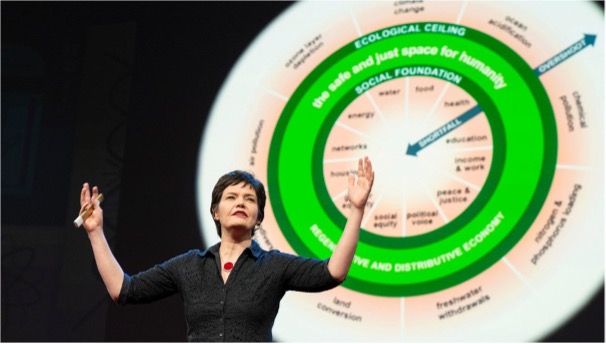
Instead, framing the challenges that cities face must start from the complexity of the city as such and the interrelations of people causing these problems. In this respect, I found the concept of a doughnut economy particularly helpful. It is elaborated by the British economist Kate Raworth in a report entitled A Safe and Just Space for Humanity. The report takes the simultaneous application of social and environmental sustainability as the point of department for humane behavior.
In essence, Raworth says that people have a great deal of freedom in the choice of activities in their city, if they stay within two types of boundaries:
The first limit is set by ecosystems; which make life on earth possible. However, we can also frustrate their operation, which has a direct impact on our living conditions.
Something similar applies to society. Here you can also distinguish several aspects and each of them has a level that people should not fall below, the second limit. If this does happen, it will jeopardize the survival of society.
If you look at a donut, you will see a small circle in the center and a large circle on the outside. The small circle represents the social foundation, the lower limit of the quality of society. The large circle refers to the ecological ceiling. Between the two circles lies the space within which people can act as they please. Kate Raworth calls this space a safe and just space for humanity.
On the way to a city for humanity , what we need to do is, first of all, to define human actions that comply with or are threatening the ecological ceiling and social foundation of our own city. What follows is the formulation of targets to correct and subsequently enforce all actual violations of ecological and social boundaries. This applies to the city itself and the global effects of its activities.
As an exercise, I created a table of principles for 10 clusters of activities to address the challenges that many cities in developed countries share, combined with one target for each principle. You may want to download this table here.
I recommend this procedure to any city that intends to develop an integral vision starting from the complexity of city life and the interdependency of its activities. Amsterdam went through this process, together with Kate Raworth. The Amsterdam city donut is worth exploring closely.
This post based on by the new e-book Better cities, the contribution of digital technology. Interested? Download the book here for free (90 pages)
Content:
Hardcore: Technology-centered approaches
1. Ten years of smart city technology marketing
2. Scare off the monster behind the curtain: Big Tech’s monopoly
Towards a humancentric approach
3. A smart city, this is how you do it
4. Digital social innovation: For the social good
Misunderstanding the use of data
5. Digital twins
6. Artificial intelligence
Embedding digitization in urban policy
7. The steps to urban governance
8. Guidelines for a responsible digitization policy
9. A closer look at the digitization agenda of Amsterdam
10. Forging beneficial cooperation with technology companies
Applications
11. Government: How digital tools help residents regaining power?
12. Mobility: Will MaaS reduce the use of cars?
13. Energy: Smart grids – where social and digital innovation meet
14. Healthcare: Opportunities and risks of digitization
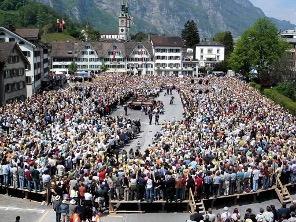
There is a widespread desire among citizens for greater involvement in political decision-making than cast a vote periodically. The participation ladder, developed in 1969 by Sherry Arnstein, is a useful summary of the degree in which government and citizens share power. Below, I jump to the highest rung of the ladder: Local government empowers citizens to make independent decisions, or partial autonomy.
In Italy this process has boomed, and the city of Bologna has become a stronghold of so-called urban commons. Citizens become designers, managers, and performers of selected municipal tasks, such as creating green areas, converting an empty house into affordable units, operating a minibus service, cleaning, and maintaining the city walls, refurbishing parts of the public space, keeping open a swimming-pool and much more.
The most important instruments are cooperation-pacts. In each pact, city authorities and the parties involved (informal groups, NGOs, schools, entrepreneurs) lay down agreements about their activities, responsibilities, and power. Hundreds of pacts have been signed since the regulation was adopted in 2011. The city provides what the citizens need – money, material, housing, advice – and the citizens make their time, skills, and organizational capacity available.
The commons-movement will influence urban governance in the longer term. The Italian political scientistChristian Iaione predicts the emergence of a city of commons. Here, many urban tasks are performed by commons and cooperatives. The city then is a network of both, decision-making is decentralized and deconcentrated.
A similar idea The city as a platform has emerged in the US coming from a completely different direction. Instead of simply voting every few years and leaving city administration to elected officials and expert bureaucrats, the networked city sees citizens as co designers, co-producers, and co-learners, according to Stefaan Verhulst, co-founder of GovLab. In the city as a platform residents look individually and collectively for new and better ways to meet their needs and enliven public life. These may be neighborhood-based initiatives, for example the redevelopment of a neighborhood or city-wide initiatives, for example a cooperative of taxi drivers, competing with Uber.
Without saying it in so many words, everyone involved sees both the city of commons and the city as a platform as a long-term opportunity to make citizens the engine of urban development instead of enabling multinational companies taking over that role. For the time being, city administrators can best focus on enabling and supporting citizens’ joint action to make cities more beautiful, liveable, and sustainable.
This post based on by the new e-book Better cities, the contribution of digital technology. Interested? Download the book here for free (90 pages)
Content:
Hardcore: Technology-centered approaches
1. Ten years of smart city technology marketing
2. Scare off the monster behind the curtain: Big Tech’s monopoly
Towards a humancentric approach
3. A smart city, this is how you do it
4. Digital social innovation: For the social good
Misunderstanding the use of data
5. Digital twins
6. Artificial intelligence
Embedding digitization in urban policy
7. The steps to urban governance
8. Guidelines for a responsible digitization policy
9. A closer look at the digitization agenda of Amsterdam
10. Forging beneficial cooperation with technology companies
Applications
11. Government: How digital tools help residents regaining power?
12. Mobility: Will MaaS reduce the use of cars?
13. Energy: Smart grids – where social and digital innovation meet
14. Healthcare: Opportunities and risks of digitization
Two recent books deal with this problem in depth and call for tailored actions. These books are Shoshana Zuboff’s The Age of Surveillance Capitalism: The Fight for a Human Future at the New Frontier of Power (2019) and Cory Doctorow’s How to destroy surveillance capitalism (2021). Zuboff describes in detail how Google, Amazon and Facebook collect data with only one goal, to entice citizens to buy goods and services:
Big Tech’s product is persuasion. The services — social media, search engines, maps, messaging, and more — are delivery systems for persuasion.
The unprecedented power of Big Tech is a result of the fact that these companies have become almost classic monopolies. Until the 1980s, the US had strict antitrust legislation: the Sherman’s act, notorious for big business. Ronald Reagan quickly wiped it out in his years as president, and Margaret Thatcher did the same in the UK, Brian Mulroney in Canada, and Helmut Kohl in Germany. While Sherman saw monopolies as a threat to the free market, Reagan believed that government interference threatens the free market. Facebook joins in if it sees itself as a ‘natural monopoly’: You want to be on a network where your friends are also. But you could also reach your friends if there were more networks that are interoperable. Facebook has used all economic, technical, and legal means to combat the latter, including takeover of potential competitors: Messenger, Instagram, and WhatsApp.
In the early 21st century, there was still a broad belief that emerging digital technology could lead to a better and more networked society.
Bas Boorsma: The development of platforms empowered start-ups, small companies, and professionals. Many network utopians believed the era of ‘creative commons’ had arrived and with it, a non-centralized and highly digital form of ‘free market egalitarianism’ (New Digital Deal, p.52). Nothing has come of this: Digitalization-powered capitalism now possesses a speed, agility and rawness that is unprecedented (New Digital Deal, p.54). Even the startup community is becoming one big R&D lab for Big Tech. Many startups hope to be acquired by one of the tech giants and then cash in on millions. As a result, Big Tech is on its way to acquire a dominant position in urban development, the health sector and education, in addition to the transport sector.
Thanks to its monopoly position, Big Tech can collect unlimited data, even if European legislation imposes restrictions and occasional fines. After all, a lot of data is collected without citizens objecting to it. Mumford had already realized this in 1967: Many consumers see these companies not only as irresistible, but also ultimately beneficial. These two conditions are the germ of what he called the megatechnics bribe.
The only legislation that can break the power of Big Tech is a strong antitrust policy, unbundling the companies, an absolute ban on acquisitions and rigorous taxation. In addition, governments should take back control of technological development, as they did until the end of the last century. Democratic control of the development of technology is an absolute precondition!
This post based on by the new e-book Better cities, the contribution of digital technology. Interested? Download the book here for free (90 pages)
Content:
Hardcore: Technology-centered approaches
1. Ten years of smart city technology marketing
2. Scare off the monster behind the curtain: Big Tech’s monopoly
Towards a humancentric approach
3. A smart city, this is how you do it
4. Digital social innovation: For the social good
Misunderstanding the use of data
5. Digital twins
6. Artificial intelligence
Embedding digitization in urban policy
7. The steps to urban governance
8. Guidelines for a responsible digitization policy
9. A closer look at the digitization agenda of Amsterdam
10. Forging beneficial cooperation with technology companies
Applications
11. Government: How digital tools help residents regaining power?
12. Mobility: Will MaaS reduce the use of cars?
13. Energy: Smart grids – where social and digital innovation meet
14. Healthcare: Opportunities and risks of digitization
I am a happy user of a Sonos sound system. Nevertheless, the helpdesk must be involved occasionally. Recently, it knew within five minutes that my problem was the result of a faulty connection cable between the modem and the amplifier. As it turned out, the helpdesk was able to remotely generate a digital image of the components of my sound system and their connections and saw that the cable in question was not transmitting any signal. A simple example of a digital twin. I was happy with it. But where is the line between the sense and nonsense of collecting masses of data?
What is a digital twin
A digital twin is a digital model of an object, product, or process. In my training as a social geographer, I had a lot to do with maps, the oldest form of ‘twinning’. Maps have laid the foundation for GIS technology, which in turn is the foundation of digital twins. Geographical information systems relate data based on geographical location and provide insight into their coherence in the form of a model. If this model is permanently connected to reality with the help of sensors, then the dynamics in the real world and those in the model correspond and we speak of a ‘digital twin’. Such a dynamic model can be used for simulation purposes, monitoring and maintenance of machines, processes, buildings, but also for much larger-scale entities, for example the electricity grid.
From data to insight
Every scientist knows that data is indispensable, but also that there is a long way to go before data leads to knowledge and insight. That road starts even before data is collected. The first step is assumptions about the essence of reality and thus the possibility of knowing it. There has been a lot of discussion about this within the philosophy of science, from which two points of view have been briefly crystallized, a systems approach and a complexity approach.
The systems approach assumes that reality consists of a stable series of actions and reactions in which law-like connections can be sought. Today, almost everyone assumes that this only applies to physical and biological phenomena. Yet there is also talk of social systems. This is not a question of law-like relationships, but of generalizing assumptions about human behavior at a high level of aggregation. The homo economicus is a good example. Based on such assumptions, conclusions can be drawn about how behavior can be influenced.
The complexity approach sees (social) reality as the result of a complex adaptive process that arises from countless interactions, which – when it comes to human actions – are fed by diverse motives. In that case it will be much more difficult to make generic statements at a high level of aggregation and interventions will have a less predictable result.
Traffic models
Traffic policy is a good example to illustrate the distinction between a process and a complexity approach. Simulation using a digital twin in Chattanooga of the use of flexible lane assignment and traffic light phasing showed that congestion could be reduced by 30%. Had this experiment been carried out, the result would probably have been very different. Traffic experts note time and again that every newly opened road becomes full after a short time, while the traffic picture on other roads hardly changes. In econometrics this phenomenon is called induced demand. In a study of urban traffic patterns between 1983 and 2003, economists Gilles Duranton and Matthew Turner found that car use increases proportionally with the growth of road capacity. The cause only becomes visible to those who use a complexity approach: Every road user reacts differently to the opening or closing of a road. That reaction can be to move the ride to another time, to use a different road, to ride with someone else, to use public transport or to cancel the ride.
Carlos Gershenson, a Mexican computer specialist, has examined traffic behavior from a complexity approach and he concludes that self-regulation is the best way to tackle congestion and to maximize the capacity of roads. If the simulated traffic changes in Chattanooga had taken place in the real world, thousands of travelers would have changed their driving behavior in a short time. They had started trying out the smart highway, and due to induced demand, congestion there would increase to old levels in no time. Someone who wants to make the effect of traffic measures visible with a digital twin should feed it with results of research into the induced demand effect, instead of just manipulating historical traffic data.
The value of digital twins
Digital twins prove their worth when simulating physical systems, i.e. processes with a parametric progression. This concerns, for example, the operation of a machine, or in an urban context, the relationship between the amount of UV light, the temperature, the wind (speed) and the number of trees per unit area. In Singapore, for example, digital twins are being used to investigate how heat islands arise in the city and how their effect can be reduced. Schiphol Airporthas a digital twin that shows all moving parts at the airport, such as roller conveyors and stairs. This enables technicians to get to work immediately in the event of a malfunction. It is impossible to say in advance whether the costs of building such a model outweigh the benefits. Digital twins often develop from small to large, driven by proven needs.
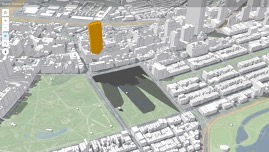
Boston also developed a digital twin of part of the city in 2017, with technical support from Esri. A limited number of processes have been merged into a virtual 3D model. One is the shadowing caused by the height of buildings. One of the much-loved green spaces in the city is the Boston Common. For decades, it has been possible to limit the development of high-rise buildings along the edges of the park and thus to limit shade. Time and again, project developers came up with new proposals for high-rise buildings. With the digital twin, the effect of the shadowing of these buildings can be simulated in different weather conditions and in different seasons (see title image). The digital twin can be consulted online, so that everyone can view these and other effects of urban planning interventions at home.
Questions in advance
Three questions precede the construction of a digital twin. In the first place, what the user wants to achieve with it, then which processes will be involved and thirdly, which knowledge is available of these processes and their impact. Chris Andrews, an urban planner working on the ESRI ArcGIS platform, emphasizes the need to limit the number of elements in a digital twin and to pre-calculate the relationship between them: To help limit complexity, the number of systems modeled in a digital twin should likely be focused on the problems the twin will be used to solve.
Both the example of traffic forecasts in Chattanooga, the formation of heat islands in Singapore and the shadowing of the Boston Common show that raw data is insufficient to feed a digital twin. Instead, data are used that are the result of scientific research, after the researcher has decided whether a systems approach or a complexity approach is appropriate. In the words of Nigel Jacob, former Chief Technology Officer in Boston: For many years now, we’ve been talking about the need to become data-driven… But there’s a step beyond that. We need to make the transition to being science-driven in …… It’s not enough to be data mining to look for patterns. We need to understand root causes of issues and develop policies to address these issues.
Digital twins are valuable tools. But if they are fed with raw data, they provide at best insight into statistical connections and every scientist knows how dangerous it is to draw conclusions from that: Trash in, trash out.
Digitale sociale innovatie – also referred to as smart city 3.0 – is a modest counterweight to the growing dominance and yet lagging promises of ‘Big Tech’. It concerns “a type of social and collaborative innovation in which final users and communities collaborate through digital platforms to produce solutions for a wide range of social needs and at a scale that was unimaginable before the rise of Internet-enabled networking platforms.”
Digital innovation in Europe has been boosted by the EU project Growing a digital social Innovation ecosystem for Europa (2015 – 2020), in which De Waag Society in Amsterdam participated for the Netherlands. One of the achievements is a database of more than 3000 organizations and companies.
It is a pity that this database is no longer kept up to date after the project has expired and – as I have experienced – quickly loses its accuracy.
Many organizations and projects have interconnections, usually around a ‘hub’. In addition to the Waag Society, these are for Europe, Nesta, Fondazione Mondo Digitale and the Institute for Network Cultures. These four organizations are also advisors for new projects. Important websites are: digitalsocial.eu(no longer maintained) and the more business-oriented techforgood.
A diversity of perspectives
To get to know the field of digital innovation better, different angles can be used:
• Attention to a diversity of issues such as energy and climate, air and noise pollution, health care and welfare, economy and work, migration, political involvement, affordable housing, social cohesion, education and skills.
• The multitude of tools ranging from open hardware kits for measuring air pollution, devices for recycling plastic, 3D printers, open data, open hardware and open knowledge. Furthermore, social media, crowdsourcing, crowdfunding, big data, machine learning et cetera.
• The variety of project types: Web services, networks, hardware, research, consultancy, campaigns and events, courses and training, education, and research.
• The diverse nature of the organizations involved: NGOs, not-for-profit organizations, citizens’ initiatives, educational and research institutions, municipalities and increasingly social enterprises.
Below, these four perspectives are only discussed indirectly via the selected examples. The emphasis is on a fifth angle, namely the diversity of objectives of the organizations and projects involved. At the end of this article, I will consider how municipalities can stimulate digital social innovation. But I start with the question of what the organizations involved have in common.
A common denominator
A number of organizations drew up the Manifesto for Digital Social Innovation in 2017 and identified central values for digital social innovation: Openness and transparency, democracy and decentralization, experimentation and adoption, digital skills, multidisciplinary and sustainability. These give meaning to the three components of the concept of digital social technology:
Social issues.
The multitude of themes of projects in the field of digital social innovation has already been mentioned. Within all these themes, the perspective of social inequality, diversity, human dignity, and gender are playing an important role. In urban planning applications, this partly shifts the focus from the physical environment to the social environment: We’re pivoting from a focus on technology and IoT and data to a much more human-centered process, in the words of Emily Yates, smart cities director of Philadelphia.
Innovation
Ben Green writes in his book ‘The smart enough city’: One of the smart city’s greatest and most pernicious tricks is that it …. puts innovation on a pedestal by devaluing traditional practices as emblematic of the undesirable dumb city.(p. 142). In digital social, innovation rather refers to implement, experiment, improve and reassemble.
(Digital) technology
Technology is not a neutral toolbox that can be used or misused for all purposes. Again Ben Green: We must ask, what forms of technology are compatible with the kind of society we want to build (p. 99). Current technologies have been shaped by commercial or military objectives. Technologies that contribute to ‘the common good’ still need to be partly developed. Supporters of digital social innovation emphasize the importance of a robust European open, universal, distributed, privacy-aware and neutral peer-to-peer network as a platform for all forms of digital social innovation.
Objectives and focus
When it comes to the objective or focus, five types of projects can be distinguished: (1) New production techniques (2) participation (3) cooperation (4 raising awareness and (5) striving for open access.
1. New production techniques
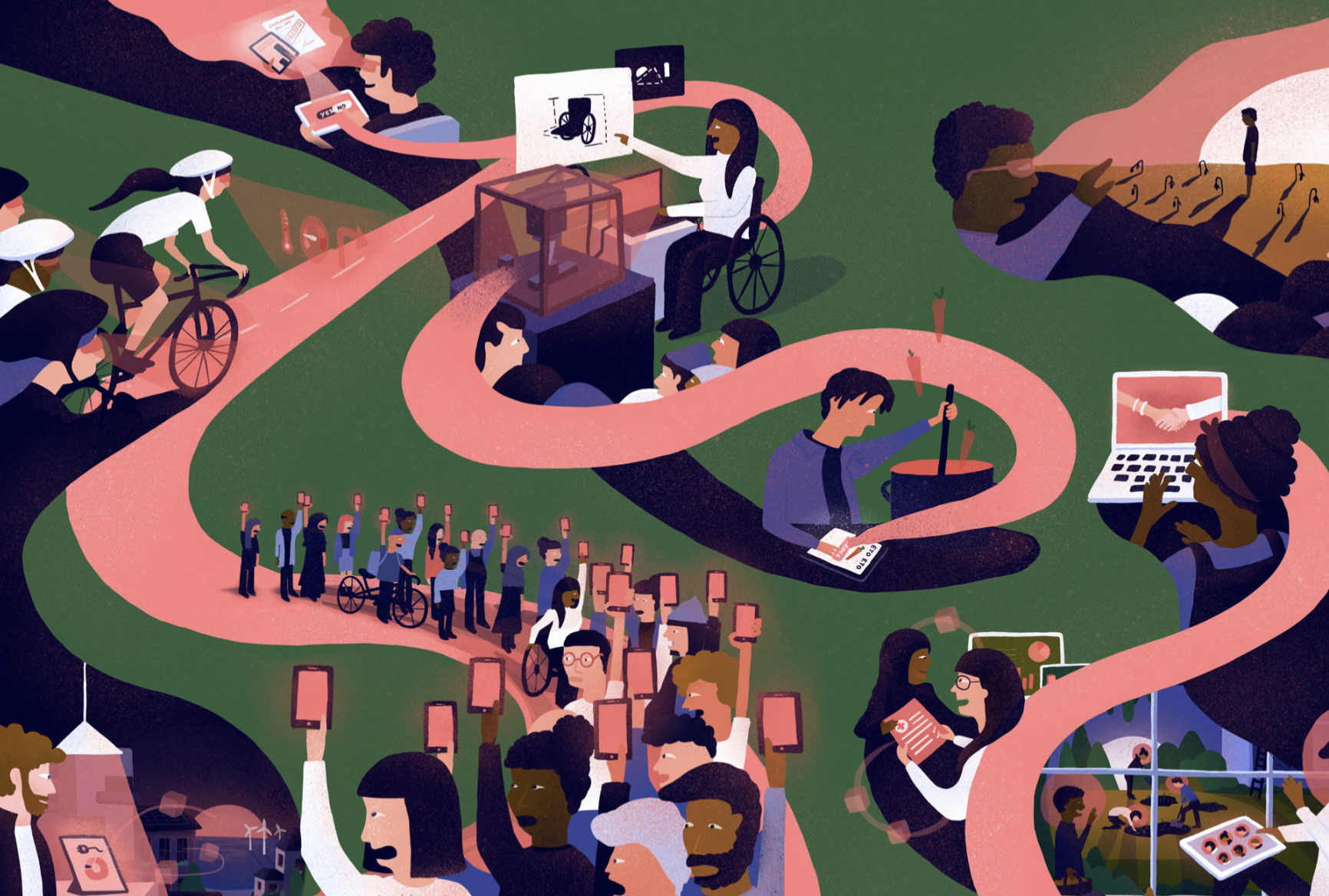
A growing group of ‘makers’ is revolutionizing open design. 3D production tools CAD/CAM software is not expensive or available in fab labs and libraries. Waag Society in Amsterdam is one of the many institutions that host a fab lab. This is used, among other things, to develop several digital social innovations. One example was a $50 3D-printed prosthesis intended for use in developing countries.
2. Participation
Digital technology can allow citizens to participate in decision-making processes on a large scale. In Finland, citizens are allowed to submit proposals to parliament. Open Ministry supports citizens in making an admissible proposal and furthermore in obtaining the minimum required 50,000 votes. Open Ministry is now part of the European D-CENTproject a decentralized social networking platform that has developed tools for large-scale collaboration and decision making across Europe.
3. Collaboration
It is about enabling people to exchange skills, knowledge, food, clothing, housing, but also includes new forms of crowdfunding and financing based on reputation and trust. The sharing economy is becoming an important economic factor. Thousands of alternative payment methods are also in use worldwide. In East Africa, M-PESA (a mobile financial payment system) opens access to secure financial services for nine million people. Goteo is a social network for crowdfunding and collaborative collaboration that contribute to the common good.
4. Awareness
These are tools that seek to use information to change behavior and mobilize collective action. Tyze is a closed and online community for family, friends, neighbors, and care professionals to strengthen mutual involvement around a client and to make appointments, for example for a visit. Safecast is the name of a home-built Geiger counter with which a worldwide community performs radiation measurements and thus helps to increase awareness in radiation and (soon) the presence of particulate matter.
5. Open Access
The open access movement (including open content, standards, licenses, knowledge and digital rights) aims to empower citizens. The CityService Development Kit (CitySDK) is a system that collects open data from governments to make it available uniformly and in real time. CitySDK helps seven European cities to release their data and provides tools to develop digital services. It also helps cities to anticipate the ever-expanding technological possibilities, for example a map showing all 9,866,539 buildings in the Netherlands, shaded by year of construction. Github is a collaborative platform for millions of open software developers, helping to re-decentralize the way code is built, shared, and maintained.
Cities Support
Cities can support organizations pursuing digital social innovations in tackling problems in many ways.
Financing
Direct support through subsidies, buying shares, loans, social impact bonds, but also competitions and matching, whereby the municipality doubles the capital obtained by the organization, for example through crowdfunding. An example of a project financed by the municipality is Amsterdammers, maak je stad.
Cooperation
Involvement in a project, varying from joint responsibility and cost sharing, to material support by making available space and service s, such as in the case Maker Fairs or the Unusual Suspects Festival. Maker Fairs or the Unusual Suspects Festival. Municipalities can also set up and support a project together, such as Cities for Digital Rights. A good example is the hundreds of commons in Bologna, to which the municipality delegates part of its tasks.
Purchasing Policy
Digital social innovation projects have provided a very wide range of useful software in many areas, including improving communication with citizens and their involvement in policy. Consul was first used in Madrid but has made its way to 33 countries and more than 100 cities and businesses and is used by more than 90 million people. In many cases there is also local supply. An alternative is Citizenlab.
Infrastructure
Municipalities should seriously consider setting up or supporting a fab lab. Fab Foundation is helpful in this regard. Another example is the Things Network and the Smart citizen kit.. Both are open tools that enable citizens and entrepreneurs to build an IoT application at low cost. These facilities can also be used to measure noise nuisance, light pollution, or odors with citizens in a neighborhood, without having to install an expensive sensor network.
Skills Training
Municipalities can offer citizens and students targeted programs for training digital skills, or support organizations that can implement them, through a combination of physical and digital means. One of the options is the lie detector program, developed by a non-profit organization that teaches young children to recognize and resist manipulative information on (social) media.
Incubators and accelerators
We mainly find these types of organizations in the world of start-ups, some of which also have a social impact. Targeted guidance programs are also available for young DSI organizations. In the Netherlands this is the Waag Society in Amsterdam. A typical tech for good incubator in the UK is Bethnal Green Ventures. An organization that has also helped the Dutch company Fairphone to grow. In the Netherlands, various startup in residence programs also play a role in the development of DSI organisations.
Urban problems are always complicated, contradictory, and complex and rarely have simple solutions. Therefore, like all other projects, digital social projects need to be carefully embedded and their interfaces explored with the other aspects of policy.






 Music: Listen, Look and Enjoy