I am a follower of #innovation, resulting in an all-day parade of tweets about self-driving cars, intelligent robots, business models, CO2-neutral buildings, growing efficiency in solar energy and smart gadgets. I feel at odds with those ‘experts’ who applaud innovation as the Holy Grail for our society’s future without making any difference.
In this post I will introduce a distinction between innovation forwards and innovation backwards. Innovation will become a matter of choice! At first, three different types of innovation will be identified. Each of these types has its technical and social variant.
Technical innovation
 Type 1 innovations intend to increase labour productivity: Mechanisation and IT have enabled mass production at low prices by automation of assembly lines, warehouses, administration and bookkeeping. Besides, technical devices are replacing conductors at trains, cashiers in supermarkets et cetera.
 Type 2 innovations occur when companies replace products by attractive alternatives in order to escape the downward spiral of price competition and decreasing margins. To be successful, public has to perceive the new products as contributions to the quality of their lives and be willing to pay accordingly: PC’s, iPhones, iPads, digital camera’s, navigation systems et cetera
 Type 3 innovations intends to secure life and a decent level of prosperity in the long run and do not result in major financial rewards at short-term: Sustainable energy, bio-based economy, clean-tech, biological farming, reuse of materials et cetera.
Social innovation
Type 1 innovations include huge improvement of labour productivity under humane conditions, based on large-scaled production, task-differentiation, assembly lines and flexible payment, albeit at the cost of the total destruction of craft[1]. During the last century, Frederic Taylor’s principles have been refined by competence management, lean production, ICT and sophisticated planning and control systems, which have extended to medicine, accounting and teaching.
 Type 2 innovations are aimed at the restoration of challenging job content. Improvement of labour-productivity is accompanied by an increasing number of low-strain jobs and by disappearing engagement. In the meanwhile, engagement is decisive in knowledge-intensive companies. Consequently, smart companies skip intermediate management levels, introduce servant-like types of management, create flexible work conditions and diminish differences in compensation between managers and professionals. Besides, a growing group of former employees is creating networks of collaborating self-governed and owned companies.
 Type 3 innovations partially replace representative by direct democracy. People are taking responsibility for their own neighborhood. Employee ownership and cooperations are reviving. Financial institutions, healthcare, assurance and social care will redevelop bottom-up. Social enterprises will replace not-for-profit bureaucracies. These new ventures will operate from a welfare perspective in the first place. The rebirth of the civil society will partially replace the eroded welfare state. An already uncountable number of initiatives are moving already into this direction in many countries[2].
Innovation forwards and innovation backwards
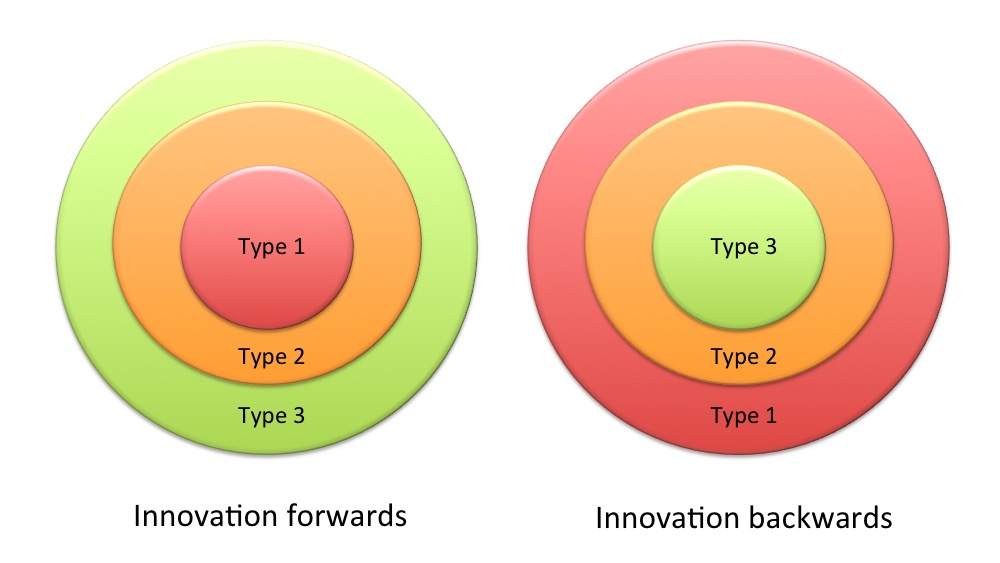
The distinction between two pairs of three types of innovations each enables me to explain the difference between innovation forwards and innovation backwards
The purpose of innovation forwards is a ‘livable existence for future generations worldwide. Type 3 innovations (technical and social) are its main driver, supported by type 2 and type 1. Innovation forwards does not exclude improving productivity, for instance by deployment of robots, but it will enforce procedures safeguarding autonomous and challenging jobs for all[3].
 The purpose of innovation backwards is growth of company turnover and shareholder value. Type 1 innovation (technical and social) is its main driver. Types 2 and 3 are supportive. Innovation backwards might include the acceptance of so-called corporate social responsibility, but only if it contributes to profit, reputation and shareholder value.
Currently, innovation backwards dominates innovation forwards. Overall indicators are: the on-going increase of CO2-emissions[4] and the increasing differences in between rich and pour countries and between its inhabitants[5].
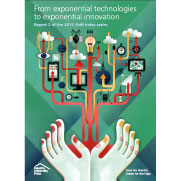
At the same time, the power of innovation forwards is increasing. The Deloite report The Big Shift is unveiling global changes during the last decades includes many hope-giving details[6], the following trends particularly:
 The connection between technology and information science (Internet of everything);
- The distributed character of knowledge and the emergence of the independent knowledge workers and Makers;
- The collapse of large multinational organizations, favouring a globalized network economy;
- The growing power of self-governance and local autonomy.Societal transition
Societal transition
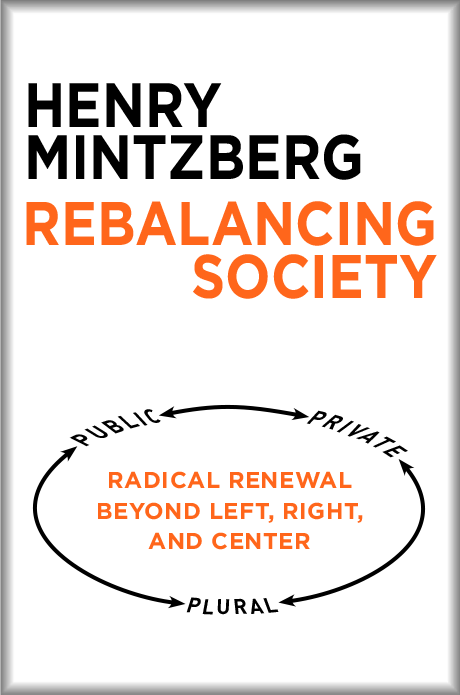
Publications about societal transition and change are abundant. For instance, in The Netherlands, influent authors like Jan Rotmans and Marga Hoek motivate thousands of change-making groups and individuals and are inspired by them. Here, I will spend a some attention to the new book of the well-known organizational scientist Henry Mintzberg, titled: Rebalancing Society. Radical Renewal Beyond Left, Right and Center [7].
 Mintzberg offers ample evidence for the dominance of innovation backwards. From 1980 on, the multinational corporations have increased their global and national power[8]: The economy of free enterprise has become societies of free enterprises. Except for maximization of their own profits and shareholder value, private companies have encouraged consumption[9] and borrowing large amounts op money. They have externalized their costs and evaded paying taxes. The ever-weakening government lost its countervailing power[10]. However, restoration of the power of the state is no option. A repetition of all well-known arguments between social democrats and liberals will occur and will not generate any change. The on-going growth of the plural sector is Mintzberg’s hope for the future. The plural sector has always been of utmost importance, for instance by the emergence of cooperations and associations. In the US, in average, each citizen is a member of two associations. There is a myriad of new initiatives by citizens in every field, varying from health, education, neighbourhood, and environment.
In addition, education, health and transport are parts of the plural sector, although these sectors have been weakened by privatisation. The growing group of social enterprises might be added too[11].
This leaves us with the question what each of us can do to promote innovation forwards. Henry Mintzberg: The place to start confronting the exploiters of this world is in front of our own mirror.
You and I are called on stage. Find your character in the table below

[1]Less humane practices can be found in the apparel, mechanical engines and in construction in emerging countries. These activities are all parts of the supply-chains of western (and Chinese) companies.
[2] See Blessed Unrest by Paul Hawken (2007)
[3] Carl Benedikt Frey and Michael A. Osborne (University Oxford, UK), The future of employment: how susceptible are jobs to computerization (September 2013)
[4] See for details until 2014: http://infographics.pbl.nl/website/globalco2-2014/
[5] See for details Thomas Piketty’s book Capital in the 21e century.
[6] The Big Shift http://goo.gl/QaNXdy is edited by ‘The Edge’, Deloite’s research institute.
[7] An earlier version of this book (2014) can be downloaded here: http://www.mintzberg.org/sites/default/files/rebalancing_society_pamphlet.pdf
[8] Withdrawing by the US of the Bretton Woods Agreement, meaning the decopling of the value of money and gold was a first step in the financialization of capitalism.
[9] With respect to food and beverages: In 2014 two of three adults in the US are overweight or obese (69 percent) and one out of three is obese (36 percent) www.hsph.harvard.edu/nutritionsource/an-epidemic-of-obesity/
[10] In1952, companies paid 32% of all tax incomes in the US. This percentage is decreased to 9% now.
[11] This article unveils the objectives of social enterprises: https://www.se-alliance.org/what-is-social-enterprise It clarifies why this type of enterprises fits into Mintzberg plural group.
[12] Het Defence Advanced Research Project Agency (DARPA) is an excellent example of public support in the development of industry and educational institutions.
[13] The representatives in the US are virtually unable to increase taxes for the rich: Nearly all members of the Senate and most members of the House belong to the 1% top-earners of the US.



 The majority of contemporary universities are realizing these outcomes only partially. Research in the US has revealed that about 40% of college students did not make any progress with respect to analytical and critical thinking skills in four consecutive years[2].
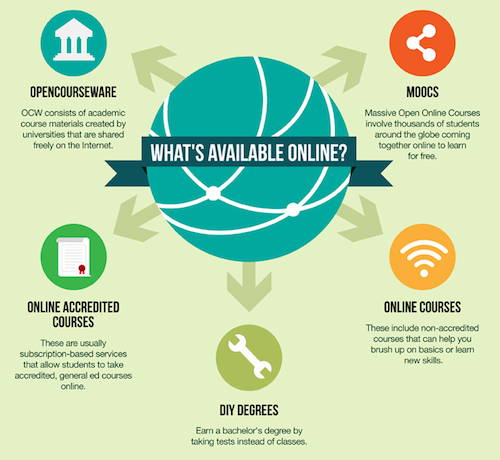
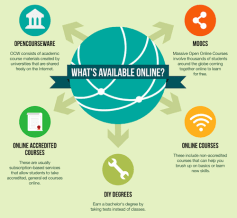 Universities can economize by flipping their classrooms radically and supporting their students in choosing appropriate open educational resources like MOOCs (= massive open online courses). At this time, MOOCs cover any part of scientific knowledge. The best scientists are involved in their development and educational technologists have designed the best visual support. The only expenses relate to delivering feedback at student’s assignments.

 Hierarchical personnel management and extensive planning and control systems enabled late 20th century companies to produce massive volumes at low prices for relatively stable and continuously growing markets. Nowadays, the environment is changing at high-speed, requiring flexibility and development of new products in short notice. The labour force is well educated and prepared to take or share managerial responsibility. At the same time most workers feel disengaged under conditions of vertical control.
 Ask any university teacher who is her or his boss. Some – probably those who have been employed the largest number of years – shrug their shoulders as though the answer matters. Others might count ten bosses at least: the chairman of the department, the head of the school, the managing director, the program director of the bachelor, the program director of the master, the director of education, the director of research, the chairman of the faculty council and the dean. Not to forget the chairmen of the education committee and the board of examiners. And we’re only talking about bosses at faculty level.
 The strong increase in complexity of higher educational institutions is accompanied by the diversity of tasks that academic personnel are performing simultaneously. Ask any university teacher to write down her or his tasks during an average week. The result: six to ten lectures or working groups in bachelor and master programs spread over three to five courses, the development of new courses, supervision of bachelor and master theses, meetings of committees, discussions with PhD students, delivery of information to prospective students, participation in teacher training, attending meetings and consulting colleagues, regional contacts, deliberations with foreign universities, tutorials with students, answering emails, and joining social media forums. They also do research, which involves various activities as well.
















 Music: Listen, Look and Enjoy