
George Harrison 1943 – 2001 (The Beatles after the Beatles part 2)

George’s later love of Indian music may have come about in a remarkable way. During her pregnancy, his mother regularly listened to the mysterious sounds of sitars and tablas in the hope that they would have a calming influence on the child in her womb.  Later, she fully supported Harrison’s career: when he was 14, she bought him his first guitar and a friend of his father’s taught him how to play it. George’s first musical influences were Django Reinhardt and Lonnie Donogram, under whose influence he founded the skiffle group ‘The Rebels’ before moving on to Lennon and McCartney’s group ‘The Quarrymen’.  He accompanied the group, then called ‘The Beatles’, to Hamburg and was deported several times because he was too young to play in nightclubs. 

Now, let’s skip ahead to Georges’ later years: In 1999, a paranoid and schizophrenic man attacks him and his wife Olivia in their home. He stabs George with a kitchen knife, puncturing his lung. Olivia eventually overpowers him with a poker. Shortly afterwards, throat cancer is diagnosed, which is successfully treated with radiotherapy.  Unfortunately, the cancer returns and George dies in November 2001. His ashes are scattered in the Ganges according to Hindu tradition.

Discography

George Harrison has already made two solo albums while the Beatles were still together: Wonderwall (1968) and Electric Sound (1969). These mainly contain instrumental tracks. ‘Wonderwall’ is the soundtrack to the film of the same name and is mixing Indian and Western sounds. ‘Electric Sound’ mainly features electronic music, in which the Moog synthesizer plays an important role.

After the Beatles split up, George releases the following albums:

  1. All Things Must Pass (1970)
  2. Living in the Material World (1973)
  3. Dark Horse (1974)
  4. Extra Texture (Read All About It) (1975)
  5. Thirty Three & 1/3 (1976)
  6. George Harrison (1979)
  7. Somewhere in England (1981)
  8. Gone Troppo (1982)
  9. Cloud Nine (1987)
  10. Brainwashed (2002, posthumous)

All Things Must Pass (1970)

Harrison can now indulge himself. His musical contribution to the albums released by the Beatles had been limited to two songs per album. ‘All Things Must Pass’ contains two CDs with original songs. This album topped the charts in both the US and the UK. You can listen to one of the songs: ‘What Is Life’ (recorded in 1992). The second song, ‘My Sweet Lord’ (recorded in 1970), can be found here:

This last song led to a lawsuit because of its similarity to the hit ‘So Fine’ by the Chiffons (1963). George lost the case and had to pay $600,000. 

Concert for Bangladesh (1971)

George doesn’t have much time to dwell on his disappointment, because his mentor and Indian sitar virtuoso Ravi Shankar calls on his help in organising a benefit concert for refugees from the former East Pakistan. Two concerts are scheduled for Madison Square Garden, one in the afternoon and one in the evening on 1 August 1971. George calls on his friends and colleagues: Ringo, Bob Dylan, Eric Clapton, Billy Preston and the band Badfinger. The concert and the album featuring the recordings raised 12 million dollars.

Living in a material world (1973)

Due to his conviction for plagiarism, George struggles with a writer’s block for quite some time, but eventually a new album, ‘Living in a Material World’, was released in 1973, the year in which he professes his Hindu faith. The album spent five weeks at number one in the US and UK charts. The single ‘Give Me Love (Give Me Peace on Earth)’ was a huge hit. Listen to a recording in George’s later years here.

According to some, this album contains the strongest compositions of his career. Critics used terms such as ‘vastly appealing’ and ‘profoundly seductive’; others found it ‘awkward’ and ‘overtly sentimental’.

Dip in career

After ‘Living in a material world’, a handful of albums were released that were of much lower quality than ‘All things must pass’ and ‘Living in a material world’. With the song ‘Blow Away’ on the album ‘George Harrison’ (1979), he reaches the top 20 in the US and Canada for the first time in years. It is one of his most popular songs, a straightforward pop song with little melodic variation.

Somewhere in England (1981) and Cloud Nine (1987)

The death of John Lennon in 1981 is a shock to George, who still considers John a mentor. He reworks the song ‘All Those Years Ago’ as a tribute to John; Paul and Linda McCartney and Ringo also contributed to it. The song peaked at number two in the US and is included on the album ‘Somewhere in England’ (1981).

I also want mention the album ‘Cloud Nine’ (1987) with hits such as ‘Got My Mindset on You’ and ‘When We Was Fab’, which is also a nostalgic look back at the time when the Beatles conquered the world as a group. Ringo also plays on this song. You can listen to it here:

The song is very similar to older Beatles songs such as ‘I am the walrus’ and contains references to ‘Drive my car’ and ‘Within you, without you’. Complete with cellos, sitar and special effects, it brings the era of psychedelic rock back to life. It is Harrison’s last hit in the US; the public considers it one of his ten best songs.

The Traveling Wilburys (1988)

Harrison’s passion for music has faded somewhat in recent years. Then something happens that brings his joy back: the formation of the supergroup ‘The Traveling Wilburys’, whose members, besides George, are Bob Dylan, Jeff Lynne, Roy Orbison and Tom Petty (of Tom Petty and the Heartbreakers). They present themselves as a group of travelling half-brothers, the Wilburys and released two albums of classic rock. The first is a huge success and has won a Grammy for ‘Best Rock Performance by a Duo or Group’. Here you can hear ‘End of the Line’, one of the songs from this album.

The group released a second album, jokingly titled ‘Traveling Wilburys Vol. III’. By then, the group has become a quartet following the death of Roy Orbison from a heart attack. George have big plans, including a series of performances, but nothing comes of it and eventually the interest of the group members waned.

The Beatles Anthology (1994)

A new project ‘The Beatles Anthology’ presented itself. It was a multimedia project consisting of six hours of television documentaries, three sets of double albums and a book about the history of the Beatles, all arranged chronologically. Apparently, each of the three remaining Beatles feel the need to record and document the past as much as possible. They first allow Jools Holland to be interviewed at length. Afterwards they start cataloguing lyrics from the past, unfinished songs, takes from recordings and all the correspondence surrounding them. Several songs by John Lennon also surface: ‘Free as a Bird’, ‘Real Love’ and ‘Now and Then’. Of these songs, only a poorly recorded vocal track and a piano part were available. Then they decide to finish these songs using digital tools and add them to each of the parts of the anthology. Free as a Bird is released in 1995, ‘Real Love in 1996. You can hear that song here

It took until 2023 for ‘Now and then’ to become available, because only then the quality of the source material can be improved with AI.

The production of this enormous project took approximately 5,000 hours of work. Apart from the priceless cultural value of the whole, it was also a great commercial success.

Brainwashed (2002)

Meanwhile George Harrison has started working on a new album: ‘Brainwashed’. He passes away during the production process. The album has been completed by his son Dhani and his friend and colleague Jeff Lynne. The album reachs the top 20 in the US and is positively reviewed by most critics, who particularly praise George’s deeply emotional slide guitar playing.

The album includes the singles ‘‘Inside a cloud’ , ‘‘Road’. The instrumental ‘Marwa Blues’ receives a Grammy Award in 2004 for ‘Best Pop Instrumental Performance’. Listen to this number here.

The song is named after Raga Marwa, an Indian classical raga that was usually played at sunset.

What else did George Harrison do?

George’s somewhat waning interest in making new albums and the overall lower quality of most of the songs in the period 1975–1985 relates to other activities that were taking up more and more of his time.

Dark Horse Records.

In 1974, George founds Dark Horse Records, a label to enable musicians to release songs that record companies were not interested in, following in the footsteps of the now defunct Apple Corps. George is helping them as a producer. Harrison’s own albums are also released under this label from 1976 onwards. A&M Records handles the worldwide distribution of the label.  Harrison’s son Dhawi revives the label in 2002 after a 10-year hiatus, in connection with the release of Harrison’s last album, Brainwashed. The label still exists, although its roster consists of a limited number of artists, such as Ravi Shankar, Joe Strummer, Leon Russell, Cat Stevens and, of course, the legacy of George Harrison himself.

Handmade Films

In 1978, George Harrison and Dennis O’Brien found Handmade Films, initially to produce Monty Python’s Life of Brian. The next blockbuster was Time Bandits (1981). Twenty-one other films followed. Most of them flopped, partly due to the excessive debts incurred by O’Brien, some of which Harrison recovers after legal intervention. Handmade Films ceased operations in 1991. 

Humanitarian activities

Throughout his career, Harrison has been politically active. In the 1960s, he supports the civil rights movement and is protesting the war in Vietnam. Later, he joins Greenpeace and Friends of the Earth in opposing the use of nuclear energy. He donates one of his houses to the Hare Krishna movement, which turned it into a temple.

Looking back

Harrison demonstrated outstanding songwriting skills, which developed already during his Beatles’ years. However, I doubt whether he ever equaled the standard of his best songs from that period. Inspired by Hinduism, he continued to explore themes such as transience and personal growth. His most important songs as a solo artist are: ‘What is life’ and ‘My sweet Lord’ (both on the album ‘All things must pass’, 1970), although a court ruled that the latter was partly plagiarised. ‘Give Me Love (Give Peace on Earth)’ (on ‘Living in a Material World’, 1973) and ‘Blow Away’ (on ‘George Harrison’, 1979) are simple pop songs, but among his most popular. In addition’’Got My Mind Set on You’ and ‘When We Was Fab’ (both on Cloud Nine, 1987).

Between 1966 and 1968, George devoted himself to learning to play the sitar. Until his teacher Ravi Shankar advised him to go back to his roots. Ravi Shankar saw him as a world-class guitarist, but he was only able to achieve an average level on the sitar. Harrison’s ‘Marwa blues’ (on ‘Brainwashed’, 2002), which posthumously won a Grammy Award, proved that Shankar was right about the guitar.
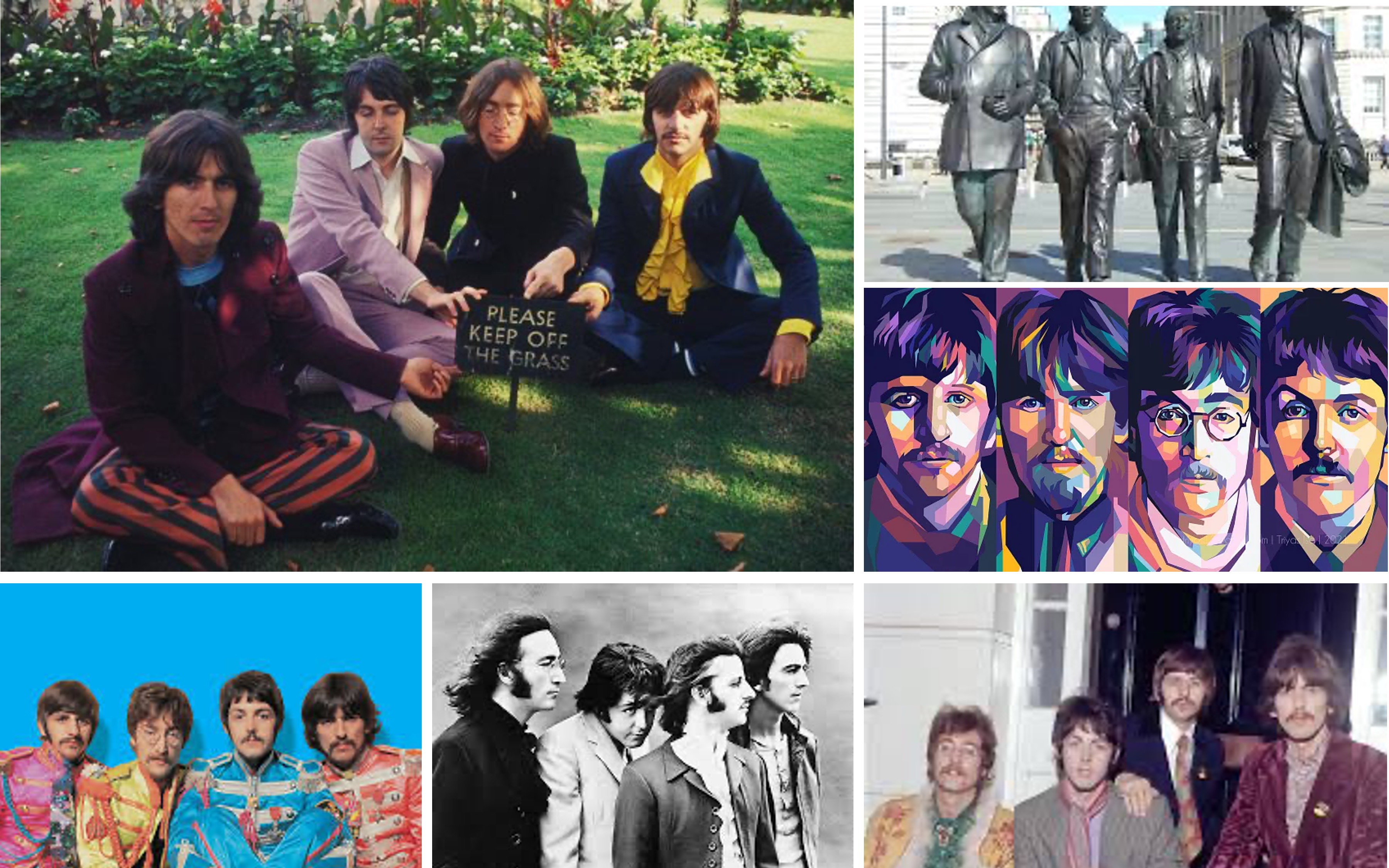
The beginning of the end – The Beatles after the Beatles part 1

In September 1969, John Lennon announces that he will leave The Beatles. At the insistence of manager Klein, he refrained from making his departure public at that time. Paul McCartney did the same shortly afterwards. Incidentally, Ringo Starr and George Harrison had already discussed leaving soon.  George felt undervalued because only two of his songs were permitted to be included in each album. These were not the worst ones: “Taxman”, “Here Comes the Sun”, “Within You Without You”, “While My Guitar Gently Weeps” and “Something”. Ringo was becoming increasingly nervous about the comments on his drumming style from Paul, himself a talented drummer.

Growing artistic and personal differences

The Beatles’ break-up is the result of a series of mutually reinforcing developments. The role of John’s relationship with Yoko Ono is often exaggerated. Yoko was an artist with her own life. More important is that Paul gradually eclipsed John Lennon musically and commercially. This became apparent after the sudden death of manager Brian Epstein and his replacement by Allen Klein, who in fact ran the business into the ground. Paul was the only one to denounce this, even taking the matter to court, where he was proven right.  This mismanagement was particularly evident in the way Apple Corps, the Beatles’ company, wasted capital on its ‘artist-oriented’ policy, which allowed each Beatle to pursue his hobbies. These were avant-garde projects by John Lennon and Yoko Ono, making electronic music by George Harrison, and producing films by Ringo Starr. The problems of Apple Corps are widely discussed in the 2021 documentary Get back.

The best band of all time

Anyone who discusses the break-up of the Beatles is mentioning the exceptional quality of their music between 1965 and 1967. The album Rubber Soul (1965) marks a watershed between the appealing pop the band played before and the later songs, which have the allure of art music. I devoted a separate blog post to art rock, psychedelic rock and its main exponents some time ago; read it here.

There were several reasons why the group was able to realise this ambition. First and foremost was the creativity of the members, followed by their broad musical background and, thirdly, their use of drugs. ‘Norwegian Wood’ is the most striking song on Rubber Soul. It deviates from what was common at the time in terms of melody structure, composition and instrumentation. It is the first song ever to feature a sitar. 

Listen to this song again, filmed during the recording of the album.

The Beatles become a studio band

When the Beatles decided to stop touring in 1966, they were able to focus on studio recordings and explore its the growing capabilities. The album Revolver (1967) was the first result of this. The song ‘Eleanor Rigby’ (here performed by Paul McCartney in 2007) once again illustrates the direction the group had taken in terms of melody and lyrics. The same applies to the singles released shortly afterwards, ‘Strawberry fields forever’ , and ‘Penny Lane’ (1967). The song ‘Tomorrow Never Knows’ opened the doors to psychedelic rock. Listen to it here:

‘Sgt. Pepper’s Lonely Hearts Club Band’ was less a new high point and more a confirmation of the path the Beatles have chosen and the consistency of the quality of their work. The same applies to ‘Magical Mystery Tour’ and the albums that followed.

The Beatles opened themselves up to a wide variety of musical influences, like:

  • German avant-garde composer Karlheinz Stockhausen: Revolution 9, I ‘am the Walrus
  • Music hall sounds from the 1920s: When I’m 64, ‘With a little help from my friends’, ‘Maxwell’s silver hammer’, ‘Honey pie’, ‘Your mother should know’ and ‘Lovey Rita’.
  • Classical music: the piccolo trumpet on ‘Penny Lane’, the piano intermezzo in ‘My Life’ and the guitar on ‘Blackbird’.
  • The use of different types of scales, in addition to the usual minor and major scales. You can hear the effect of this in ‘Norwegian Wood’, ‘Golden Slumbers’ and ‘We Can Work It Out’. In the last song, this effect is reinforced by a change in time signature from 4/4 to 3/4.
  • Religious music: The hymn-like structure of ‘Hey Jude‘. The acoustic guitar in ‘Blackbird’ is inspired by Bach’s Bourrée in E minor.
  • Folk music: ‘Eleanor Rigby’, ‘Norwegian Wood’, ‘Dear Prudence’, ‘I’ve Just Seen a Face’, ‘You’ve Got to Hide Your Love Away’, ‘I Am a Loser’, ‘Two of Us’ and ‘Julia’
  • Indian music: ‘Within You Without You’ and ‘The Inner Light’ are entirely Indian. Indian influences can be found in: ‘Across the Universe’, ‘Sexy Sadie’, ‘Norwegian Wood’ (sitar), ‘Love You To’, ‘Lucy In The Sky With Diamonds’, ‘The Indian Drone’, ‘Tomorrow Never Knows’ and ‘I Am The Walrus’.

Although Rubber Soul was the first comprehensive example of the new direction, the older song  ‘PS I love you’ already showed upcoming changes. Just listen to it:

Recognition for the Beatles as the best band ever

Just how good were the Beatles really? The 2019 edition of Billboard, by far the most important music magazine in the world, ranked the Beatles as the greatest popular music artists of all time, followed by the Rolling Stones in second place. The Beatles’ first place applies on almost all fronts: number of albums sold, number of top scores in the UK and the US, the quality of lyrics and music, instrumental and vocal quality of the band members and variety of repertoire. Only when it comes to lead vocals does Mick Jagger beat John and Paul.

In his book ‘The Songwriting Secrets of The Beatles’, Dominique Pedler shows how the harmonic patterns that the Beatles use and combine in their songs have never been used before in pop music and have since become exemplary. Many of these patterns originated in the ‘magical’ interaction between Paul and John. This collaboration makes them the most successful songwriting duo in modern music history. The dichotomy between Paul McCartney’s optimism and John Lennon’s realism forced both to outdo each other, resulting in the unprecedented production of 180 songs, the most albums sold by any artist, and a still unbroken record of 20 number one hits on the Billboard Hot 100. Lennon said he wanted to write a pop song like McCartney; McCartney said he always wanted to have Lennon’s skeptical view of sacred cows. Meanwhile, the value of the collaboration with George Harrison and Ringo Starr should not be overlooked. The Beatles were not called ‘the fabulous four’ for nothing, and Mick Jagger spoke of a four-headed monster.

Let it be

Back to 1969, the year the Beatles decided to split up. Their work was far from over, apart from the solo albums each of them was preparing. The coffers were empty and they were contractually obliged to deliver two more albums, which would be called ‘Let it be’ and ‘Abbey Road’. 

The band members agreed that the next album would be a ‘live’ performance. Paul was particularly keen on this idea, but in the end, all that remained was an unannounced performance on the roof of the Apple Corps building in London.

Writing new songs was the hardest part and led to further tension between the band members. Paul wrote the songs ‘Let it be’ and ‘Get back’, which would eventually end up on the album. As a result, there was nowhere near enough material when the ‘rooftop concert’ was due to take place. Despite all the problems and the fact that it was cold and bleak on the roof, the Beatles celebrated their (last) party. More and more people flocked to the Apple Corps building. Traffic came to a standstill and eventually the police put an end to it.

You can watch and listen to the entire ‘rooftop concert’ on 30 January 1969 in Central London here:

Abbey Road

The group decides to put the finishing touches to ‘Let it be’ on hold for a while – which appeared to be one year – and concentrate on the Abbey Road album. Everyone now seems to be back on track. George Harrison writes excellent songs: ‘Here comes the sun’ and ‘Something’; John writes ‘Come together’, Ringo comes up with ‘Octopus’s garden’, which becomes a resounding sing-along, and Paul writes ‘O Darling’ and ‘You never give me your money’, a swipe at manager Klein.  There are still a few short fragments and unfinished ideas left, and then the brilliant decision is made to combine them into a medley, which becomes an overview of what the Beatles have written in recent years. The medley ends with ‘The End’, a song with short guitar solos by each of the band members and a drum solo – his first te be recorded – by Ringo. Many fans consider this medley to be one of the highlights of the Beatles’ oeuvre. There is no filmed recording of the medley. You can listen to how it sounds on the album ‘Abbey Road’ here.

It might be interesting to watch and listen to a live performance as part of the Sheffield Beatles Project (cover). You can do so here: 

To finish the last album, ‘Let it be’, in addition to the songs played during the ‘rooftop concert’, a series of old unused songs are dug out and reworked. On 9 May 1970, the album hits the shops. By then, the Beatles are no longer together. Music critics praise both albums and, contrary to expectations, especially ‘Let it be’. 

Paul’s first solo album is released three weeks later, much to the annoyance of John, George and Ringo. Over time, they stop avoiding each other but they occasionally play on each other’s albums.

The Beatles after the Beatles

John, Paul, George and Ringo are determined to continue their musical careers as solo artists. They will each produce a considerable number of albums. According to critics, only a few of their songs come close to the work in the Beatles’ heyday. The main reason is the disappearance of the magic in the collaboration between John and Paul.

The albums of George Harrison (who died in 2001) are spiritual, melodious and perfectionist, with a penchant for world music, in which his love of Indian music is prominent. Paul makes melodious pop music and rock and is constantly searching for new forms. He misses the ‘band feeling’ and for this reason he forms the group Wings in 1972. John Lennon (murdered in 1981) wrote politically engaged songs with a very personal character, and Ringo did what he had never been allowed to do before and made party music.

The break-up of the band did not affect the members financially. Immediately after the band split up, each Beatle was worth between 10 and 20 million dollars. Their fortunes grew rapidly through concerts, solo albums, royalties, investments, film productions and other business ventures. John Lennon’s fortune at the time of his death (1981) was 200 million dollars. This has risen to 700-800 million (in favour of Yoko Ono). George Harrison had an estate worth approximately 400 million at the time of his death (2001). Exact figures are unknown, but at least half of that has certainly been added to date (in favour of Olivia Harrison). Ringo Starr’s estate is worth around 350 million dollars. Paul McCartney’s is worth between 1.2 and 1.5 billion dollars.

A chronological overview of the most important parts of the oeuvre and activities of George Harrison, Ringo Starr, John Lennon, and Paul McCartney, including lots of music, is presented in each of the four upcoming episodes. These episodes begin with some notes about their lives. At the end, I will reflect on their individual careers.