

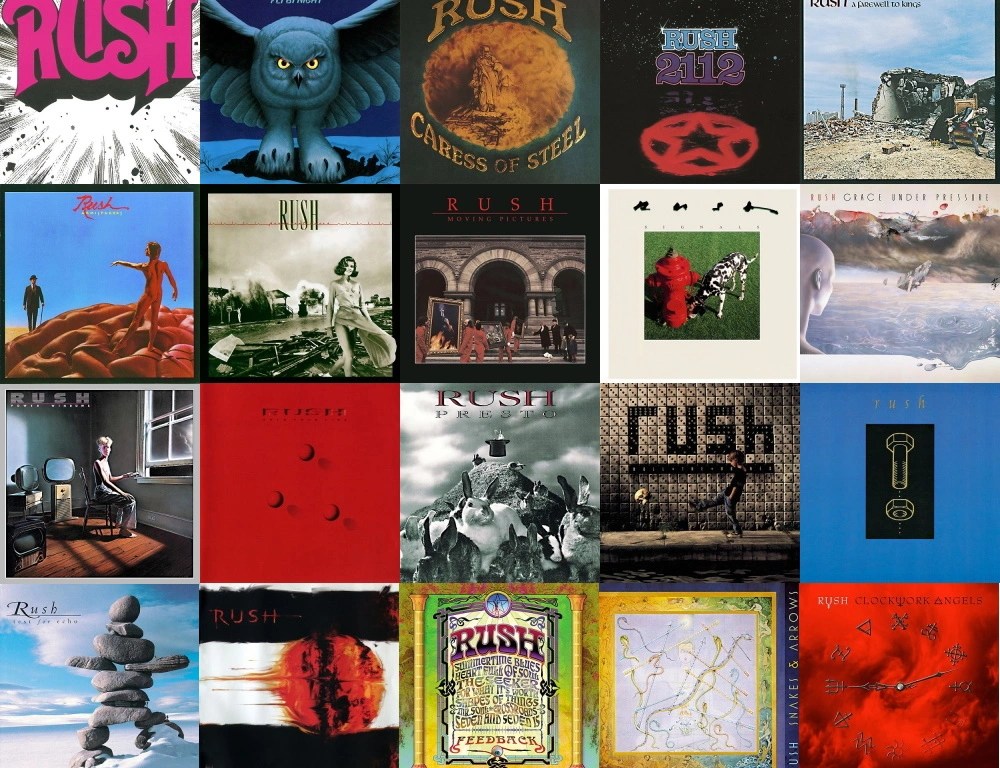
Rush is a Canadian band formed in 1968 in Toronto. After some personnel changes, until its disbanding in 2015, the band consisted of Geddy Lee (vocals, bass guitar and keyboards), Alex Lifeson (guitar) and Neil Peart (drums, percussion). Lee and Lifeson wrote the music, Peart the lyrics.
Most prog rock groups were psychedelic-oriented in their early years, in the late 1960s. Rush, on the other hand, was a hard rock band and as such entered the world of prog rock. Hard rock has always remained the group’s DNA; the group made a conscious decision to be inspired by prog rock and smoothly moved with the different guises that prog rock took over the years. Hard rock combined with prog rock rock the phenomenal craftsmanship of the three members have led to the group always having a large following.
Giving attention to the band is warranted because it illustrates the development of progressive rock over three periods, giving a first impression of the changes that took place in the genre.
Embracing prog rock
The band’s hard rock roots still dominate its second album, ‘Fly by night’, which also shows the first signs of prog rock. A song like ‘By-Tor & the Snow Dog’ (Fly by night, 1975) consists of several sections, has complex arrangements and a mythological theme.
The next album, Caress of Steel, continues the trend towards prog rock. This is evident in the long compositions, choice of mythological themes and complex structures. You can hear this in the song ‘The Necromancer’ (Caress of Steel, 1975), an atmospheric epic song, b great success either. The fourth album ‘2112’ (1976) provides a breakthrough. You’re watching and listening here to an animation of the full title track ‘2112’ (2112, 1976) that covers one side of the record and consists of seven parts; here a live recording from ‘2112’. It is a sci-fi epic set in the city of Megadon in the year 2112. Hard rock fans who like progressive rock are in the right place here, and vice versa.
The upward trend in interest in Rush as a prog rock band continues in ‘A farewell to kings’ (1977) and Hemisphere(1978). The group now also lends its ear to established prog rock groups such as Yes and King Crimson. You are now watching and listening to ‘A Farewell to kings’ (A Farewell to kings, 1977)
The transition to neo-progressive rock
In albums from the late 1970s and early 1980s such as “Permanent Waves” (1980) and “Moving Pictures” (1981), more neo-progressive characteristics come through. To this end, Lifeson starts experimenting with classical and 12-string guitars and Lee adds bass pedal synthesisers and Mini Moog. Peart expands his already no small amount of percussion instruments to include triangles, wood blocks, cowbells, timpani and a gong. Besides adding instruments, the band stayed in tune with progressive rock trends by composing long, conceptual songs with science fiction and fantasy themes, which are more accessible than the songs from the previous period. ‘Permanent waves’, and especially ‘Moving picture’ penetrated to the top of the charts in Canada, the US and Europe. and were even appreciated by the critics.
A number of songs from both albums Pictures’ also scored high as a single.
The ‘Spirit of Radio’ (Permanent Waves, 1980) is a complex yet accessible composition with diverse styles, including reggae and new wave elements. The content of the songs shifts from a fairy-tale and mythical fantasy world to current social themes.
Rush toured with ‘Permanent waves’ for six months and reached some 650,000 fans during that period.
‘The camera eye’ (Moving Pictures, 1981) combines neo-progressive elements and contains experiments with electronics. This song, which lasted 11 minutes, was the band’s last long song. The same album also features ‘Tom Sawyer’ (Moving pictures, 1981). You can watch and listen to that now, a recording from 2007 in Ahoy, Rotterdam.
These two albums were followed by another series of albums, for instance ‘Signals’ that found a warm reception and, while retaining the hard rock DNA, went along with the changes that prog rock was undergoing.
‘Subdivisions’ ( Signals,1982) is an introspective song in which synthesisers play a more important role than the guitar. This makes this song a model for neo-progressive rock. Other songs on this album, such as ‘Digital man‘, ‘The weapon‘ and ‘Chemistry’ show that the band was also influenced by ska, reggae and funk and, of course, hard rock. You watch and listen to Chemistry here.
Post-progressive influence
Over time, Rush evolves further with a focus on textures, atmospheres and simpler structures. Synthesisers continue to play an important role in this initially. The album ‘Grace under pressure’ (1984) builds on the style of ‘Signals’. The title is a paraphrase of Hemmingway’s quote ‘Courage is grace under pressure’. This is followed by ‘Power window’ (1985) and Hold your fire (1987). Illustrative songs in the last album are ‘Time stand still’ and ‘The pass’. In this album, the guitar again resonates more strongly than in the previous albums.
In the early 1990s, Rush further abandons the heavily keyboard-dominated sound. This is evident in the albums Presto (1989), Rolling the bones (1991), Counterparts (1993) and Test for Echo. From the latter album, you can hear here the title track ‘Test for Echo’, performed live in Toronto (1997). After the ‘Test for Echo’ tour, the band took a break, eventually lasting five years. Cause were tragic events in Peart’s life.
The trio picked up where they left off in 2001 and the first album the group released is ‘Vapor Trails’ (2002). All songs were recorded without keyboards and synthesizers. The same applies to Snakes & Arrows (2007), whose song ‘Far cry’ became a hit. You can listen to this song here. The recording was made at Rotterdam Ahoy in 2007.
The group’s latest studio album is Clockwork Angels (2012). You can listen to three songs from this album; ‘Caravan‘, ‘Halo effect‘ and ‘The garden’. In the latter song, hard rock has finally largely given way to more introspective neo-pro rock sounds, accompanied by a string section.
In August 2020, Peart dies of brain cancer. Lee and Lifeson declare that they will still play songs together but will never tour again.
The band has sold about 40 million albums. ‘Moving pictures’ was the best-selling and also highest-rated album, which you should definitely listen to in its entirety once.
In essence, Rush remained a hard rock band with an open eye to other styles, the development of prog rock first and foremost. This led to long songs, irregular and shifting tunings and changing time signatures. In the 1980s, the band added elements borrowed from new wave, reggae and pop. At the time, synthesisers and electronic percussion were widely used. The mix of hard rock, technical virtuosity and features of prog rock made Rush unique, and the group in turn influenced the further development of post-progressive rock.
Generalising, you could say that neo-progressive rock is more concerned with atmosphere and emotion and less with demonstrating technical virtuosity. Long songs are less prominent and there is more focus on accessibility. Post-progressive rock further opens to other genres, such as alternative rock and pop music. In the next post, I discuss the differences between the first and second periods more systematically, then shift the focus to the third period and put the three periods side by side.
 Music: Listen, Look and Enjoy