
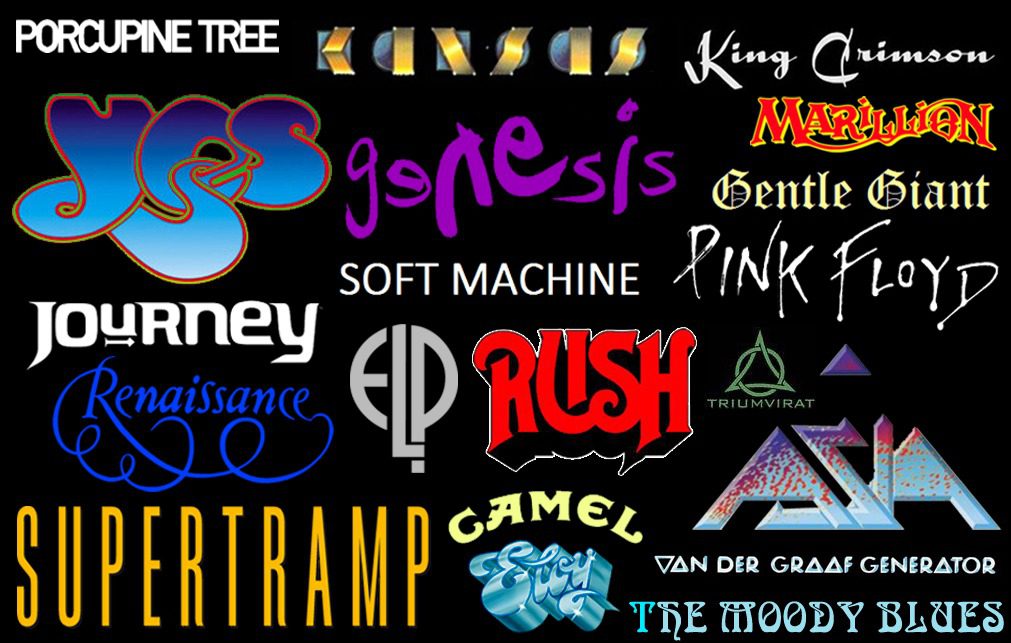
The beginnings (Prog rock 1965 – 2025, part 1)

The term “prog rock” (progressive rock) will not be on everyone’s lips. That changes as soon as names of groups like Pink Floyd and Genesis drop. These groups wanted to distinguish themselves by constantly striving for innovation within the boundaries of the genre but also by building bridges with other genres such as jazz and soul. ‘Prog rock’ differs from ‘mainstream rock’, which was discussed at length in the six-part series I published earlier (You can find the first episode of that series here).

In this first post, I will clarify the concept of progressive rock and show some examples of musical styles that underpin it. Broad agreement exists that the development of ‘prog rock’ was decisively influenced by three albums by the Beatles after 1966, namely ‘Rubber Soul’, Revolver and ‘Sgt Pepper’s Lonely Hearts Club Band’. A second influential group were the Beach Boys, particularly their album ‘Pet Sounds’. You are now watching and listening to the song ‘A Day in the Life’ from the album ‘Sgt Pepper’s Lonely Hearts Club Band’. In the absence of live recordings by the Beatles themselves, here you listen and watch the live version made by Dutch cover band ‘The Analogues’. 

Many other groups provided building blocks for the development of ‘prog rock’, such as, ‘The Doors’, ‘The Pretty Things‘, ‘The Zombies‘, ‘The Byrds’, ‘Grateful Dead’, ‘Jethro Tull‘, ‘Caravan‘, ‘Yardbirds‘,’So’Soft Machine‘, ‘Hollies’ and ‘Velvet Underground’. You can spend the next months deepening your acquaintance with most of these groups

Features

Although progressive rock will not mean the same thing to everyone, a few of the characteristics below will be something everyone will be able to mention:

– Striking lyrics or sound figures that attract and hold attention (‘hooks’, also called ‘earworms’.

– Deliberate deviations from rhythm, tempo, measure and key, which may be perceived as surprising or dissonant.

– Unorthodox instrumentation, such as the sitar and harpsichord.

– Distortion of guitar sounds, also to mimic the sound of exotic instruments, such as the sitar.

– The use of electronics in music reproduction and recording.

– High level of instrument mastery.

– Composition techniques borrowed from jazz and classical music.

– Frequent occurrence of long songs and improvised solos.

– In many cases, the studio became the place where the music was developed.

– Music to listen to; not dance music. 

– Symphonic elements.

– Poetic lyrics.     

– Striving to be recognized as an art form.

‘Artrock’

In the beginning of the 1960s musicians distinguished themselves from ‘commercial’ pop music by uswing the label ‘progressive pop’. Identifying with ‘progressive rock’ was a nest step. sometimes the term ā€œart rockā€ is used exclusively for avant-garde rock music. An example is Bowie’s album ‘Station to station’ (1976), whose title track you can listen to and watch here. Critics were divided over the album and some of his fans had great difficulty with its experimental nature. It would later influence a large group of ‘new wave’ artists. 

The groups I mentioned above each represent different stylistic contributions to the development of ‘prog rock’.  By far the most important contribution came from psychedelia: In the 1960s musicians frequently used hallucinogens as a source of inspiration or to create an atmosphere on stage that supported the use of perception-altering drugs. Other influences came from symphonic rock, ‘space music’, jazz rock, classical music and folk rock, incidentally in combination with the use of hallucinogens. I dwell on each of these forms.

Psychedelics

Especially in the early years, a remarkable difference occurred between Europe and the US. In Europe, the influence of psychedelics was central to the creation of music, which, besides the Beatles’ albums already mentioned, was also true of the Beach Boys with their leading album ‘Petsounds’. 

With lead guitarist Jeff Beck, the ‘Yardbird’s laid the foundations for the ‘psychedelic guitar’ with its ominous sounds in minor, hyperactive instrumental breaks, unpredictable tempo changes, the use of Gregorian chants, Eastern-sounding tonal loaders and shifting rhythms. You can hear and see this here in the song ‘Heart Full of Soul’ (1965)

The psychedelic variety that developed from the American West Coast was primarily intended to enhance the hallucinatory experience of drugs in the public. Among other things, light effects were used for this purpose, but the music, usually based on blues(rock), was also more intense. It was then referred to as acid rock. ‘Grateful death’ was one of the first acid rock bands and Jefferson Airplane was that first whose albums sold widely. You can listen to this group here, which also explicitly referred to the use of drugs in ‘White rabbit’.

Acid rock also featured many long guitar solos as in this song by the Paul Butterfield Blues band ‘Driftin Blues’ The electric (Hammond) organ, here in ā€˜The Doors’ Riders on the Storm ā€“ is also often heard.

In the late 1960s, the partly drug-based youth culture experienced highlights like ‘Summer of love’ (1967) and the Woodstock Rock Festival(1969). Legislation became stricter and several headliners (such as Jimi Hendrix, Janis Joplin and Jim Morrison) died. Acid rock developed in the direction of hard rock and heavy metal. That transition can be clearly heard in the song ‘In-A-Gada-Da-Vida’from ‘Iron Butterfly’. 

Other groups eventually shifted towards ‘prog rock’. They experimented with electronics and added classical and jazz-related themes to their music. Examples are Pink Floyd, Yes and King Crimson. Here, you watch and listen to Lark’s Tongues in Aspic Part 2 by the latter group here.

‘Space or cosmic rock’, also called ‘Krautrock’ 

The term ā€˜Krautrock’ refers to a broad collection of experimental musical forms, which developed mainly in West Germany. The artists involved combined elements of psychedelic rockavant-garde composition and electronic sounds. Common elements were hypnotic rhythms, extensive improvisation, use of realistic sounds and of early synthesisers. Themes often related to space. Prominent groups associated with the Krautrock label included ‘Tangerine Dream‘ (1975), ‘Osees‘ (2021), ‘Kraftwerk’ (1974), ‘Can‘ (1973) and more recently Neu!!! (2016), The development of this style resulted from young people’s desire to develop their own genre of music in their own language and apart from German ‘Schlagers’. Here as an example, Kraftwerk’s best-known song, ‘Autobahn’.

Jazz and classical music

Several groups sought to enrich their timbre by incorporating jazz. They usually used wind instruments in addition to guitars. Examples include ‘Colosseum‘ (1970), ‘Blood, Sweat and Tears‘ (1969), ‘Chicago‘ (1969), ‘Caravan‘ (1972), ‘Soft Machine’ (1974) and the Dutch group ‘Focus‘ (1973). Of more recent origin is ‘In Cahoots’ (2015).

Classical influences sometimes be heard in the choice of melodies, such as ‘Beck’s Bolero’ (2016) . Watch and listen here to ‘Jethro Tull’s’ ‘BourĆ©e’, (1969), inspired by Johann Sebastian’s Bach BourrĆ©e.

Most of the groups mentioned in this post have provided building blocks for the development of ‘prog rock’.  Some groups, such as the ‘Beatles’, the ‘Beachboys’ and ā€˜Pink Floyd’ were on the frontier of the genre in the late 1960s. Starting in the next post, I will discuss groups that rightfully pass for ‘prog rock’. I will do this from three angles: the three periods that are distinguished in the development of ‘prog rock’, (progressive, neo-progressive and post-progressive rock); four groups characteristic of these periods (Pink Floyd, Genesis, Marillion and Rush) and two artists who have made essential contributions to it throughout their lives (Peter Gabriel and Steven Wilson). The final episode will be about ‘new blood’, developments beyond 2020.

BeyoncĆ©: Megastars of pop music in the early 21st century

In a previous episode, I described how skillful producers are betting that new songs will achieve high sales. At the time, I used songs by BeyoncĆ© and Rihanna as examples. In separate posts, starting with this one, I will pay attention to both mega-stars. The story about the development of prog rock will continue in the next post.

BeyoncĆ© Giselle Knowles-Carter is born in Houston, Texas, in 1981. Her name is an homage to her mother’s birth name (Tina BeyincĆ© Carter). She owned a hair salon, and her father was a sales manager at Xerox. As a child, BeyoncĆ© was a steady participant in singing and dancing competitions. At her 7the, she won a talent contest with John Lennon’s song Imagine. She pursued a musical education. Due to the requirements of her fast-developing career, she did not finish it. 

From the age of eight, she attempts to become known on the girl groups circuit. Her father quit his job to become a full-time manager, bringing the family to the brink of poverty. At her 15th, success glimmered when the group signed a contract with Columbia Records, resulting in the first album ‘No, no, no’, The group was called Destiny’s Child from then on, inspired by the Bible book Isaiah. Large success came in 1999 with the group’s second album ‘Writings on the wall’, and with the third album ‘Survivor’ that followed a year later.  

Listen to the song ‘Say my name’ from the second album

In the meantime, BeyoncĆ© struggled with severe depression. In varying line-ups, the group would go on to become the best-selling girl group ever. BeyoncĆ© was the brains behind the music and choreography.  The group went on a lengthy successful world tour. After slowing down and producing another album, the group broke up amicably. 

Before Destiny’s Child ceased to exist, BeyoncĆ© released a solo album “Dangerously in love”.  It sold 11 million copies, and she received 5 Grammy Awards for it, the highest accolade in music.

From her debut album, you can see the best-selling single here. The recording also captures the large-scale set-up of her shows, which would continue to grow with each subsequent tour. Today, she is considered one of the best entertainers, surrounded by extremely costly and sophisticated choreography, for which the world’s best dancers are hired. So far, only Taylor Swift has caught up with her on this.

The second solo album followed in 2006. The third ‘I am… Sacha Fierce’ (2008) consists of two parts.  In the first part, she is herself; in the second part, she ‘plays’ ‘Sacha Fierce’, her ‘alter ego’.  The first part contains more quiet songs, while the second reveals more dance influences.  This album added eight Grammys to her collection.

Now, you can listen to the ‘quiet’ Halo, not a live performance, but a music video. A halo is an attribute, with which statues of saints were generously provided. 

From the album ‘4’ (2011) BeyoncĆ©’s lucky number, you can listen here to ‘(Girls) run the world’, performed on the 25th anniversary of the Opray Winfrey show, also her last one.Ā 

Each new album received more rave reviews from public, press and music critics.  This was especially true of album six, ‘Lemonade’, the best album of the entire decade because of the music, but also the cocktail of styles. The album is a modern form of R&B primarily, but it has also components of reggae, blues, rock, hip-hop, soul, funk, americana, country, gospel, electronics and rap. It also contained frank lyrics, for example about her husband’s infidelity. BeyoncĆ© calls herself a “modern-day feminist” and many of her songs are about love, relationships, female sexuality and independence.

With music mainly from this album, she toured all major stadiums around the world from 2016, the ‘Formation tour’, named after one of the songs from the album ‘Lemonade’. Here the song ‘Formation’. On 16 July 2016, she performed at the Amsterdam Arena.

Her seventh album, ‘Renaissance’ (2022) was also particularly well received, and it is the basis for the world tour BeyoncĆ© just finished. The song that you can listen to now is ‘Break my Soul’ and was filmed at the London performance of the show in June 2023. Electronic dance music dominates. More than 80 performances of this mega-show were scheduled. The cheapest tickets in London cost around €250; in Toronto, you could go for €100 less.

Even before the tour is over, BeyoncĆ© has achieved just about everything imaginable musically before Taylor Swift took over.  Never has an artist has earned 28 ‘Grammys’.  She has now sold 200 million albums (physical and digital), which can be added to the 60 million together with Destiny’s Child. Leading magazines like Billboard and Time name her as the best female artist of the 21stecentury. She is on the list of the 100 most influential people in the world. BeyoncĆ©’s nickname is ‘bee queen’ and her fans are called the bee-hive.

Finally, some details about the context of her life. BeyoncƩ married (also) world-famous rapper Jay-Z on 4 April 2008. Here, the couple is pictured together. They have a daughter aged 11 (Blue Ivy) and twins born in 2017 (Rumy and Sir).

BeyoncĆ© was the face of her own fashion line, House of DerĆ©on, which she set up with her mother in 2006: ‘Where sidewalk and catwalk meet’.  Their clothes were wildly popular among fans, but sales declined eventually due to a lack of innovative momentum.  The line was discontinued in 2012, partly after a fuss about overly sexy clothes for young girls. It has been revived in 2020 in connection with the then upcoming world tour. Later BeyoncĆ© launched a swimwear line with Adidas. Now she is working in partnership with Balmain. Several perfumes have been named after her. BeyoncĆ© has further appeared in numerous films, such as Pink Panther. Her voice is also heard in Lion King (Nala).

According to US business magazine Forbes, BeyoncĆ©’s wealth is about $540 million. She has earned most of it from her singing, but the clothing line and her long-term association with Pepsi, for which she received $50 million, also contribute. From the ongoing world tour, whose gross proceeds are estimated at $2 billion, she is also sure to make several hundred millions.

It wasn’t just making money that rang the bell. BeyoncĆ© also collaborates on campaigns to encourage schoolchildren to exercise. A nice clip to illustrate.

BeyoncĆ©’s fortune stands in the shadow of that of her husband, rapper Jay-Z, whose name is derived from the two underground lines (J and Z) that run through Brooklyn. He grew up in one of Brooklyn’s most dangerous neighbourhoods, repeatedly got into trouble with the police but managed to break away from the criminal milieu and became a successful musician and businessman. Unlike BeyoncĆ©, he owes his fortune mainly to successful business activities; besides his own record label (Roc-A-Fella), he invests in beauty products and in expensive champagne and cognac brands. He owns his own film company and finally, he owns a large collection of works by Jean-Michel Basquiat. Forbes estimates his wealth at over $2.5 billion. This makes him the richest hip-hop artist in the world, falling just short of the 1,000 richest people in the world (place 1208). In June 2023 Jay-Z and BeyoncĆ© bought the most expensive house ever sold ($200 million) in the state of California.

The making of megahits

Clockwise, starting from upper left: Stargate (producers), The calm of the procurer’s space, the notes of a top-liner, Esther dean (top liner)

Creating songs that have great chances of becoming global blockbusters and casting their performers is billion-dollar business.

In this post, I will elaborate a couple of examples: Two female superstars as examples: BeyoncƩ and Rihanna. Hard-working and talented artists in terms of voice and performance, equipped with a well-stocked wallet and surrounded by an endowed staff. Later, I will return to both, focusing on their work and person.

Brain Research

A lot of research has now been done on factors that explain the popularity of hits. This research often starts with the way the brain processes information. Our brains is lazy, or rather, it strives for maximum efficiency. The brain prefers information it can process smoothly: Think of:

  • Short sentences;
  • Easy or intriguing words;
  • Alliterations (Liesje leerde Lotje lopen op de lange Lindenlaan’) ;
  • Rhyme;

Most songs are written in English and much of the audience barely understands the song’s lyrics. The aim therefore is to enable listeners humming along with the chorus after just one or two listens. Understanding the content may possibly come later. Or never.

Hooks

The first ten seconds are crucial in this respect. The beginning must sound familiar: the lyrics, sound or rhythm contain ‘hooks’ that grab you. If not, listeners will zap the song away, except for a few connoisseurs who think they have discovered something special. 

‘Hooks’ are short rhythmic or verbal themes that constantly recur.  A potential top hit has several ‘hooks’. Examples of ‘hooks’ are:

Opening

  • Rhythmic hand clapping.
  • Common chords (think Boogie Woogie).
  • A simple sequence of nonsense words: ‘nananana nananana’.
  • An explosion of sounds.

Intro

  • Words that arouse curiosity.  Often the title of the song is repeatedly.
  • Words that touch you (‘catchy’).

Chorus

  • Brief.
  • Repetition of rhyming phrases and sounds.
  • Comes back often.

The song ‘Ra Ra Rasputin’ by Boney M. is full of ‘hooks’. Just read the chorus and then listen to the whole song. 

Ra Ra Rasputin. Lover of the Russian queen. Ra Ra Rasputin. Russia’s greatest love machine.

Verses

Opening, intro and chorus are a whole that logically’ leads to the next verse. In most songs their subject and meaning are of secondary importance. A verse prepares listeners for joining the next chorus.

We listen to Rihanna’s controversial song S&M. This was produced by Stargate and Frenchman Sandy Julien Wilhelm. Again, the hallmarks of a megahit immediately stand out:

  • The intriguing sounds at the beginning: ‘na na na na na na come on’.
  • The dance rhythm.
  • The intro, with the sweet little voice.
  • The fusion of lyrics and rhythm in the chorus: “sticks and stones may break my bones but chains and whips exite me”.
  • The repetition of intro and chorus.

You can read the full text here

Producers and top liners

The above knowledge alone will not enable you to make a megahit. Therefore, craftsmanship is needed. The music industry relies on experienced and artistically gifted teams, whose members have mastered the required skills and add a dose of creativity.  Such a team includes among others ‘producers’ and ‘top liners’. This dichotomy replaces the familiar division of labor between composers and lyricists.  Many megahits come from a limited number of teams. In this way, plagiarism can also be limited. Lines of communication are short, and producers and ‘topliners’ know ‘their’ artists and they exchange ideas on newer songs. 

Stargate

Stargate is a team of producers. They are long-time Norwegians Mikkel Eriksen and Tor Erik Hermansen.  They spend days at a time producing ‘tracks’, say sound clips.  Two or three of them sit behind keyboards and computers and fiddle away, until a ‘catchy’ series of sounds rolls out.  This is by no means always a whole song, but rather an intro or chorus. They listen to these tracks until the best ones remain. The lesser ones are sometimes used for commercials.

The more than 100 songs they have produced can be found here. Many of them have landed in charts around the world.

Esther Dean

As soon as there are a dozen or so potentially good ‘tracks’ on the shelf, producers invite one of their ‘top liners’ for a multi-day session. Esther Dean is one such top liner.  Here is a list of all the songs (117) she co-authored. She was involved in some of BeyoncĆ©’s and especially Rihanna’s biggest hits, whose voice she feels and can imitate particularly well. 

Esther places herself in a soundproof cell and listens to a track. She has prepared by writing down hundreds of short phrases, catchy words, from newspapers and other sources. The beginning of a song is nothing but her singing into a track with combinations of these words. She is extremely gifted at fusing words and sounds, even if the words are meaningless for the time being. She keeps repeating this dozens of times until she feels something good is coming.  She plays with sounds, words and phrases until there is a catchy intro and chorus. Together with the producers they finish the song for 90%. When the producers are satisfied, they write the intermediate verses

By the end of a multi-day session, about five potential mega-hits have been set to lyrics and music, including all musical effects, with no musical instrument other than the electric ones involved. Later, the shows usually will deploy a live orchestra. The most promising hits are submitted to record companies and top artists like BeyoncƩ and Rihanna listen in critically.

At least 10 highest-grossing hits of BeyoncƩ and Rihanna were produced by Stargate in collaboration with Esther Dean, who as a result easily made several million dollars per song.

Things may also turn out differently than intended

Finally, we listen to a song produced by Ryan Tedder. He sent a track to a top liner who turned it into the song ‘Halo’ for BeyoncĆ©. We listen to Halo, a quiet song, now with the singer in the picture. The stylistic features mentioned earlier stand out again. The listener is increasingly drawn into the ‘halo’ as the song progresses.

Something went wrong, however, as Ryan Tedder also gave the track to Kelly Clarkson, who created her own lyrics to it: ā€˜Already Gone’.

Obviously, Kelly was very angry because her song appeared later, but legally there was nothing wrong. 

Kelly is certainly BeyoncĆ©’s inferior as a singer, but she is also a theatre personality, so she allows herself to feature the chorus of BeyoncĆ©’s song ‘Halo’ in her song when appropriate. An otherwise rare and poor recording of this can be heard here: https://www.youtube.com/watch?v=x0stee65ba4

There are also audio freaks who have created a mash-up of both songs. A mash-up is the musically sound mixing of two or more music tracks. Fans view an example here: https://www.youtube.com/watch?v=bGuJQPWjk1Q

The repetition effect. Also, for the song as a whole.

Of paramount importance for the music industry is the repetition of intended hits on radio or television, the so-called plugging of songs. Also, airtime is bought in commercial breaks for which millions are invested in catchy videos.  Moreover, ‘free’ artist performances are offered to program makers and organisers of music. Here, Rihanna sings her song Diamonds on the catwalk of Victoria’s Secret Fashion Show. This high-profile (under)fashion show is usually graced by top artists who come to plug their latest hit. A ‘win-win’ situation, obviously only for top artists.

Song under a magnifying glass: Puff Daddy: I’ll be missing you.

Puff Daddy was one of Sean Combs’ stage names. He was born in 1970 in Harlem, then a poor black neighbourhood in New York. His father was shot and killed when Sean was just two years old. The family left New York. Sean turned out to be an ambitious boy, having finished university by the age of 20, and went to work at a record production company. After a few years, he founded his own company ‘Bad Boy Entertainment’ with which he made a lot of money that allowed him to live a luxurious life with women, money and drugs.Ā 

Now listen to the song this post is about:

The lyrics of a song are sometimes a whole story, like ā€˜I’ll be missing you’ will reveal, behind many songs there is also another story.

The song

One of Sean’s best-known performers was the rapper ‘Notorious B.I.G. He was killed by a gunshot in a dispute between rival groups. Sean wrote this song, a kind of ‘in memoriam’, in response to this event. It was an international hit and Sean’s singing career took off.

The refrain of the song is very poetic

Every step I take
Every move I make
Every single day, every time I pray
I’ll be missing you
Thinkin’ of the day
When you went away
What a life to take, what a bond to break
I’ll be missing you (I miss you, B.I.G.)

As is often the case, the song has been covered by other artists. Here is another rather smooth version.

Its style

The actual lyrics are a ‘rap’, as you may have noticed. As I explained in the former post, rap is a musical style, reciting lyrics in a rhythmic way. As such, this is nothing new; medieval troubadours were already doing it. The ‘rap’ we know comes from ‘hip-hop’ (sub)culture, that developed in the 1980s in the Bronx, then also a poor neighborhood in New York.Ā 

As illustrated by the presentation of Eminem’s songs in the previous post, much rap is opposing (American) society and lyrics are often sexist and glorify violence. The popularity of this genre has grown rapidly and so has the variety of styles. Puff Daddy’s song is gospel rap, having a religious background.

Another hallmark of hip-hop culture is breakdancing. Young people in New York’s black ghettos had few opportunities to make a difference in society. So, they all wanted to become famous rappers or to perform as dancers. Their style is called ‘breakdance’, also popular in the Netherlands in the 1990s. How perfect can it be? Here is an example.

What’s wrong with the song?

But there is something wrong with ā€˜I’ll be missing you’. Listen to the performance of Sting singing ‘Message in a bottle’ (Paris 2017).

Sting’s song is much older than Puff Daddy’s. Another famous song was found to be plagiarised. A court therefore ruled that all royalties from ‘I’ll be missing you’ would go to Sting until 2023. In 1997, the two men became acquainted, and appeared to like each other. It was decided that from then on, Sting would no longer receive all of his royalties, but ‘only’ an amount of $5,000 per day. They also decided to do a concert together, featuring Faith Evans, the widow of Notorious B.I.G.Ā You can look and listen to this performance here:

Covers

‘l’ll be missing you’ is also a favorite song of amateur choirs. Finally, you might listen and look at an example

What do you think of this performance, compared to the earlier chorus I showed?

Rapper Eminem. Worshipped and disgusted

Only a few decades ago, both parties in the US Congress disqualified rap as a symptom of the destruction of American values. This because of its coarse language, hatred of women and gays and barely concealed calls for the use of violence. Anno 2024, much seems to have changed. Headlines report that the Spanish swimmers-in-law impressed at the Olympics with a compilation of songs by US rapper Eminem. The swimmers’ performance is a nice opportunity to get a first impression of this kind of music. Find the show here.

What is rap?

Rapping is a vocal style in which the performer rhythmically utters lyrics in rhyme, often against the background of electronic sounds and synthesised (drum)beat. In many songs, ‘samples’ from popular artists provide the musical accompaniment. Rap developed as a part of the hip-hop subculture in the 1970s – along with breakdance and graffiti – the epicenter being the Bronx in New York. ‘Rapper’s Delight’ by the Sugarhill Gang from 1979 is the first recorded rap.

Indulging in hip-hop culture was a way for inner-city black youths to cope with the lack of opportunities.

What is rap about?

In the 1980s was an expression of living conditions in the slums and resistance to them. Leading examples from that time are ‘Fight the Power‘ by Public Enemy , ‘Fuck the police’ by N.W.A. Watch and listen to anoyher example, ‘The Message’ by Grandmaster Flash and the Furious Five below.

Following on from this politically-oriented rap, ‘gangsta rap’ emerged, which sang the violent lifestyle of black youths, called on them to rebel and caused great controversy. Later, rappers focused their probes on gays and women in general. A content analysis of rapper Tyler, the Creator’s album ‘Goblin’ showed 213 instances of homophobic language. Another content analysis of rap lyrics showed that 22% contained violence against women, including images of sexual assault, murder and rape. Almost 50% featured swearing, shaming and distrust and 67% depicted women as objects for men to possess, use and abuse.

Eminem

Eminem, born Marshall Bruce Matters III in St. Joseph, Missouri, is raised by his mother Debbie in poverty-stricken conditions in a working-class black neighbourhood in Detroit. Later, Marshall’s girlfriend Kim Scott also is moving in with them. They were one of three white families on the block and regular victims of violence. At the age of 14, Marshall starts rapping with his friend Mike and together they cal themselves ‘M&M’. After Mike disappeared from the picture, Marshall bastards that to Eminem.  He appears to possess a special sense of language. He writes long lyrics and looks for words that rhyme or have sound affinity for every syllable. Modest as he is, he barely gets out of words in interviews, but in possession of pen and paper, sentences, metaphors and complex rhyme schemes emerge, often over more than one syllable. In the meantime, he consistently maintains beat and rhythm in a way that many a writer or poet can learn from. In doing so, he proves to be among the greatest rappers ever. However, success was a long time coming. 

His first album ‘Infinite‘ dates to 1995 and revolves around the arguments with his mother to raise his newborn daughter Haillie with little money. By then, the family had moved into a mobile home in a crime-ridden area. He sells 1,000 copies of the music cassette from the loading bay of his car and works as a dishwasher, gets fired repeatedly, becomes addicted and attempts suicide. After taking part in the Rap Olympics, better times are breaking out. Here, the already famous Dr. Dre discovers him and gives him a record deal, although the fact that Eminem was white arouses a lot of resistance in the black community. 

I have peppered this post with a few of Eminem’s songs, taken from some of his best-selling albums. The first one is ‘Guilty conscience’, from the Slim Shady LP (1999). Eventually, sales of his albums will make him a multimillionaire. Like many other rappers, he is criticised for the violent content of his songs and the hatred of gays and women that emanates from them. In ‘Guilty conscience’, which you can listen to and watch now, it mainly revolves around criminal behavior and violence.

In the music video, Eminem (the bad conscience) and Dr. Dre (the good conscience) rap about dealing with the temptation of criminal behavior, such as a man about to rob a liquor store, a student’s urge to have sex with an underage girl at a frat party, and a construction worker’s intention to kill his wife after he catches her cheating with another man. Eminem and Dr. Dre finally agree that this is the best solution. In some versions of the video, the murder has been removed and only the shot is audible.

Violence, homophobia and misogyny

Violent lyrics, homophobia and misogyny crop up in all of Eminem’s albums. Another example: In the song ’97 Bonnie & Clide on ‘The Slim Shady LP’ (1999), he disposes of his wife’s body. The song “Criminal” on his third album The Marshall Mathers LP (2000), includes lines like, “My words are like a dodger with a jagged edge, That’ll stab you in the head, whether you’re a fag or les’, Or a homosex, hermaph or a trans-a-vest, Pants or dress, hate fags” 

Listen and watch ‘Criminal’ on the Marshall Mathers LP (2001) here

Eleven of this album’s 14 tracks include derogatory names for women like “bitch” and “ho(e)” (derived from whore), sexual objectification of women, legitimisation of violence against women, mistrust of women, belittling of sex workers and glorification of pimping. Other rappers, musicians in general and anyone else who has fallen into disgrace with Eminem are also mercilessly put in their place.

Personal struggle

Below you can listen and watch the song ā€˜Lose yourself’ on the album ‘8 mile’ (2002) Many critics consider this Eminem’s best song and he spent 12 weeks at the top of the ‘Billboard Hot 100’. The song is autobiographical and depicts the struggles he had to overcome to earn respect from other rappers. Joe Biden used the song during his 2020 campaign.

The ‘method’ Eminem

Eminem has so far released 50 singles and 13 albums, which – apart from Infinite – have been huge sales successes. A total of 220 million records have been sold and his music videos have been viewed more than 10 billion times on YouTube. Eminem has won 15 Grammy Awards, eight American Music Awards and 17 Billboard Music AwardsBillboard named him the “Artist of the Decade (2000-2009)“. It is not surprising then that he wrote the song ‘Rap God’ in 2013. It appeared on the album The Marshall Mathers LP2.

From his first albums, Eminem has created a murderous dirt-spouting ‘alter ego’ named Slim Shady. Against this extravagant anti-hero, he set himself – Marshall Mathers – as an introverted autobiographer. At the start of the millennium, Slim Shady was the embodiment of the rebellion of an entire generation of young people. By no means exclusively in the slums of US cities, but increasingly worldwide.

A song like ‘My name is’ (Slim Shady) (1999), which you can listen to and watch now, is mixing humor with steely verbiage that more than justifies the ‘Parental Advisory Explicit Content’ sticker.

Eminem has maintained dialogues with his ‘alter ego’ for more than 25 years. In those years, some of the verbiage from the early days of rap has become part of standard language, at least on the street and some of its shock effect has disappeared. In his latest album (2024) ‘The Death of Slim Shady (Coup de GrĆ¢ce). Listen to ‘Guilt conscience 2’ on the album ‘The Death of Slim Shady’ (Coup de GrĆ¢ce). 

In this song, Eminem accuses Slim Shady of being the cause of all the controversies he has caused and the resulting damage to his career. Eminem decides that the scoundrel must die, after he has been washed over by a canon of swear words and insults. After this, Eminem kills Slim.

The song ‘Houdini’ illustrates why Eminem is so successful. His music videos are attractively designed and usually based on ear-catching samples from other artists. In this case, it is the Steve Miller Band’s song Abracadabra. Despite what I consider to be the poison-black world he sings about; humor is not lacking. Undisputable, the album’s raunchy lyrics and intricate wordplay show that he is still on a lonely high as a rapper. Check out ‘Houdini’ here, also from Eminem’s latest album ‘The Death of Slim Shady (Coup de GrĆ¢ce)’ (2024)

Cultural background

Scholars believe that hip hop is rooted in cultures with predominantly conservative views of masculinity and femininity and that these can lead to condemnation of those who do not conform to them. This applies to US culture much more strongly than European culture, for example.

The original hip-hop subculture in poor American neighborhoods puts the ‘masculinity’ of the black heterosexual on a pedestal and in parallel degrades women and homosexuality. In his 2006 documentary Hip-Hop: Beyond Beats and Rhymes from 2006, which you can watch here, Byron Hurt explores the relationships between hip-hop, masculinity, misogyny  (hate against women) and homophobia. After conducting dozens of interviews, Hurt sees a pattern of homophobia, the objectification of women and the mutual struggle for being ā€˜on the throne’ between men, all of which contribute to how masculinity is validated. The acceptance of rape is then considered as an ‘appropriate response’ to women who challenge male dominance, refuse sexual advances or ‘offend’ men. At the same time, some women nevertheless seem unable to disassociate themselves from featuring ‘wrong men’. In ‘Love the Way You Lie’ on the album Relapse (2010), Eminem and Rihanna sing of such a depraved relationship.

Hip hop grew to become the US best-selling music genre from the turn of the millennium. Its popularity has long since ceased to be limited to disadvantaged residents of slum neighbourhoods. Eventually hip hop has spread worldwide among all social groups and even ages. I wonder whether the appreciation of the songs of Eminem and other famous rappers like Jay-Z has become detached from their content. While writing this post, this question kept coming up as I was writing this post and also how this might be possible 

Gourdine and Lemmons’ study, titled “Perceptions of Misogyny in Hip Hop and Rap: What Do the Youths Think?” is helping when answering this question. 64% of all children and teenagers in the US report listening to rap songs daily. There appears to be a strong correlation between their age and the extent to which they recognise its violent slant, misogyny and homophobia. Raps are often incomprehensible, especially for those whose first language is not English. As listeners get older, appreciation for rap as a musical form often persists, despite growing awareness of the negative aspects of its content, comparable with violence in movies.

That the content of a rap and its appreciation can diverge is apparent in the video of Eminem’s live performance at the 2020 Oscars ceremony in front of an enthusiastic audience. One might assume that the majority does not hate women and is not homophobic or violent. The same goes for the Spanish swimmers I started this post with.

A new sound?

From the turn of the millennium, there has been a growing community of LGBTQ+ hip hop artists. Examples include rappers like Azealia Banks and Frank Ocean, mainstream hip-hop artists, who came out recently. They were followed in 2019 by Lil Nas X. In their songs, most female rappers draw attention to women’s rights. So do mainstream artists like Tylor Swift, Lauryn Hill, BeyoncĆ© and Mary J. Blige. As a result, only a small minority of female rappers’ lyrics still mention homophobic and misogynist views. 

As a 52-year-old, Eminem is at a turning point in his career. His ranting alter ego has been discarded and continuing the old path, littered with violent scenes, fighting feuds with colleagues, misplaced language towards gays and women, seems like a dead end. He himself puts into perspective the misogyny and homophoby attributed to his raps.  For instance, he attributes the frequent use of the term ‘faggot’ (flicker) to his use of slang, in which this term is not necessarily a condemnation. Nevertheless, he apologises for having hurt people. “I don’t have problems with anyone…”

Everyone is watching to see what this means for a possible 14de album. For now, the amount of Eminem’s albums in circulation worldwide still gives plenty of cause for both adoration and disgust.

John Coltrane (The evolution of jazz 11/11)

John William Coltrane (nicknamed ‘Trane’) is born on 23 September 1926 in Hamlet (North Carolina, U.S.) and he died on 17 July 1967 in Huntington (New York, U.S.). He played clarinet and tenor in a local marching band. Later, he switched to saxophone. After high school, he found work in a sugar refinery to supplement the family’s income, which had by now moved to Philadelphia.

1940s

On his 17de birthday, he was given a saxophone. June 1945 was an important moment in his career; it was then that he first heard Charlie Parker play, about which he later said, “the first time I heard Bird play, it hit me right between the eyes.”

In the army, his musical talent was soon discovered, and he joined the Melody Masters, the swing band at his base in Hawai. His first record recording was in 1946, where he played several jazz standards and bebop songs. Back in Philadelphia, thanks to a scholarship, he took courses in music theory and saxophone. While playing in various bands, he continued to practice fanatically. 

1950s

Meanwhile, Charlie Parker had also discovered his talent and Coltrane regularly played with him as a freelancer, as did Dizzie Gillespie and Johnny Hodges. In 1955, Miles Davis invited him to join his quintet when it was coming back from his heroin addiction. With this quintet, Coltrane recorded the albums Cookin’, Relaxin’, Workin’and Steamin’ (with the Miles Davis Quintet).

From ‘Relaxin’, you can listen here to a live performance in Zurich by Coltrane and Davis in ‘If I Were a Bell’. The recording dates from 1961.

The quintet ceased to exist after several years, now because of Coltrane’s heroin addiction.

In 1957, Coltrane teams up with Thelonius Monk, but due to various contractual obligations, a joint album never materialised. Only in 2005, a good recording of a concert in November 1957 surfaced and an album was produced after all: ‘Thelonius Monk Quartet With John Coltrane at Carnegie Hall’. This album was highly acclaimed. Newsweek spoke of the “musical equivalent of the discovery of a new Mount Everest”. The album shows how Monk gives all the space to Coltrane and subtly supports his solos. Listen to ‘Sweet and Lovely'(1957):

In 1957, Coltrane resumes collaboration with Miles Davis, who perfected the style he had already practised with Monk, i.e. rapid succession of notes, fitting within a predefined sequence of chords. At this time, Daves’ albums ‘Milestones’ and ‘Kind of Blue’ were also recorded. 

1960s

Free jazz

In the early 1960s, Coltrane recorded the album ‘Giant Steps’ (1960). In the history of jazz, this album rivals Davis’ Kind of Blue’. This album has a trickier sequence of patterns of notes than any jazz song. Listening to the title track ‘Giant steps’ while watching an animation of the notes flying by is fascinating. ‘Giant steps’ is compulsory practice material for conservatory students.

Of a very different nature is ‘Naima‘, a tone poem dedicated to his wife. This also applies to two other songs referring to family members: ‘Cousin Mary’ and Syeeda’s Song Flute’, dedicated to his stepdaughter. Watch and listen to the latter song. Played here by the Colorado State University Jazz Ensemble:

A recording like this gives a good idea of what the song sounds like on the record. The difference, of course, is that the song on the album is largely improvised and this version is a transcription of it.

Coltrane forms his first quartet now, later quintet. Its first record was ‘My Favorite Things‘ (1965), on which he plays soprano saxophone. The group plays regularly at the famous jazz club ‘Village Vanguard’ in New York and develops increasingly towards ‘free jazz’. This is evident in one of the most frequently played pieces, ‘Chasin’ the Trane’ (1961). Later, Coltrane added a second bass player to get a deeper pulsating foundation. You can hear that on the albums OlĆ© Coltrane’ (1961), ‘Africa/Africa/Brass’(1961). This song is played here by Archie Shepp and the Hessische Rundfunk Bigband. The beauty of this arrangement is that a second bass player has also been added to this orchestra and the timbre is made extra massive by four (!) tubas.

Of slightly later date are ‘The John Coltrane Quartet Plays’ (1965) and ‘Ascension’ (1965). You watch and listen to part of this album here.

A middle ground?

Many critics were decidedly negative about Coltrane’s development. They spoke of ‘anti-jazz’ and fellow musicians, including Miles Davis, also disliked it. Coltrane took this criticism to heart and the style of the ‘Classic Quartet’, as it was called, becomes more harmonic. This is especially evident in the albums ‘Ballads‘(1961).

In live performances, he continues to push the boundaries between jazz standards and more free forms of jazz. This is evident on albums such as ‘Impressions’ (1963), ‘Live at Birdland’ (1963) and ‘Newport‘(1963). You can watch and listen to ‘I want to talk about you’, from the latter album, here.

Spiritual inspiration

In 1964, the ‘Classic Quartet’ produced its bestseller, ‘A Love Supreme’. This work is an ode to Coltrane’s love for and belief in God. For this, Coltrane thoroughly immersed himself in the writings of various religions. His spiritual inspiration is continued in other albums, such as ‘Ascention‘ (1965), ‘Om‘ (1965) and ‘Meditations‘ (1966) . ‘Om’ is main symbol of Hinduism and refers to the infinity of the universe.

In these albums, Coltrane deepened his commitment to avant-garde jazz, inspired by Ornette Coleman, Albert Ayler and Sun Ra. He asked Pharoah Sanders to join the quartet and attracted a second drummer.  Other members of the quartet could no longer follow Coltrane’s path and left the band. 

Cosmic transcendence

With his new group, Coltrane plays long versions of earlier work, sometimes up to 30 minutes. Some concerts have been recorded: ‘Live at the Village Vanguard Again! (1966) and ‘Live in Japan’. Studio recordings appeared on ‘Expression‘ and ‘Interstellar space’(without Sanders).

Death

Coltrane died unexpectedly of liver cancer at the age of 40, after which the African Orthodox Church canonised him. Coltrane is depicted as one of the saints on and 280m2 icon – the ‘Dancing Saints’- in St Gregory of Nyssa Episcopal Church in San Francisco.

Coltrane’s sons continue his musical work. I end with a song taken from the album ‘Expression’, played by Ravi Coltrane’s quartet in 2008.

‘Chasing Trane: The John Coltrane Documentary’ is a 2016 film directed by John Scheinfeld. You can watch it here

Miles Davis (The development of Jazz 10/11)

Miles Dewey Davis III was born on 26 May 1926 in Alton (Illinois, U.S.). He died on 28 September 1991 in Santa Monica (California, U.S.). He grew up affluent; his mother was a violinist and his father a dentist. 

Davis has been attracted to blues, big bands and gospel from an early age. At nine, he became his first trumpet. Elwood Buchanan taught him to play on it. Davis later spoke of it as the “biggest influence on my life”. Buchanan stressed the importance of playing without vibrato, against the fashion of the time, which he continued all his life.

1940s

At the age of 15, Davis goes to high school and joins a marching band, led by his music teacher Buchanan. He also plays in small ensembles. He eagerly studies music theory and learns to read scores. 

Under pressure from his mother, who felt he should finish school first, he turned down the offer to join the Tiny Bradshaw band. Shortly afterwards, he plays as a substitute in the Billie Eckstine Band, in which Art Blakey, Dizzie Gillespie and Charlie Parker also play. After this experience, Davis decides to move to New York “where the action is”. He is admitted to the Juilliard School of Music but does not finish his education to pursue music full-time. He plays in several bands, including the Charlie Parker quintet. Here he regularly plays with Gillespie and Mingus. In one of the songs ‘Now’s the Time’, he plays a solo that anticipates what would become ‘cool jazz’.

Recordings during this period include ‘Half Nelson‘ (1947) and ‘Sippin’  at Bells‘ (1947). 

In August 1948, Davis, along with Mulligan, Roach, Lewis and others, form a nine-member band (nonet), seeking a musical alternative to bebop. Eventually, nine songs were recorded and released as singles. It was not until 1957 that these were compiled into the album ‘Birth of the Cool’, which has a previously unprecedented orchestral timbre.Ā 

1950s

After returning from a stay in Paris, Davis became depressed and he found himself out of work. He was not yet 24 and became addicted to heroin, which did not help his playing. He eventually got to grips with his addiction and recorded two albums: ‘Miles Davis Quartet’ (1953) and ‘Miles Davis Volume 2′ (1956). More albums followed and they portray his transition from cool jazz to hard bop. Hard bop is more focused on harmony and melody and regularly uses popular songs as a starting point for improvisation. ‘Walkin” is the first album representative of this genre. You can see a recording from this album here:

Miles’ performance at the Newport Jazz Festival in July 1955, along with Monk and Mulligan, brought back public interest in his work. The Miles Davis Quintet, which now included John Coltrane, released four albums in the second half of the 1950s, recorded in two marathon sessions in 1956.  ‘Cookin’ with the Miles Davis Quintet’ (1957), ‘Relaxin’  with the Miles DDavis Quintet1958), ‘Workin’ with the Miles Davis Quintet’(1960) and ‘Steamin’ with the Miles Davis Quintet‘. Watch a recording of ‘When I fall in Love’ from the latter album

Davis travelled to Paris several times, including recording the soundtrack to ‘Ascenseur pour l’Ć©chafaud‘ (1958, with director Louis Malle).

Tired of all performances and travel, Davis was ready for a new project. He aspires to a job at a university to combine his theoretical knowledge and his skills as a performer. But it becomes a project with Canadian-American composer, pianist and arranger Gil Evans. Between 1957 and 1962, the two make five albums that differ greatly from Davis’s oeuvre up to that point. 

On Miles Ahead (1957), Davis plays on flugelhorn “The Maids of Cadiz” by LĆ©o Delibes, the first time Davis recorded ā€˜classical music’. You can listen to a recording of this song played by Gil Evans’ big band here (2018). 

Porgy and Bess (1959), one of the albums made with Gil Evans, contains arrangements of pieces from George Gershwin’s opera.  Sketches of Spain (1960) features music by JoaquĆ­n Rodrigo and Manuel de Falla and compositions by Evans. The album was a great success; it sold more than 120,000 copies in the US alone. On this album, you can listen to, among others, Davis’s version of the Concerto d ‘Aranjuez.

The duo’s last album is Quiet Nights (1963), a collection of bossa nova songs that, incidentally, was released against Davis’ and Evans’ wishes.

The box set Miles Davis & Gil Evans: The Complete Columbia Studio Recordings (1996) won the 1997 Grammy Award for ‘Best Historical Album’ and ‘Best Album Notes’. It is gift with which to please many a music lover.

In March 1959, Davis released ”Kind of Blue” which is often called his best album and one of the best albums in the history of jazz. By 2019, it had sold a total of 5 million copies. Songs include: ‘Freddy Freeloader’, ‘So What’ and ‘All Blues”. The latter song is played here by the Frankfurt Radio Big Band in 2020.

‘Kind of Blue’ departs from Davis’s earlier hardbop jazz style where improvisations are based on complex chord progressions. Instead, soloists improvise based on a predetermined ‘mode’, usually one or more of the seven classical scales, or a variation thereof. The aim of such a modal approach is to increase the freedom for soloists to shape an improvisation. Later, John Coltrane, among others, would also opt for this ‘modal approach’.

1960s

Miles continues to tour with his quintet during these years, which sees many personnel changes over the years. He also had to be hospitalised several times for hip fractures and a liver infection. His record sales dropped to a minimum. However, In the late 1960s he again record five new albums: ‘Miles smiles’ (1966), Sorcerer‘(1967), ‘Nefertiti‘(1967), ‘Miles in the sky’(1968) and ‘Filles de Kilimanjaro’(1968). During concerts, the band links songs together so that they flow into each other. Davis continued to do this until 1975.

In the last two albums, Davis switches partly to electric instruments, the beginning of his ‘fusion’ period.  Rock influences are now increasingly audible. ‘In a silent way’ (1969) is considered the first fusion album, and it prompted a lot of comments from jazz critics. Here you can listen and watch ‘In a silent way’ from the album of the same name.

1970s

Bitches Brew’ (1970) is another bestseller. By 2003, it had sold one million copies. The songs that make up the album were compiled and edited from separate recordings with technical aids. Miles Davis starts performing with ‘Bitches Brew’ in the support acts of rock bands such as those of Steve Miller and Neil Young. He also performs to an audience of 600,000 at The Island of Wight Festival. Again, critics follow him with suspicion. You can watch and listen to part of Bitches Brew here.

Davis became influenced by the music of Karlheinz Stockhausen; critics spoke of ‘space music’.  The album ‘On the corner’(1972) mixes this influence with funk. A series of albums with recordings of performances followed: ‘In concert’(1972), ‘Get up with it’(1974), Agharta (1974), Pangea (1976) and Dark Magnus (1977). Fans loved these albums; critics wiped the floor with them. They denounced Davis’s habit of playing with his back to the audience or looking at the ground during performances. He used alcohol, codeine and morphine to stay on his feet during these performances and had to be hospitalised repeatedly.

In 1975, Davis stops making music. In the following five years, he tries to put together a new band. Eventually, he managed to come back. He releases two new album ‘The man with too horn’(1981) and ‘We want Miles’ (1981), which earned him a Grammy Award for ‘Best Jazz Instrumental Performance By a Soloist’. 

It was only after he suffers a stroke that he distanced himself from the use of alcohol and drugs for the rest of his life, started drawing and living a healthy life. He now also plays ‘cover’ versions of pop songs, such as Cindy Lauper’s ‘Time After Time’. He swapped his funk-based style for a more melodic one. He also collaborated with a slew of other artists, such as Zucchero Fornaciari in a version of Dune Moss.

1990s

In 1991, at the Montreux jazz festival, Davis plays for the first time songs from the albums Miles Ahead, Porgy and Bess and Sketches of Spain, which he had recorded with the recently deceased Gil Evans in the late 1950s, with an orchestra conducted by Quincy Jones. You can listen and watch their entire performance here. Davis’s occasionally weak playing was because he was seriously ill at the time of the concert.

At a grand concert in Paris attended by many colleagues, he receives the order “Chevalier of the Legion of Honour” from the hands of the French minister of culture, who called him the “Picasso of Jazz”. 

Back in the US, his latest album ‘Doo-Bop’ which would be released posthumously (1992), as well as Rubberband (2019). On 25 August, he performs publicly for the last time. A snippet of his last performance in Europe on 1 July 1991, the song ‘Human Nature’, can be seen here. 

In September, Miles dies of a series of complications.

Miles Davis is widely hailed as a pioneer of 20th-century jazz and his influence on the development of rock. The Guardian places him among the best jazz musicians ever. Davis was at the forefront of many innovations: ‘cool jazz’, ‘hard bop’, ‘fusion’ with rock, soul, funk and hip-hop. As such, his work is a sustained critique of bebop. He stretched the boundaries of jazz far and, in doing so, also inspired many musicians.

A two-hour-long documentary, ‘The Miles Davis Story’ won an international Emmy Award.

Dizzy Gillespie (The development of Jazz 9/11)

Dizzy (John Birks) Gillespie was born on 21 October 1917 in Cheraw (South Carolina, U.S.) and he died on 6 January 1993 In Englewood (New Jersey, U.S.). His father was the leader of a local band. At the age of four, he started playing the piano. After his father’s death, he was 10 at the time, he skilled himself on trombone and trumpet. 

1930s

After hearing Roy Eldridge play on the radio, he aspired to a career in jazz. From 1935, he played professionally in various orchestras. In Teddy Hill’s band, he made his first record, the ‘King Porter Stomp'(1937). This ‘jazz standard’ was recorded many times after that. You can listen to the song here, played on a classic gramophone:

A technically improved reissue from1994 can be found here. A ‘stomp’ is a specific repetition of chords and is deployed in many melodies.  Here you can hear it and probably youbrecognize the ā€˜stomp’.

https://upload.wikimedia.org/wikipedia/commons/d/d4/Stomp_progression_block_chords_F.mid

1940s -1950s

From 1939, Gillespie was part of Cab Calloway’s orchestra that played at the Cotton Club in Harlem at the time.  With this orchestra, Gillespie records his first composition “Pickin’ the Cabbage”(1940). Listen to the original recording here.

After an argument, Calloway fired Gillespie. He blamed him for misplaced humor and, moreover, thought his solos were too adventurous. ‘Chinese music’, Calloway called them. Later, Calloway would make repeated use of Gillespie’s virtuosity. After his dismissal, he wrote and arranged music for various bands, including those of Woody Herman, Jimmy Dorsey and Ella Fitzgerald. However, new opportunities presented themselves. 

First, he joins Earl Hines band and then Billy Eckstine’s band, of which Charlie Parker was also a member. In these bands, his contribution to the development of bebop came to fruition and Gillespie became the face of this genre. 

During this time, Gillespie brings several compositions to his name, such as ‘A Night in Tunisia’ (1942, recorded here in 1981), ‘Groovin’High‘ (1947), Woody ‘n’ You’ (1944), ‘Salted Peanuts’  (performed here by Dizzie Gillespie and his Orchestra in 1946). These songs are substantially different from mainstream swing music in melodic and rhythmic terms. ‘Woody ‘n’ You’, a tribute to Woody Herman, is one of the earliest examples of bebop. You can listen to this song here in a performance by the WDR Big Band from 2023.

During these years, Gillespie played in several small ensembles and formed several big bands.  With one of these, he records the film ‘Jivin’ in Be-Bop’ in 1947. Watch and listen to a clip ‘Bebop Dancers’ here, which shows that fast-paced bebop requires special dancing skills. The film consists of a sequence of song and dance numbers, with no further plot.

The band ‘Gillespie and his Bee Bop Orchestra’ played an important role in broadening the popularity of bebop. At the fourth ‘Cavalcade of Jazz’ in 1948, he was announced with the words, “the musicianship, inventive technique, and daring of this young man has created a new style, which can be defined as off the chord solo gymnastics.”

Since the sound cup of his trumpet had become bent during a party 45o, he always played on such a type of trumpet because he liked the sound.

1960s – 1970s

Gillespie met South American trumpeter Mario BauzĆ”, with whom he performed together in various jazz clubs in Harlem. Gillespie becomes an aficionado of Afro-Cuban jazz, which was popular for its danceable nature. With his compositions ‘Manteca‘ and ‘Tin Tin Deo’, Gillespie himself also contributed to Afro-Cuban jazz. On a jazz cruise to Havana, he met Arturo Sandoval and together they toured Europe with the United Nations Orchestra. Here is a recording in Havanna in 1985 in which Gillespie and Sandoval play ‘Night in Tunisia’:

1980s/90s

In the musical ā€˜Stevie Wonder’, he played the trumpet solo in the song ‘Do I Do’. He wrote the soundtrack for the film ‘The Winter in Lisboa’. You can watch that now. 

In December 1991, Gillespie was diagnosed as suffering from pancreatic cancer. He abruptly cancels his tour but succeeds in recording another album in early 1992. In December that year, a grand celebration of his 75ste birthday took place, but he could not attend it himself due to his poor health. He died on 6 January 1993.

He is considered one of the best jazz trumpeters of all time.

Duke Ellington (The development of jazz 8/11)

Ellington conducts the orchestra from behind the piano

Edward Kennedy ‘Duke’ Ellington was born in Washington D.C. on 29 April 1899 and died in New York City in 1974. His father and mother both played the piano. At the age of seven, he received piano lessons himself. His mother made sure he always looked neatly groomed. This worked out so well that in his surroundings he was called ‘Duke’. ‘Duke’ was a passionate baseball fan, and he earned some extra money by selling peanuts during games. 

1910s

Only at the age of 14, Duke gets a taste for playing the piano. He writes his first composition ‘Soda Fountain Rag’, probably inspired by his job as a bartender. You can hear this one here: 

More than 1,000 more compositions would follow, many of them destined to be played on a 78-rpm record. Many of these became jazz standards.

He now also takes music lessons to improve his technique and to master notation. At the age of 17, he leaves school to perform here and there, while painting during the day. At 18, he forms his own band, ‘The Duke’s Serenaders’. Instead of being satisfied with the successful gigs, he leaves for Harlem NYC with musical friends to get a piece of the ‘Harlem Renaissance’. This fails and ‘Duke’ and his friends return penniless to Washington D.C. 

1920s

Still, Ellington will return to Harlem NYC in 1923 where he got a four-year contract at the Hollywood Club. He became bandleader of a 10-piece band. With this orchestra that gradually came to be called ‘Duke Ellington Orchestra’, Ellington played all his life.  The orchestra still tours the world under the direction of Ellington’s youngest son Paul. 

Ellington wrote a few songs for the ‘Chocolate Kiddles’, a revue that toured several European cities in 1925. You can hear an excerpt from this revue, played and sung by Johnny Dunn and Jake Green, here:

By now, the band had a recognizable sound thanks to Ellington’s innovative arrangements and piano playing. In 1927, the prestigious ‘Cotton Club’ contracted the band after a successful audition. The repertoire was broad, consisting mainly of songs and tunes from revues. Audiences flocked, moreover, the performances were heard weekly on the radio. He recorded several songs with singer Adelaide Hall, of which ‘Creole Love Call’, became a world hit. You can hear the original recording here.

1930s

In the early 1930s, Ellington records several films. In ‘Check and Double Check’, the orchestra plays his ‘Old Man Blues’ during a dance scene.

During the Great Depression, Duke Ellington’s orchestra managed to survive. In 1933, he recruits singer Ivie Anderson and together they produce the hit ‘It Don’t Mean a Thing (If It Ain’t Got That Swing). In the following recording, you can hear Ella Fitzgerald sing the song, accompanied by the Duke Ellington Orchestra (1965). Ella also shows she has mastered scat singing. That is singing on meaningless words.

Other songs from that era include: ‘‘Mood Indigo’(1930), ‘Sophisticated Lady’(1933), ‘Solitude‘(1934) and ‘In a Sentimental Mood’(1935).

During this period, he and his orchestra performed several times in England, Scotland, France and Ellington writes series of compositions around a specific musician.  ‘Jeep’s Blues‘ was bested for Johnny Hodges, ‘Yearning for Love’ for Lawrence Brown, ‘Trumpet in Spades’ for Rex Steward, ‘Echoes of Harlem’ for Cootie Williams and ‘Clarinet Lament‘ for Barney Bigard. These compositions perfectly matched the style and technical skill of each.

A well-known song like ‘Caravan’ also dates from this period (1937). Incidentally, this song was composed by Juan Tizol, one of the members of Ellington’s band. You can see a recent version here, played at the 2021 Big Band Jazz Party. A nice band, no show suits, a mix of old and young players, a beautiful setting and stars that fall from the sky.

1940s

Meanwhile Ellington teamed up with Billy Strayhorn, who became an indispensable ‘alter ego’ when it came to polishing lyrics and compositions, as well as rehearsing with the band and even playing the piano on recordings.  Strayhorn also composed ”Take the ‘A’ Train’, still today the band’s signature tune. 

Ellington was a master of composing short melodies; he also continued composing longer pieces, such as ‘Black, Brown, and Beige(1943) which deals with the history of slavery. The link is to a performance by the Klezmer Company Orchestra (2011). This composition received a lukewarm reception. More successful was ‘Jump for Joy'(1941). Here performed by the ‘Newark Academy Jazz Essentially Ellington Orchestra’ (2017) 

Beggers’s Holiday’(1946) eventually made it to Broadway.

1950s

Once again, big bands struggled to pull together. Count Basie disbanded and continued with a small ensemble. Duke Ellington was initially luckier; he booked a 77-day tour in Europe in which he performed 74 times. Then difficult times also dawned for the Duke Ellington Orchestra. At the Newport Jazz Festival on 7 July 1956, a small miracle happened, which I described in episode 2/11 of this series. Everything had backfired on that day; eventually tenor saxophonist Paul Gonsalves played a solo, and Ellington let him improvise for six minutes, while the audience turned into a dancing crowd. The recording of this performance would become the best-selling album of Ellington’s career. 

1960s

Ellington starts devoting himself to composing film music. The first film was ‘Anatomy of a Murder’ (1959). This was followed by ‘Paris Blues'(1961) in which Paul Newman and Sidney Poitier performed. Here you listen to Paul Newman playing ‘Mood indigo’. 

During this period, Ellington also made recordings with musicians he did not have daily contact with, such as Louis ArmstrongColeman HawkingsJohn Coltrane and also Frank Sinatra. A session with Charles Mingus and Max Roach resulted in the album ‘Money Jungle‘. 

He performs all over the world and is recording with several local artists, such as Sweden’s Alice Babs, and South Africa’s Sathima Bea Benjamin.

1970s

Ellington works on his first opera,’ Queenie Pie’, but it remains unfinished. His last performance was in the ballroom at Northern Illinois University on 20 March 1974. He dies of lung cancer on 24 May 1974.  At his funeral, Ella Fitzgerald spoke the words “It’d a very sad day. A genius has passed”.

Here the first joint performance with Louis Armstrong after 40 years on the Ed Sullivan Show, ‘In a Mellow Tone'(1961)

Louis Armstrong (The development of jazz 7/11)

Louis Armstrong (nicknames Satch and Satchmo) was born on August 4th, 1901, in New Orleans and died on July 6th ,1971 in New York City. He played trumpet and cornet and had a great influence on the development of jazz.

He spent his childhood in poverty. At the age of 11, he bought a cornet in a pawn shop and by the age of 13, he was already playing in bands entertaining audiences in dance halls, brothels and riverboats.

1920s

In 1922, ‘King Oliver’ asked Armstrong moving to Chicago and play in his ‘Oliver’s Creole Jazz Band’. You can listen to an early recording of the band here.

In Chicago he is payd well for the first time. Influenced by his first future wife Lil Hardin, he broadens his skills by also playing classical music. From 1924, he plays in the Fletcher Henderson Orchestra, the most prominent African-American band of the time.  Here you can listen to this orchestra, whose members at the time included both Louis Armstrong and Coleman Hawkins.

Armstrong has fully mastered the New Orleans style (‘old jazz’). When he joined the Fletcher Henderson band, he had been pioneering the most current forms of jazz for quite some time. This included the shift from collective to individual improvisation. His improvisations were sophisticated, subtle and melodic.

In 1925 Armstrong formed his own band ‘Louis Armstrong Hot Five (later Hot Seven)’. Among others he recorded the hit Potato Head Blues (1927) and his improvised solo in this song has since been imitated countless times.

Writing about improvisations, the introduction and solo of the song ‘Weather Bird’ (1928) together with pianist Earl Hines is one of the most famous improvisations in the history of jazz. Listen here:

During that year, Armstrong made 25 recordings. He also started singing more and more, his ‘Ain’t Misbehavin’ (1929) became a hit. So did Armstrong’s interpretation of Carmichael’s ‘Stardust’ (1931) and ‘Lazy River’ (1931). You can listen to the latter below. He appears to be a master of ‘scat singing’, which is singing and improvising with meaningless words.

1930s

The Great Depression put many musicians out of work. Louis Armstrong could come and play at the New Cotton Club in Los Angeles, along with Lionel Hampton on drums. Hollywood could still afford a rich nightlife.  Moreover, radio recordings were made of all the performances. Later, Armstrong developed problems with his fingers and lips, and signed contracts to play in films more often.

1940s

After many years on the road, in 1943 Armstrong settled in Queens NYC with his then fourth wife. Again, many big bands had to stop performing because expenditure became too high. At the same time, interest in small ensembles was increasing, which suited Armstrong. Armstrong’s new group was called ‘Louis Armstrong and His All Stars’. In 1948, he recorded the English-language version of Suzy Delair’s song ‘C’est si bon’ which became a world hit. You can hear and see him play and sing on this 1962 recording:

1950s

Over the last 30 years, Armstrong has written over 50 songs, averaged over 300 performances a year, made many recordings and appeared in 30 films. His best-known film is ‘High Society’ with Bing Crosby, Grace Kelly, Frank Sinatra and Celeste Holm.  Listen to the duet with Crosby:

In the 1950s, Armstrong was a beloved American icon. However, at that time a generation gap emerged between him and the younger generation of jazz musicians, such as Charlie Parker, Miles Davis and Sonny Rollins, who scorned Armstrong’s ‘vaudeville style’. In turn, Armstrong called their bebop style ‘Chinese music’.

During those years, he recorded two albums that were considered masterpieces: ‘Louis Armstrong plays W.C. Handy‘ (1954) and Satch Plays Fats (songs by Fats Waller). 

1960s

In 1963, he appears in Dave Brubeck’s jazz musical ‘The Real Ambassadors’ in which he performs ‘Summer Song’, one of his most popular vocal performances up to then. You can listen to it below

During these years, Armstrong toured Egypt, Ghana and Nigeria. However, he suffered a heart attack and had to rest for quite some time. It was not until 1964 that he set foot in the studio again and recorded his international hit ‘Hello Dolly’. The song reached number one on the Hot 100 and dethroned the Beatles. You can watch and listen to a recording from 1968 here.

Armstrong starts another world tour, but he breaks it off for health reasons as well. 

In 1968, he made the last recordings with his trumpet on the album ‘Disney Songs the Satchmo Way’ and scored another hit ‘What a Wonderful World’. You can hear and see that one now:

Armstrong dies in his sleep of a heart attack on 6 July 1971.