

Few (top) hits have become as popular and played by as many singers, vocalists, choirs and orchestras as Viva la Vida, or ‘Long live life’. The song is on the fourth album released by Coldplay, which was called Viva la vida or death and all his friends (2008). The then already popular band had been around for quite some time. In 1996, singer Chris Martin and drummer Jonny Buckland had met during an induction week at University College London. Students Will Champion and Guy Berryman joined the duo and Starfish, a band that mainly performed in pubs, was born. They soon changed the name to Coldplay when a friendly band of that name ceased to exist. The band still exists in this formation.
To introduce the song, here is the ‘official’ music video.
This video gives a better idea of the song than a recording in one of the gigantic stadiums where Coldplay usually performs and where the vocals of the audience dominate Chris Martin’s voice. To have an idea of that, watch a snippet of Coldplay’s performance at Pinkpop in 2011.
According to singer Chris Martin, the song Viva la Vida came about by accident. He could not fall asleep and had just taken a couple of sleeping pills when the words ‘I used to rule the world’ along with a matching tune shot through his head. He expelled the emerging sleep, picked up his guitar and formed an idea of the rest of the song, which he later finished together with his bandmates.
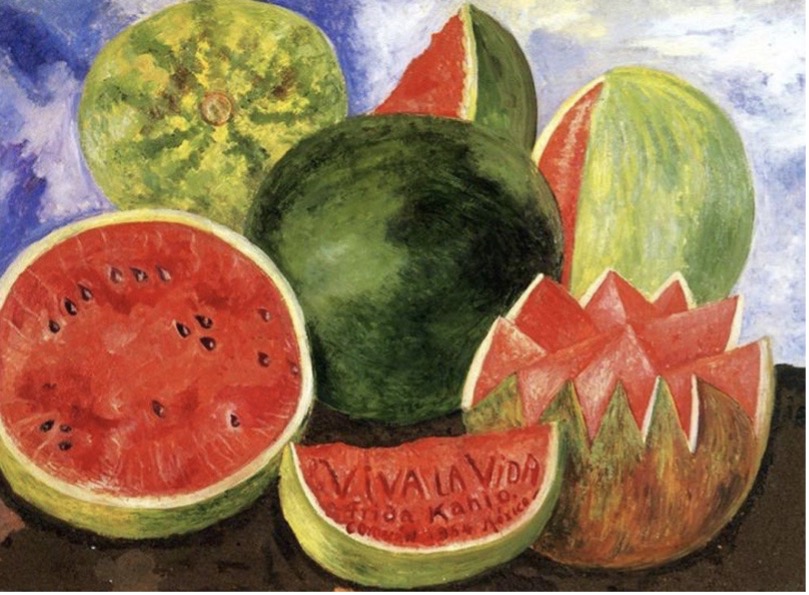
The lyrics are all optimism about the possibility of overcoming adversity, as well as authoritarian rulers. The title of the song and the album as well were inspired by the words on a painting by the Spanish artist Frida Kahlo (pictured above), who herself had endured several setbacks and illnesses, but had always kept her faith in better times. Here is a link to the lyrics
The song is written from the perspective of an authoritarian monarch who has lost his power and now ‘sweeps the streets he once owned’ and complains that he once had the key, but the gates now remain closed to him. The reference to the fact that the gates to heaven will also remain closed is a childhood trauma of singer Chris Martin who, as a ‘naughty boy’, was often promised eternal damnation’. He says he is fascinated by the (delusional) idea that in heaven there is some kind of court analysing people’s lives. On the positive side, at least, there is no place there for the ‘I character’ from the song.
As an interlude, listen and watch the version by a large choir and orchestra conducted by Cicero Alves. The choir’s presentation is infectious.
The instrumentation of Coldplay’s song deviates from the usual piano and guitars. The intro consists of violins, that also carry the rest of the song, along with an electric piano and bass guitar. Otherwise, there are only the sustained thump of a bass drum, the sound of a timpani and a church bell.
The song’s popularity was not limited to the music world. In the 2008-2009 season, the song was played in Hamburger SV’s stadium after every goal. Unfortunately for the club, it could never say ‘we used to rule the world’. That same season, the song became the anthem of FC Barcelona and that club was more successful than ever.
Finally, look at a flash mob in which the youth symphony orchestra Amici Della Musica Allumiere from the Italian city of Trento played the stars from heaven.
Is Vida la Vida can Coldplay plagiarism?
It’s not all gold that shines. After Viva la Vida reached the top of the charts, Coldplay faced several charges of plagiarism. Was the song, the melody in particular, all Coldplay’s? When the song became a hit, there were at least four accusations of plagiarism.
The first came from US singer Cat Stevens. The song ‘Foreigner Suite’ features two passages that are suspiciously simi lar to passages in Viva la Viva. The video below compares the allegedly similar parts.
The second accusation came from an unknown American band Creaky Boards. Coldplay allegedly used part of the melody of ‘The Songs I Didn’t Write’ in Viva la Vida as the melody of their song. A song in which the singer is expressing his jealousy of all those nice songs he didn’t write. You only must listen to the first minute. The chorus is clearly different. By the way, it is quite a nice song.
The third song is ‘Love again’ by Carly Rae Jelsen from 2005. The accusation is the intro and the chorus. I believe the similarity is only on a few bars, so here the chance of coincidence is very high.
The fourth indictment came from guitar virtuoso Joe Satriani in his instrumental song’ ‘If i could fly’:
The video below shows the deliberate clips from ‘Viva la Vida’ and ‘If I could fly’ in sequence.
This appears to be the most serious charge for plagiarism. In Joe Satriani’s case, there was a very real chance that a judge would have confirmed plagiarism. Musicologists who have examined both pieces of music find that there is a high degree of similarity. The chord progression, tempo and rhythm are almost identical. A minute comparison of the score shows that both songs have so many similarities that coincidence is out of question.
Yet this does not necessarily mean that Chris Martin deliberately copied the tune. The story is that the phrase ‘I used to rule the world’ along with a matching tune came to his mind at night. At night, our brain works in full force and countless memories can emerge from the subconscious, tunes once heard included.
In 2009, the two parties reached an out-of-court settlement. The content of the settlement was an undisclosed financial agreement resolving the copyright dispute, without an admission of copying by Coldplay and any public disclosure of the exact monetary or contractual terms.
Chris Martin has always dismissed accusations of plagiarism. He says they these accusations inspire him to make even better songs. Deliberate use of ‘samples’ often results from appreciation and is explicitly announced.
 Music: Listen, Look and Enjoy