

“In my days, they made much better music than nowadays”
From now on, every blog post will be accompanied by a video podcast. The podcast provides an introduction, whilst the blogpost explores the topic in greater detail. The podcast is in Dutch, but YouTube can translate it into English. If you like, you can also watch the podcast on your TV. Simply select YouTube and search for ‘kanaal expeditie muziek’. You can also cast the podcast from your mobile device to your TV.
A blog post and a podcast without musical interludes quickly become boring. I therefore intersperse the text with songs currently favoured by my 14-year-old grandson. According to him, his choice is also representative of his classmates’ preferences.
Listen – to get in the mood (or not) – to this recent track, a duet by the South Korean singer Rosé and the American singer-songwriter Bruno Mars; both are representatives of today’s popular music. The title ‘APT’ refers to a Korean drinking game. The song reached the top of the charts in both countries and elsewhere too.
The generation effect
You often hear the remark ‘In my day, they made much better music than nowadays’. Inquire octogenarians about their favourite popular music and you’ll often hear the names of Elvis Presley, Buddy Holly and the Blue Diamonds. ‘Youngsters’ who have passed the age of seventy tend to prefer the Beatles or the Rolling Stones, bands that caused a sensation in the 1960s.
In this article, I’ll examine the assumption that we have a lasting preference for music from our teenage years. I also consider the extent to which popular music itself has changed over the past decades[1] . That could point to a conscious choice.
The second track on his list is ‘Expresso’, sung and written by the American Sabrina Cartenter, her first top-ten hit in the US. It is about female self-confidence, which, incidentally, does not end so well in the accompanying video.
In the post-war period, six generations are often distinguished: Generation Alpha (born from 2015 onwards); Generation Z (born between 1995 and 2015); Generation Y or millennials (born between 1980 and 1995); Generation X (born between 1960 and 1980); baby boomers (born between 1945 and 1960) and the silent generation (born before 1945). The boundaries between these periods are fluid. Some authors have developed entire theories about the identity of each of these groups: the spirit of the times, prosperity, parenting style and expectations for the future; all play a role in this.
Now listen to ‘Undressed’, sung by the American singer-songwriter Sombr. Nominated for ‘International Song of the Year’ in the UK in 2026. The song is about a young man who, despite all the temptations, does not want to start a new relationship.
Musical preferences related to generations
The table below shows, for people belonging to the aforementioned (age) groups, the periods from which their favourite songs[2] originate. The figures indicate the percentage of favourite songs per period out of the total number of favourite songs.
For example, you can see that 39% of the favourite songs of those belonging to the ‘silent generation’ come from the 1950s and earlier. Songs from the 1960s and later account rrfor 22% of all songs. 7% cannot be linked to a specific period.
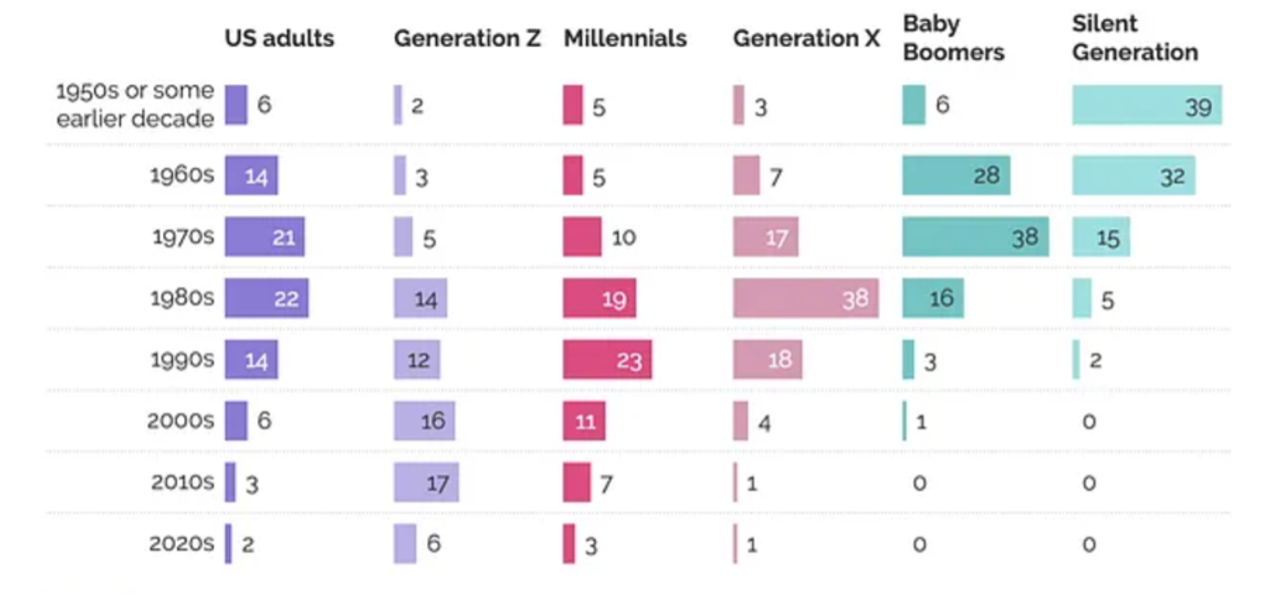
Baby boomers have a lasting preference for music from the 1960s and 1970s. This means that, from the moment they passed the age of 30, both groups have listened to very few new songs. Of course, there are also differences within these groups: someone who was a fan of the Rolling Stones rather than the Beatles at the age of 18 is still (not) a fan at the age of 50.
The table shows that as age increases, so does the preference for music from one’s ‘younger years’, roughly the period up to the age of 30. This phenomenon is known as ‘nostalgic loyalty’, the ‘generation effect’ or the ‘reminiscence bump’.
In identifying generation-specific preferences, I am treading on thin ice. After all, there are differences within each generation in terms of social class, education, cultural background, gender and, not least, personality. Factors that have influenced everyone’s musical preferences. Of course, to understand the current preferences of a particular age group, one doesn’t need to go back to their younger years. Everyone is exposed to the changing musical landscape during successive periods. The existence of generation-specific preferences therefore rests on broad generalisations, which are no less valid.
I will now explore the musical preferences of the various age groups in more detail, focusing on the Netherlands.
But first, another musical interlude. It is ‘Sailor Song’ by Gigi Perez, an American singer-songwriter. Yet another song that reached the top of the charts in many countries. It contains the line “I don’t believe in God / But I believe that you’re my saviour”. Conservative Christian groups in the US asked her to remove this line. She refused, remarking that writing lyrics is not a democratic process.
Musical preferences of different age groups
Generation Alpha
The youngest generation likes simple music; children’s songs are still popular, especially if they have a modern arrangement, a lively tempo and rhythm, and do not come across as childish. The programme ‘Kinderen voor kinderen’ seemed to manage this well.
Generation Z
Members of Generation Z do not usually have a strong preference for any particular style. Teenagers are still exploring, as evidenced by their extensive channel-hopping. The overview of preferences by age group illustrates their broad range of interests: the songs they listen to span a much longer period than is the case with other age groups. This period extends back to a time before they were even born.
Generation Z listens to hip-hop, dance and EDM (electronic dance music). Also popular are energetic, melodic, danceable pop songs that are easy to sing along to and are accompanied by appealing music videos. A wide range of songs are popular, occasionally including old classics such as Queen’s ‘Bohemian Rhapsody’ and the Eagles’ ‘Hotel California’. The slightly older members of the group (from around the age of 12) often fall for megastars such as Taylor Swift, Kendrick Lamar and Billie Eilish.
TikTok is a key source of information, but Nederland 2 (Top 2000) and Qmusic are more popular than is sometimes thought. This age group also accesses a lot of music via streaming. Playlists have replaced albums.
When choosing their favourite songs, Generation Z is attuned to what’s popular within their own age group and often plays it safe by selecting songs that are already high up the charts.
You can also see this broad interest reflected in the songs my grandson has chosen. Alex Warren and Bruno Mars appeared twice on his ‘top ten’. But Olivia Dean, Sabrina Carpenter and Gigi Perez were also on the list. Indeed, they are predominantly upbeat and cheerful songs. Hip-hop is missing; according to him, it’s boring.
Here is Alex Warren with the song ‘Ordinary’. This was his breakthrough hit in 2025, immediately landing him at the top of the US charts, and the song was awarded the title ‘Song of the Year’. In the UK, the song broke the 70-year-old (!) record for the longest-running number one hit by a foreign male artist. This record was previously held by none other than Elvis Presley.
Generation Y (the ‘millennials’)
The ‘early years’ of this group span the period 1990–2010. During this time, electronic dance music (EDM), hip-hop and R&B broke through, and attending festivals played an increasingly significant role. DJs such as Tiësto and Armin van Buuren were and remain popular. The members of this group experienced the rise of large-scale commercial pop and were open to it, with depth and quality playing an important role – and that is still the case today. Artists such as Bruce Springsteen, Coldplay and Adele are highly regarded, as are singers like Anouk and Marco Borsato.
Generation X
The ‘early years’ of this group spanned 1980–2000. This group grew up with punk, rock, metal, new wave and grunge. Styles in which guitar music plays a dominant role and which are still appreciated. Internationally, artists such as Nirvana and U2 were popular. In the Netherlands, Doe Maar, Drukwerk and De Dijk were popular. These preferences still hold true.
It’s time for another interlude. The song ‘Golden’, a hyper-energetic animation about young girls who want to become famous.
Baby boomers
This generation, together with the ‘sprightly old-timers’ of the ‘silent generation’, has the strongest nostalgic loyalty. Only their preferences differ.
Most baby boomers experienced the rise of ‘beat’ culture. In their younger years (the 1960s and 1970s), they mainly listened to rock and pop on ‘Hilversum 3’ (‘Tijd voor teenagers’) and pirate radio stations. Favourites were, and still are, not only the Beatles and the Rolling Stones, but also other British bands and Dutch pop groups such as Golden Earring and Shocking Blue. Folk music and soul also held appeal. Youth culture was on the rise, but – how well-behaved we were – it remained limited to singing protest songs (‘Mr President’), long hair, left-wing political ideas and alternative clothing.
The Silent Generation
The ‘younger years’ of this group fell in the 1940s and 1950s. Favourites were ‘crooners’ such as Frank Sinatra, Doris Day, Bing Crosby and, for the somewhat younger members of this group, rock ‘n’ roll too. Dancing – foxtrot, waltz, jive, swing and ‘slow’ – took place to the music of countless small orchestras. Big bands were also popular, such as the famous Ramblers. People were introduced to music via the radio, the gramophone and dance evenings. A ‘youth culture’ barely existed or was just emerging; music was part of family culture.
Listen now to the English singer Olivia Dean with the jazzy track ‘So easy to fall in love’. Another global hit. It is a call to women to focus on finding out what they think of the other person on dates, rather than putting themselves on display.
To better understand the differences between generations, we must look not only at the music itself, but also at the way in which people of the same generation encountered it. For the ‘silent generation’, this was primarily within the confines of the family (‘gathering round the radio and the record player, and later the TV’) and at dance evenings. As a result, their musical ‘canon’ is limited. Younger generations can encounter music in many more ways. Think of music channels, festivals and platforms such as Spotify. The result is that they are familiar with many more styles, regardless of which ones they prefer.
Changes in the musical offering
Is there anything to be said about changes in the music itself, which may influence the musical preferences of members of different generations?
Between 1955 and 2025, significant stylistic changes did indeed occur in pop music. I have already written extensively on this subject[3] . One can speak of the rise of, more or less in succession, ‘rock ‘n’ roll’, ‘beat’, ‘psychedelic rock’ (often overlapping with ‘art rock’ and ‘prog rock’), ‘country rock’, ‘hard rock’ and ‘metal’, ‘punk’, ‘new wave’ and ‘grunge’, ‘soul’ and ‘funk’, ‘dance’ and ‘hip hop’. No single style has disappeared, though the 21st century has seen a shift from rock and soul towards hip hop/rap, EDM (electronic dance music) and pop. The various styles have influenced one another, resulting in the current diverse range of popular music. Lists of ‘best hits and albums of all time’, such as the Radio 2 Top 1000 and the Rolling Stone Top 500, prove this.
The following song was written and performed by the American Ravyn Lenae and, like all the other songs you could listen to, ranked highly in the charts, including those in the Netherlands. It is about the eternal tension between wanting to be independent yet still having a romantic relationship. She sings ‘Oh no, I don’t need you, but I miss you, come here’.
More than ever before, every generation is confronted with a wide and accessible range of popular music. Moreover, contemporary music shares many similarities with music from earlier periods. The ‘reminiscence bump’ – the nostalgic preference of the surviving members of the ‘silent generation’ and of baby boomers for music from their ‘youth’ – is unlikely to diminish significantly. Many baby boomers find it hard to let go of the time when they grew their hair long, went to concerts and built up a collection of LPs to listen to together. It is a pity that those for whom this is the case thereby shut themselves off from musical highlights from later periods. Moreover, they make conversations with their (grand)children about their musical preferences a lot more difficult[4]. I expect rather a broadening of the musical palette of Generations X, Y and Z.
I’ll conclude with ‘Die with a smile’, a song written and performed by Lady Gaga and Bruno Mars. The song is about the need for love in times of uncertainty. The song was praised by critics for its vocals, instrumentation and the emotional depth of the lyrics. More than any other song in this episode, this ballad illustrates the blending of styles from past decades.
[1] In answering both questions, I draw on statistical analysis of data from Spotify.
[2] In this case, the songs they listen to via Spotify.
[3] In the series ‘History of rock after 1960’, ‘French rock 1955–2025’ and ‘Prog rock 1965–2025’, I have discussed the differences in styles in detail. For this, see the overview of my blog posts: http://is.gd/QUT3Aa
[4] OpenAI has helped me to characterise the different generations and to revive memories of the music from my ‘younger’ years, which I fortunately do not categorically prefer over today’s music.

